 Thursday, October 08, 2026
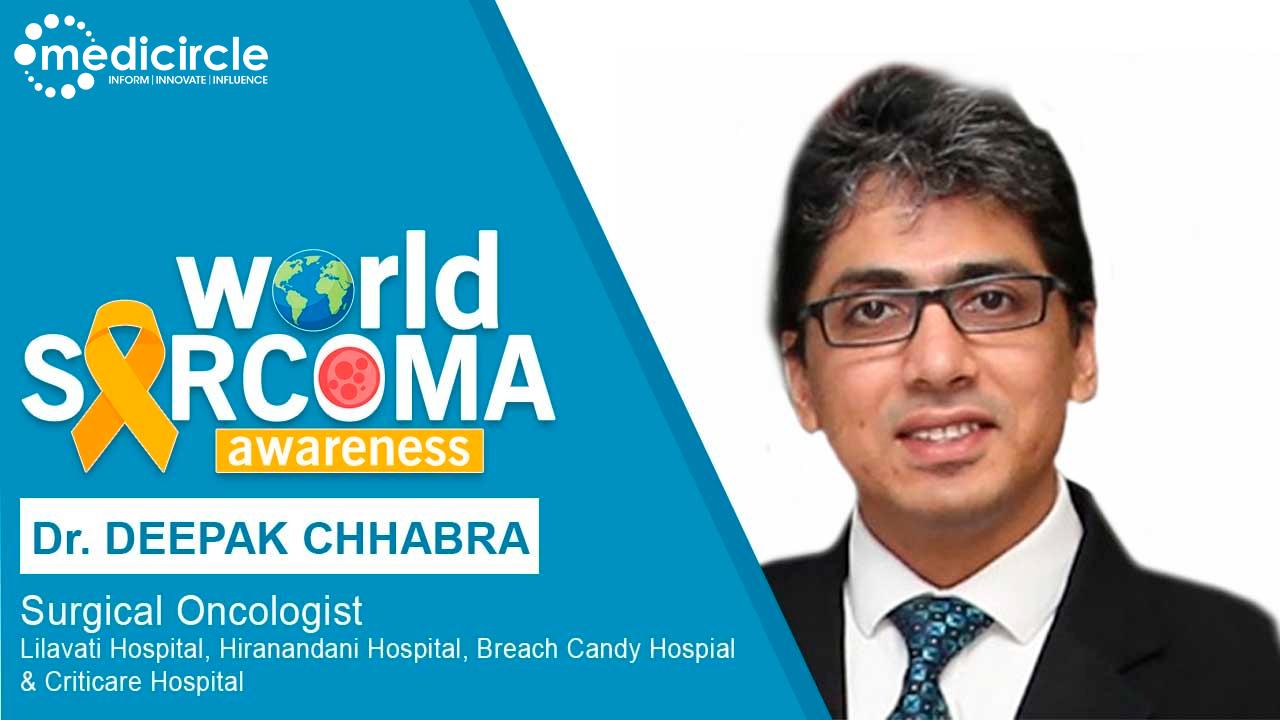
 "Sarcoma is a type of cancer; its presentation is very different. Treatment options are available for sarcoma but the positive attitude of the patient helps in getting the most favorable outcomes" – Dr. Deepak Chhabra, Surgical Oncologist





Sarcoma is the general term for a broad group of cancers that begin in the bones and the soft tissues. Bone sarcomas are rare tumors approximating 0.2% of all cancers. Soft tissue sarcoma forms in the tissues that connect, support, and surround other body structures. This includes muscle, fat, blood vessels, nerves, tendons, and the lining of the joints. It has an average of 2.1% of the frequency range in males and 1.2% in females. As sarcoma awareness days are absorbed every year on July 21, we at Medicircle are conducting an exclusive series to raise awareness about this rare medical condition.
Dr. Deepak Chhabra is a Surgical Oncologist with close to two decades of clinical practice. He has operated thousands of cases of various forms of cancer. Dr. Chhabra is a Surgical robotic surgeon. He specializes in the treatment of Gastrointestinal, Hepato-Pancreato-Biliary, Breast, and utero-ovarian cancer surgeries. He is associated with Lilawati Hospital, Hiranandani Hospital, Breach Candy Hospital, Criticare Hospital, and Hinduja Hospital.
Carcinoma and sarcoma
Dr. Deepak says, "Sarcoma is a type of cancer. Whenever we talk of any cancerous tumor, we termed them carcinoma or sarcoma. Difference between carcinoma and sarcoma – carcinoma is the tumor of any specific body organ and sarcoma is the tumor of supporting soft tissue structures like bone, ligaments. If the tumor is arising from any synovial fluid (fluid present between two bones), we call them synovial sarcoma, a tumor arising from muscle is known as rhabdomyosarcoma. Fibroids that gets converted into tumor over a period are termed as leiomyosarcoma. So, sarcoma is a general term that tells that tumor is arising from any soft tissue structure of the body.
Diagnosis
Dr. Deepak expresses, “Presentation of sarcoma is very different. This gets detected easily as it is visible. Inflammation, difficulty in doing the normal day-to-day activity, lump formation are some signs. Detection is always based on awareness. As there is a saying "Eyes don't see what the mind does not know". Thus, one needs to be aware of their symptoms and signs. Lack of awareness leads to late detection of disease.
Treatment
Dr. Deepak emphasizes, "We generally control the disease and not cure the disease. There are treatment options available for sarcoma provided the person gets benefitted from treatment. After the treatment procedure is done, we do regular follow-ups every 3-6 months which is very important. Sarcoma spread through blood from one place to other. So, to know if the disease has relapsed, the patient needs to undergo a full body check-up. Hence, we control the disease in the form of treatment. Localized sarcoma can be treated up to 80% over a while. After this, there is a locally advanced stage where the tumor spreads to other parts of the body and then comes the metastatic phase.
Message to sarcoma patients
Dr. Deepak adds, “Patients need to keep a positive attitude. The patient needs to accept first that it is the reality and needs to fight from it. Somewhere, the attitude of the patients affects the treatment outcome. Patients should not self-medicate themselves and should follow the doctor’s advice.
(Edited by Renu Gupta)





.jpeg)








.jpg)
.jpg)
.jpg)
.jpg)
.jpg)
.jpg)


.jpg)
.jpg)
.jpg)