 Thursday, October 08, 2026
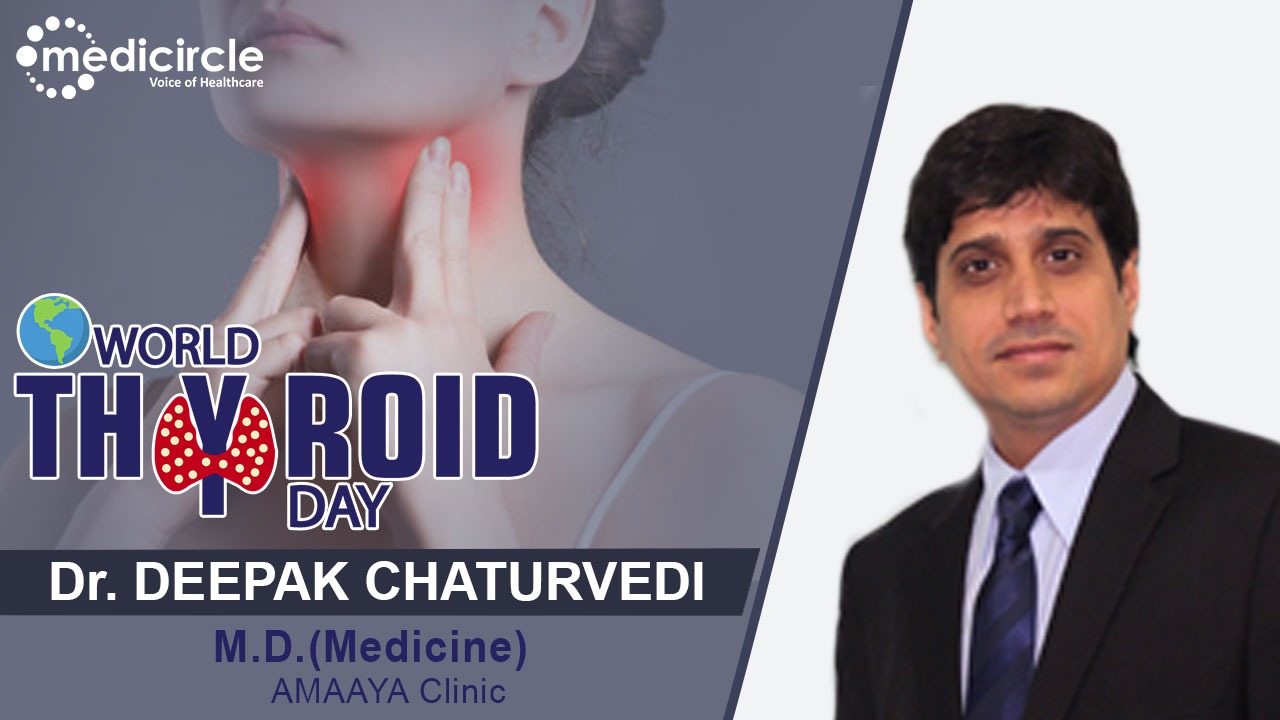
 Dr. Deepak Chaturvedi points out that though it is very early to give a definitive viewpoint but if we try to foresee the situation; after a couple of years, there are high chances that proper thyroid functioning of COVID affected patients would get impacted in a higher percentage than those who have not got infected by the virus at all.





Thyroid is an important gland, and problems with this gland may be more common than we may think. Millions of people in India suffer from thyroid disorders. Hypothyroidism is the most common thyroid disorder. To spread awareness about it, Medicircle is speaking to eminent endocrinologists so that people can manage this condition well with insights gained directly from experts.
Dr. Deepak Anjana V. Chaturvedi; M.D.(Medicine) has extensive experience in the field of Thyroid, Internal Medicine, Medical Anti Aging, Hormone Corrective Therapy, Metabolic Medicine, Diabetes, Obesity, Age Management, and Life Style & Wellness Medicine with thousands of beneficiaries globally. He is a well-known international speaker in the field of Medical Anti Aging, Hormones, Life Style, Corporate wellness, and Medical Spirituality. He has designed a concept of "Medical Spirituality" in which he explains the "Relationship between Stress, hormones, neurotransmitters and human behavior as a multidirectional model". The importance of this relationship holds potential importance in making decisions related to Social, Interpersonal, and Financial issues. Apart from this, he has many other accomplishments and accolades that accentuates his expertise.
What triggers hypothyroidism
Dr. Chaturvedi explains, “We can divide thyroid disorders into 2 categories - hypothyroidism and hyperthyroidism. Hypothyroidism is the condition in which the thyroid gland’s function slows down or there is inflammation leading to inadequate production and release of crucial hormones. Whereas, hyperthyroidism is a condition in which the thyroid glands are overactive and the release of hormones is excessive.”
He further points out, “Whenever we talk about thyroid disorder we mainly talk about hypothyroidism, and people, in general, are more interested in knowing about this condition. There are several causes of hypothyroidism:
Iodine deficiency – Iodine is an important ingredient that helps in the synthesis of thyroid hormones. Around 40-50 years ago, iodine deficiency was the major cause of hypothyroidism but now our salt is iodized and there has been a good intake of iodine and its supplements in the diet to reduce its deficiency in general. However, we can still say that if there is hypothyroidism, iodine deficiency could be one of the primary causes of it.
Autoimmunity – Our body can get affected by hypothyroidism when it’s immune system starts damaging it instead of protecting it. It is a leading reason for hypothyroidism these days. This condition is difficult to correct and can continue for life-long in individuals. It gets associated with other diseases as well, like if a patient is suffering from rheumatoid arthritis or diabetes, he/she may develop autoimmune hypothyroidism as well. So, there is more focus by clinicians these days on autoimmune hypothyroidism.
Goitrogens – These are substances that disrupt the normal functioning of the thyroid gland. It is believed that certain cruciferous vegetables like broccoli, cabbage, etc. contain thiocyanate which can trigger the formation of goitrogens. In this condition. Hormones are produced but not released so the thyroid hormone cycle remains incomplete,” explains Dr. Chaturvedi.
Not much association between diet and autoimmune thyroid diorder
Dr. Chaturvedi mentions, “There is no linear association between dietary patterns and autoimmune thyroid disorder as such. However, some doctors do advise restrictions of dairy products and a gluten-free diet but since these restrictions are difficult to be followed for a long term, there is no definite study to provide strong evidence between dietary restrictions and their impact on autoimmune thyroiditis. Generally, people are advised to keep the consumption of food rich in these two categories under control. However, this certainly is not a cure.”
Hypothyroidism and Covid-19
Dr. Chaturvedi points out, “Most illnesses are connected to thyroid disorders in the sense that if one is suffering from hypothyroidism or hyperthyroidism and the condition is not well corrected then, there are chances of that individual to get affected by many ailments. Also, the chances of the severity of infections and diseases in such individuals are high. Since Covid is relatively a new phenomenon there is not much study or evidence to prove the impact of Covid on thyroid patients but based on the previously proven outlooks on thyroid patients being more prone to diseases, we can say that there is possibility of more impact of Covid on patients suffering from thyroid disorders.
If we see from another angle, though it is very early to give a definitive viewpoint but if we try to foresee the situation; after a couple of years, there are high chances that proper thyroid functioning of Covid affected patients would get impacted in a higher percentage than those who have not got infected by the virus at all” says Dr. Chaturvedi.
(Edited by Amrita Priya)





.jpeg)








.jpg)
.jpg)
.jpg)
.jpg)
.jpg)
.jpg)


.jpg)
.jpg)
.jpg)