 Saturday, October 10, 2026
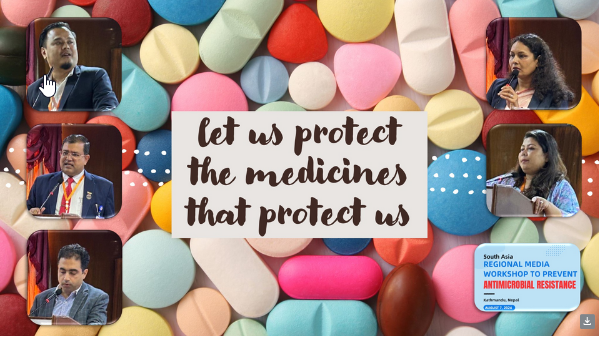
 Let us hope world leaders at next month's United Nations General Assembly High-Level Meeting on AMR will commit for stronger action to effectively address the global health threat that AMR poses.




"No one is safe until everyone is safe," said Dr Umesh Dahal, Director General, Department of Livestock Services, Government of Nepal. He was referring to antimicrobial resistance or drug resistance when microbes (such as bacteria, virus, fungi or parasites) stop responding to medicines – which makes diseases difficult (or impossible) to treat.
Misuse and overuse of antimicrobial medicines is alarmingly high in human health, animal health, and agriculture, and it eventually impacts our environment too. With rising antimicrobial resistance (AMR), medicines are failing to treat diseases in human beings, plants, and animals.
"AMR can be prevented," said Dr Palpasa Kansakar, World Health Organization (WHO) National Professional Officer for AMR and Laboratories in Nepal. Dr Palpasa and Dr Umesh were among the experts at the South Asia Media Workshop to prevent AMR organised by Health TV Online, Global AMR Media Alliance (GAMA), Ministry of Health and Population of Nepal and partners.
"Universal access to high quality and affordable antimicrobials is an essential component of universal health coverage,” said Dr Palpasa. She also pointed out that access to WHO recommended diagnostics and standard treatments should also be ensured at all levels for everyone if we are to deliver on universal health coverage.
Reality check on antimicrobial use in human and animal healthcare and agriculture
Timely and accurate diagnosis and right treatment can help reduce misuse and overuse of medicines. Infection prevention and control is vital too. But reality on the ground tells a different tale.
Drug susceptibility test tells us if a medicine will work against a disease-causing microbe or not. “Around 32% of doctors and other healthcare workers have access to laboratory facilities that can test for drug susceptibility test in their healthcare institutions and among them, less than half (49%) recommend these tests before prescribing medicines,” said Dr Pramod Joshi, Executive Chief, Nepal Health Research Council, Government of Nepal. This data is from a study done by Nepal Health Research Council.
“This study also found that only half (54%) of the doctors and healthcare workers had access to national guidelines for antibiotic prescriptions. Almost half of the medicine-dispensers (43.4%) dispensed antibiotics without prescription,” added Dr Pramod Joshi. “Among those patients who came to seek healthcare in outpatient clinics, 22% to 28% of them were found to buy antibiotics without prescriptions and did not complete the full recommended course of antibiotics.”
The study referred to by Dr Joshi also looked at antimicrobial use by veterinary doctors. “One-third of veterinarians had access to drug susceptibility testing facilities in their working areas. But only 32% of them went for this test before prescribing antibiotics,” said Dr Pramod Joshi.
Antimicrobials are also used in food and agriculture. This study found that “more than 50% of the farmers thought (wrongly) that ‘antibiotics can be used against all types of diseases in plants and animals.’ Almost half of the farmers self-medicated their animals - and two-thirds of them arbitrarily increased the dosage and frequency of medication if no sign of improvement was noticed,” said Dr Joshi.
Colossal economic impact of AMR
The cost of AMR to the economy is significant. “According to a World Bank report in 2017, if no action is taken now, AMR is likely to cause additional health expenditure of US$ 1.2 trillion per year by 2050 and push up to 24 million additional people (particularly in low-income countries) into extreme poverty by 2030. AMR can directly affect progress in achieving at least 6 of the 17 United Nations Sustainable Development Goals and can also be linked indirectly to the remaining 11. Moreover, the spread of new resistant strains of bacteria in terrestrial and aquatic animals increases animal suffering and losses. This in turn affects livelihoods worldwide, as 1.3 billion people rely on livestock for their living and over 20 million people depend on aquaculture,” said Dr Joshi.
“If antibiotics lose their effectiveness, we lose the ability not only to treat bacterial infections but also to manage other health conditions. For example, modern medicine is often dependent on infection prevention and control, and the ability to prevent and treat infections using antimicrobials - such as during surgeries,” said WHO Nepal’s Dr Palpasa Kansakar. “We should only use antimicrobials when prescribed by certified health professionals and never demand antibiotics if our health workers say we do not need them. Please always follow your health workers' advice when using antibiotics.”
Agrees Dr Sangeeta Mishra, Director General of Health Service Department, Ministry of Health and Population, Government of Nepal: "We have to educate the people to say NO to misuse and overuse of antimicrobial medicines - without correct and timely diagnosis and drug susceptibility testing, they should decline the indiscriminate use of medicines."
Dr Mishra added that "Let us ask questions to doctors why are we being prescribed antimicrobial medicines? Is the diagnosis accurate? Is drug susceptibility test report there? We also need to do a reality check on who should write a prescription. If a doctor is authorised to do so then what happens to those who reside in remote areas where there is no doctor?"
Quadripartite toolkit for engaging media in AMR
Various forms of media help to shape public opinion, narratives and discourse that affect public behaviour, knowledge, attitudes and practice. Media also help to dispel myths and misconceptions, combat misinformation and promote evidence- and science-based information. Media were therefore identified as one of four priorities during two global consultations for raising awareness about AMR, organized in 2022 by the Quadripartite organizations - the Food and Agriculture Organization of the United Nations (FAO), United Nations Environment Programme (UNEP), World Health Organization (WHO) and World Organisation for Animal Health (WOAH). In response, the Quadripartite developed a practical toolkit for engaging media in AMR and launched it last month.
Drug-resistant infections challenging health security
A major share of those who deal with drug-resistant infections and untimely deaths associated with AMR is attributed to TB (tuberculosis).
Drug-resistant forms of TB infected an estimated 410,000 people in 2022 globally as per the WHO Global TB Report 2023, informed Dr Prajowl Shrestha, Director of National TB Programme of Nepal. But only 43% of them (176,650) were diagnosed and initiated on treatment in the same year – or in other words, only 2 out of every 5 people with drug-resistant TB could get diagnosed and put on treatment.
In South-East Asian region, 170,000 people developed drug-resistant forms of TB in 2022 out of which only 74,300 were diagnosed and put on treatment (43%), shared Dr Shrestha.
Nepal is among the 30 high burden countries for drug-resistant TB globally.
AMR threatens the effective prevention and treatment of an ever-increasing range of infections. For instance, urinary tract infections, upper respiratory tract infections, typhoid and influenza are becoming difficult to treat, resulting in treatment failure, permanent disability or even death. Bacterial resistance to antibiotics directly caused 1.27 million deaths and indirectly caused, contributed to or was associated with an additional 4.95 million deaths annually in 2019. The emergence of extensively drug- resistant gonorrhoea is another major public health concern.
Strengthening infection prevention and control, along with boosting access to standard quality diagnostics and treatments with equity globally - especially in low- and middle-income countries - is vital to curb AMR. Raising awareness and health literacy is a bedrock to advance progress towards preventing AMR, as well as towards universal health coverage.






.jpeg)










.jpg)
.jpg)
.jpg)
.jpg)
.jpg)
.jpg)


.jpg)