Tuesday, October 06, 2026
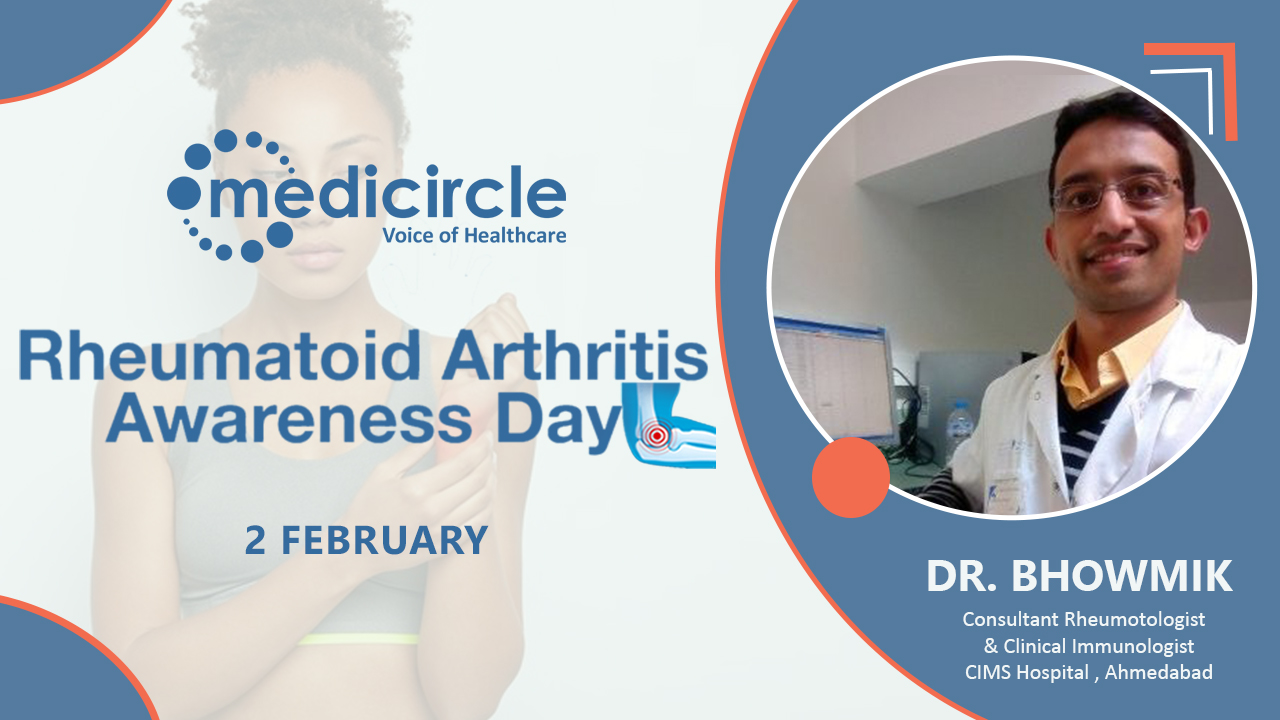
 Dr. Bhowmik Meghnathi talks about signs and symptoms, role of diet in the management of disease, and myths related to rheumatoid arthritis.





Rheumatoid arthritis is estimated to affect approximately 0.24 to 1% of the Indian population and is twice as common in women compared to men. It affects more than 180 million people in India. The prevalence is higher than many well-known diseases such as diabetes, AIDS, and cancer. Around 14% of the Indian population seeks a doctor's help every year for this joint disease. Medicircle presents an exclusive series on rheumatoid arthritis to spread awareness about various aspects of this disease.
Dr. Bhowmik Meghnathi is a Consultant Rheumatologist and Clinical Immunologist. He is also EULAR (European League Against Rheumatism) certified rheumatologist with 12 years of experience. He is currently working at CIMS Hospital, Ahmedabad. He has a special interest in SpondyloArthritis and Psoriatic Arthritis. He has been trained in Rheumatology in New Delhi and later obtained the prestigious ASAS Fellowship in Paris. He is also the only Indian rheumatologist at the Assessment of SpondyloArthritis International Society and is also a member of the International GRAPPA Society that is the group for research and assessment of psoriasis and psoriatic arthritis.
Arthritis and Its Signs and Symptoms
Dr. Meghnathi, explains, “arthritis means that joint is tender that it is painful and swollen. The terminology arthralgia means there is only pain of the joint whereas arthritis means that there is inflammation of the joint. So, the joint is not only painful, but you may notice that there is swelling over the joint, you may notice that the joint is at times warm when you feel and touch the joint. There is a restriction of the range of movement at times over the joint and there is a loss of function or the activities of daily living could be hampered. Rheumatoid Arthritis is a prototypic polyarticular disease meaning that more than or equal to five joints are involved. Most of the joints of the hands are involved predominantly. However, at times there can be only knees or ankle joint involved. So, overall, usually, you see arthritis causing joint pain and swelling. Along with that if it is a systemic disease, which has persisted for a longer duration of time, you might see some constitutional features like fever, loss of appetite, and feeling of extreme fatigue or tiredness. So, these are all the major signs and symptoms of rheumatoid arthritis,” says Dr. Meghnathi.
Smoking and Tobacco is Harmful to RA Patients
Dr. Meghnathi points out, “What we can say is that certain lifestyle risk factors may put you at risk for developing rheumatoid arthritis, especially when we talk about males who smoke. Smoking and tobacco are certain risk factors, which can lead to precipitation or activation of rheumatoid arthritis. Whether it is an active form of smoking or a passive form of smoking, you can get affected. Even if you are surrounded by an atmosphere where other people are smoking, you inhale that smoke then that also predisposes you to a certain risk factor. So, the females whose husbands have a habit of smoking, are invariably exposed to the passive form of smoking.”
Role of Diet in Rheumatoid Arthritis
Dr. Meghnathi explains, “We need to categorize diet which has a tendency to increase inflammation and diets which tend to decrease inflammation so there is a pro-inflammatory and anti-inflammatory diet. So, when we talk about anti-inflammatory diet, there are diets, which are high in refined sugars, carbs like pastries, fried food, french fries, burgers, junk food, etc. If you consume a lot of fruits and fresh vegetables, which are rich in vitamin C, like amla, berries, blueberries, strawberries or you eat a lot of fresh green leafy vegetables, you are consuming an anti-inflammatory diet. So, fresh fruits and vegetables which are high in antioxidants are a rich source of an anti-inflammatory diet. There is some non-vegetarian diet in this category that is rich in omega3 fatty acids like fish, salmon, or tuna. These can help control rheumatoid arthritis. There are certain foods that does occasionally have beneficial effects like avocado can help you with the osteoarthritic part and can help you lubricate the joints. So, there are certain fruits as well which you may find beneficial,” says Dr. Meghnathi.
Inputs on Sour Food Consumption
Dr. Meghnathi, mentions, “Most common question that doctors encounter by patients is that “can we eat sour food?” There is no clear answer or common answer for every person. So, if there are 100 patients with rheumatoid arthritis, say 80 to 85 of them eat sour foods and can tolerate it then we can encourage them to eat whatever their body is taking and is suitable for them. If certain patients with rheumatoid arthritis have noticed that time and again when they take any sour food or anything fermented and notice that their joint pains are flaring every time. In such scenarios, we realize that your body might be allergic to that kind of food substance. So, in that particular case, you may try to avoid it.
No Treatment – A Myth
Dr. Meghnathi sheds a positive light and points out, “There are wonderful treatments available for rheumatoid arthritis. As rheumatologists, we classify the treatment under three to four major groups like conventional synthetic disease-modifying drugs, targeted synthetic disease-modifying drugs, and biological drugs. There are also injections which are the next level of medication that can help you control rheumatoid arthritis. Biologics cost a bit more but since we have biosimilar drugs, they have brought down the cost of such medications. So, it’s a myth that there is no treatment.
The earlier you get yourself treated and the earlier you achieve remission or low disease activity in rheumatoid arthritis, the better the chances that your disease would be under control. Now, there is another question that is there a cure? So, if I were to ask the same question, replacing rheumatoid arthritis with hypertension or diabetes, and if I would say that is there any cure for hypertension, is there any cure for diabetes? The answer is no. But the answer also is that you can very well control it and live with it normally,” points out Dr. Meghnathi. “So, if your disease is in an early stage, then you may lead a life where you might need very little medicine and even after medicine is stopped, you may live a life which is called drug-free remission life. But if the disease flares up, you might have to start the medicines again. Just like it is in case of blood pressure, hypertension or diabetes, you can live a normal life with medication,” says Dr. Meghnathi.
Drug-Free Remission is Possible
Dr. Meghnathi, suggests, “What is important is that you identify whether you are suffering from it or not and then take regular medicines on time. And if you're lucky enough, you might be able to go into drug-free remission, or at least achieve a low disease activity or remission with the medication and live a normal life. We are not sure about lowering the counts because lowering the count is dependent on multiple factors. It depends on the genes. It depends on the environmental factors, there might be many factors that might be triggering rheumatoid arthritis. So, in general, the prevalence might remain the same, but the misery can certainly be reduced,” adds Dr. Meghnathi.
(Edited by Amrita Priya)





.jpeg)
.jpg)
.jpg)
.jpg)
.jpg)
.jpg)
.jpg)


.jpg)
.jpg)
.jpg)
.jpg)
.jpg)
.jpg)