 Thursday, October 08, 2026
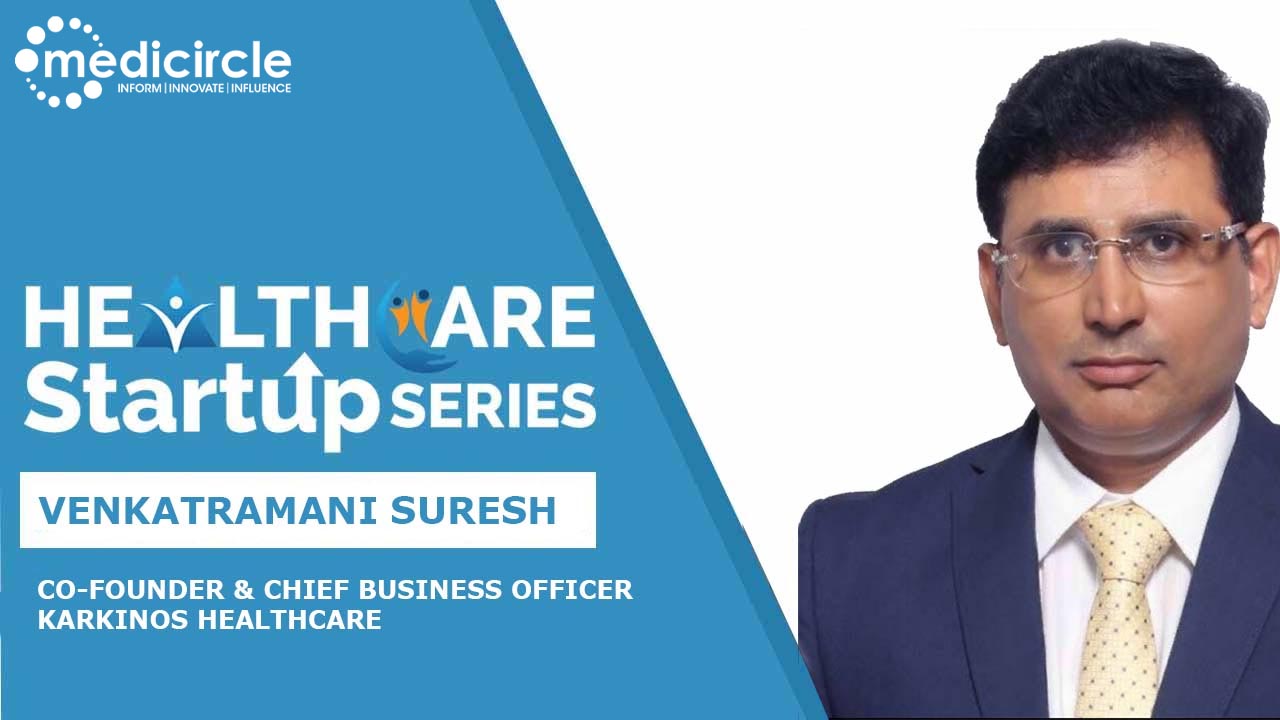
 Venkataramani Suresh informs about his journey with Karkinos Healthcare for quality cancer care with early detection and care closer at home. He speaks about the integration of healthcare services to make cancer care affordable and accessible.




Venkataramani Suresh holds immense experience as a Chief Business Officer in the internet industry. He was previously the Chief Sales Officer of Naukri.com and later the Chief Business Officer of Matrimony.com. He has completed a Management Development Programme from the Wharton School. He is currently the co-founder of Karkinos Healthcare.
Contribution as a healthcare entrepreneur
Venkataramani Suresh says, “I need to look at it from two or three different perspectives. The Impact of the current Indian start-ups, specifically the healthcare start-ups on the economic, social, and psychological aspects of the Indian society at large. Let us also look at a bird’s eye view of the paradigm shifts in consumer behaviour, technology adoption, and digital adoption in the last 24 months or so.”
Behavioural Shift of Consumers Post-Pandemic
Venkataramani Suresh states, “Thanks to the pandemic, all of us have witnessed a huge paradigm shift in the way consumers have adapted to Internet and technology. The pandemic has forced these behavioural shifts on consumers, and they have had a positive impact on the start-up eco-system in general and the healthcare eco-system in particular. HealthCare has occupied a huge mindshare of consumers post the pandemic.
Healthcare opportunities for India
Venkataramani Suresh states, “From an employment perspective, the start-ups not only help patients gain access to quality health care but also create job opportunities. This sector will create over 40 million jobs by 2030 as per an invest India report.”
Over the past 12-18 months we have seen a huge uptick from FII’s (Foreign Institutional Investors) in the healthcare ecosystem of India.
With a conducive environment available for start-ups in India, we can expect them to generate more employment opportunities as they leverage technology to solve some of the existing challenges.”
R&D in India
Venkataramani Suresh, informs, “Not just about creating employment, but from an R&D perspective, India has a phenomenal competitive advantage. We have seen in the past few years, the abbreviated new drug application or the ANDA approvals have gained significant momentum. India offers significant opportunities in areas like R&D and medical tourism both in urban and rural India.”
Technology in healthcare
He further says, “Impact of technology is vivid in the social sector as it does have a positive impact on the patients specifically in remote areas. Most of the healthcare start-ups are using personalization to their advantage, upgrading preventive models and treatment protocols to satisfy patient needs.”
Artificial Intelligence, augmented reality, virtual reality, robotics, and 3d printing are some of the key technologies that we have seen where the healthcare innovations have happened. Indian start-ups today are leveraging these technologies to create locally relevant and novel digital solutions that would address various challenges. These start-ups have become an integral part of the healthcare ecosystem. The way health tech companies are now looking at telehealth is more serious than ever before.
Even consumers have started adopting telehealth to a larger extent. This is benefiting the isolated patients with cloud-based technologies to patients with chronic diseases, who fear visiting hospitals in the current context of COVID.
Solutions such as artificial intelligence, chatbots voice interfaces, are going to be the norm of the day going forward, whereby healthcare and the healthcare experience will be customized.
The Indian government is playing an incredibly significant role in improving health care access through the Pradhan Mantri Jan Arogya Yojana scheme (PMJAY). Digital health care is a significant part of the Central's plans to digitize India. The Ministry of Health and Family Welfare has launched several initiatives for delivering affordable quality care and to lower the cost burden.”
Products and offerings by Karkinos Healthcare
Venkataramani Suresh informs, “As per the WHO report, one in 10 Indians are likely to have some sign or symptom of cancer over the next 5-10 years. With a population of over 140 Crore people this would mean 14 Crore people may have some sign or symptom of cancer in the years to come and this is a time bomb waiting to explode.”
Cancer care closer to home - WITH Karkinos Healthcare
Venkataramani Suresh informs, “Karkinos Healthcare is on a journey to provide cancer care closer to home and to ensure that quality cancer care is available at an affordable rate for anyone and everyone who needs quality cancer care.”
Control cancer in India
Venkataramani Suresh informs, “India is one of the very few developing countries that has formulated a National Cancer Control program. The National Cancer Control program looks at the control of tobacco-related cancers, early diagnosis and treatment of cervical cancer, distribution of therapy services, pain relief, and palliative care, through the augmentation of health infrastructure. And that's exactly what Karkinos Healthcare is trying to get at, by improving accessibility, availability, and affordability of cancer care. “
Early detection of cancer
Venkataramani Suresh informs, “Another huge problem that we face in India is around 75% of the cancer cases are detected at stage three or stage four. And this is primarily because of lack of awareness, education, and the taboo about cancer. Karkinos is focused on the early detection of cancer.
Accessibility to cancer care
Venkataramani Suresh says, “Karkinos is enabling connectivity amongst all centers, seamless access to data, diagnostics, and patient consulting, which includes a combination of a central knowledge repository, diagnostic capabilities, and a common HR training pool. This leads to the decentralization of expert care. “
The technology platform that Karkinos Healthcare is building consists of a distributed architecture, with the development of tools and applications that will integrate seamlessly and securely to all the Karkinos Healthcare backbone in drug discovery, diagnostics, and treatment strategies.
Karkinos also aims to contribute towards Atmanirbhan Bharath through drug discovery, research, treatment innovation, large-scale screening, and longitudinal data to build robust demand analytics, predictive models, and clinical decision support systems for real-world evidence.
Karkinos is creating a platform for referral of complex cases, surgery, and radiotherapy supported by a network of smaller centres for diagnosis and ongoing treatment so that the treatment can be decentralized, thereby reducing the load on the apex centres for non-complex treatment, while increasing accessibility and cutting down on loss of productive days for the family.
Equity in healthcare
Venkataramani Suresh states, “We need to work on efficient resource allocation amongst various levels of care between urban and rural parts of the country. India still faces the challenge of sustaining the skill-mix, quality, and distribution of healthcare professionals. We can't achieve equity by focusing on just delivery, but we also need to look at how can we reduce the burden of financial constraints.
Less than 10% of the Indian population is covered by any form of social or voluntary health insurance. For a country as big and complex as India, we need multiple interventions like knowledge, education, information, collaboration of various stakeholders viz., government, NGOs, and the private sector. This is not a challenging task, but it needs a dedicated focus with an equity- focused approach.”
(Edited by Dr.Rati Parwani)
Contributed by: Venkatramani Suresh, Co-founder of Karkinos Healthcare





.jpeg)










.jpg)
.jpg)
.jpg)
.jpg)
.jpg)
.jpg)


.jpg)