 Saturday, October 10, 2026
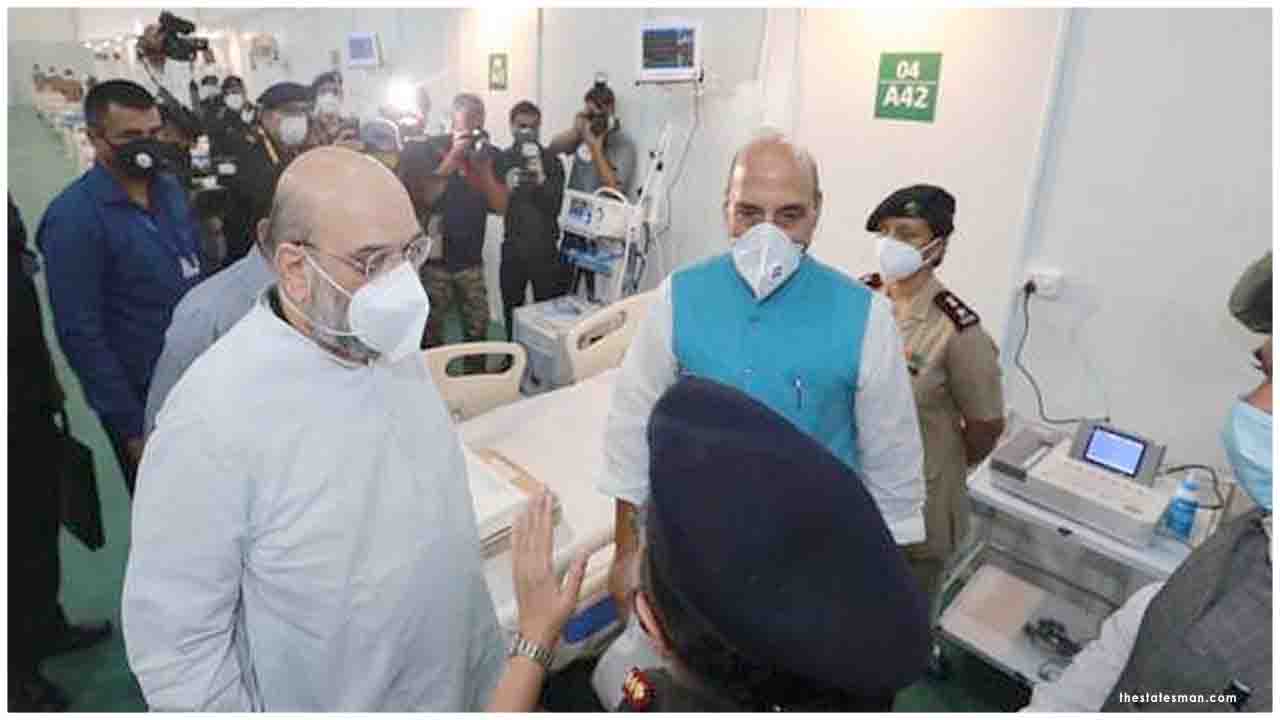
 Shri Amit Shah says “I thank DRDO, Tatas and our Armed Forces Medical personnel who have risen to the occasion and helped tackle the emergency.”





Union Minister Shri Amit Shah and RakshaMantriShriRajnath Singh visited the 1000 Bed with 250 beds SardarVallabhBhaiPatel COVID19 Hospital in Delhi Cantonment. This reflects the commitment of the Modi Government for the welfare of people. Furthering this spirit of the welfare of people and defeating COVID19 and curing and saving as many lives as possible, the hospital was developed in a record time of 12 days by DRDO, Ministry of Home Affairs, Ministry of Health and Family Welfare Ministry, Armed Forces and Tata Sons.
On this occasion Union Home Minister Shri Amit Shah said Prime Minister Shri Narendra Modi is fully committed to helping the people of Delhi in these challenging times and this Covid hospital is yet again, highlights this resolve. He said “I thank DRDO, Tatas and our Armed Forces Medical personnel who have risen to the occasion and helped tackle the emergency.”
Union Health Minister Dr. Harshvardhan, Minister of State for Home Shri G. Kishan Reddy, Delhi Chief Minister Shri Arvind Kejriwal and DRDO Chairman Shri G. Satheesh Reddy were also present.
Under the leadership of Prime Minister Shri Narendra Modi, Union Home Minister Shri Amit Shah held a series of meetings since 14th June to review COVID-19 management and ways to tackle it in Delhi-NCR. On the directions of Shri Amit Shah, a number of important decisions were taken like reducing COVID treatment rates to one third in Delhi’s private hospitals, Providing 20,000 additional beds, Increasing testing by using Rapid Antigen Kits, Re-demarcation of containment zones, Contact tracing of infected persons with the help of Arogya Setu and It has App and providing COVID telemedicine to the patients by expert doctors of AIIMS.
With the efforts of the Modi Government the 1000 bed Sardar Patel COVID Hospital has been established in record time. Delhi is currently experiencing a surge in the number of COVID-19 infections with an increasing number of patients requiring medical care. An urgent need to augment the existing hospital beds capacity of Delhi for the COVID-19 patients was discussed between the Ministry of Home Affairs and MoD on the modalities of deploying a 1000 bed hospital in a span of fewer than 14 days. DRDO was asked to establish the hospital.
DRDO undertook the design, development and operationalization of the facility on a war footing. With permission from the Indian Air Force, land situated near the New Delhi Domestic Terminal T1 was identified and construction work by DRDO commenced the 23rd of June at the site on Ulan Bator road, adjacent to CGDA Hqrs.
The hospital will be operated by a medical team of Doctors, Nurses and Support Staff from the Armed Forces Medical Services (AFMS) while the facility will be maintained by DRDO. Additionally, for the mental wellbeing of patients, the hospital has a dedicated DRDO managed psychological counseling center. COVID-19 patients referred by the District Administration will be admitted and treated free of cost at this facility. Critical cases will be referred to as AIIMS.
The project has been funded with a major contribution of Tata Sons. Other contributors are M/s BEL, M/s BDL, AMPL, Sri Venkateswara Engineers, Brahmos Pvt Ltd, Bharat Forge and the DRDO employees voluntarily contributing one day salary.
The unique centrally air-conditioned medical facility is spread over 25,000 sqm and is equipped with 250 ICU beds. Each ICU bed is equipped with monitoring equipment and a ventilator. The infrastructure is built with a negative internal pressure gradient for safe contagion containment. The facility has been engineered using a rapid fabrication technique based on octanorm modules.
The hospital consists of separate Reception cum Patient Admission Block, Medical Block with Pharmacy and Laboratory, Duty Doctors and Nurses Accommodation and 4 modular Patient Blocks each consisting of 250 beds. The corridor network has been designed to keep the patient’s movement separate from the doctors and staff movement. Sanitation facilities and toilets are situated between the blocks for easy access to patients and facility personnel.
The Patient Blocks are self-sufficient with facilities for patients and medical care staff. Patient facilities include Oxygen Supply to each bed, X-Ray, ECG, Haematological test facilities, Ventilators, COVID Test Lab, Wheel Chairs, Stretchers and other medical equipment. DRDO developed COVID-19 technologies productions by the Industry in the last 3 months such as Ventilators, Decontamination Tunnels, PPEs, N95 Masks, Contact-Free Sanitiser Dispensers, Sanitisation Chambers and Medical Robots Trolleys will be utilized at the facility.
The facility will be secured with security staff, CCTV surveillance and access control systems. The hospital is equipped with an integrated fire safety and control system. Environmental, Safety and Waste Disposal Processes have been built into the design of operations. A large parking area has been designated for Staff, Public, Ambulances and Firefighting services.
The hospital is being made operational on the 5th of July 2020, having been constructed in 12 days. Commissioning of this Hospital will contribute to an increase of 11% additional COVID-19 beds in Delhi, thus overcoming the current critical situation.






.jpeg)










.jpg)
.jpg)
.jpg)
.jpg)
.jpg)
.jpg)


.jpg)