 Thursday, October 08, 2026
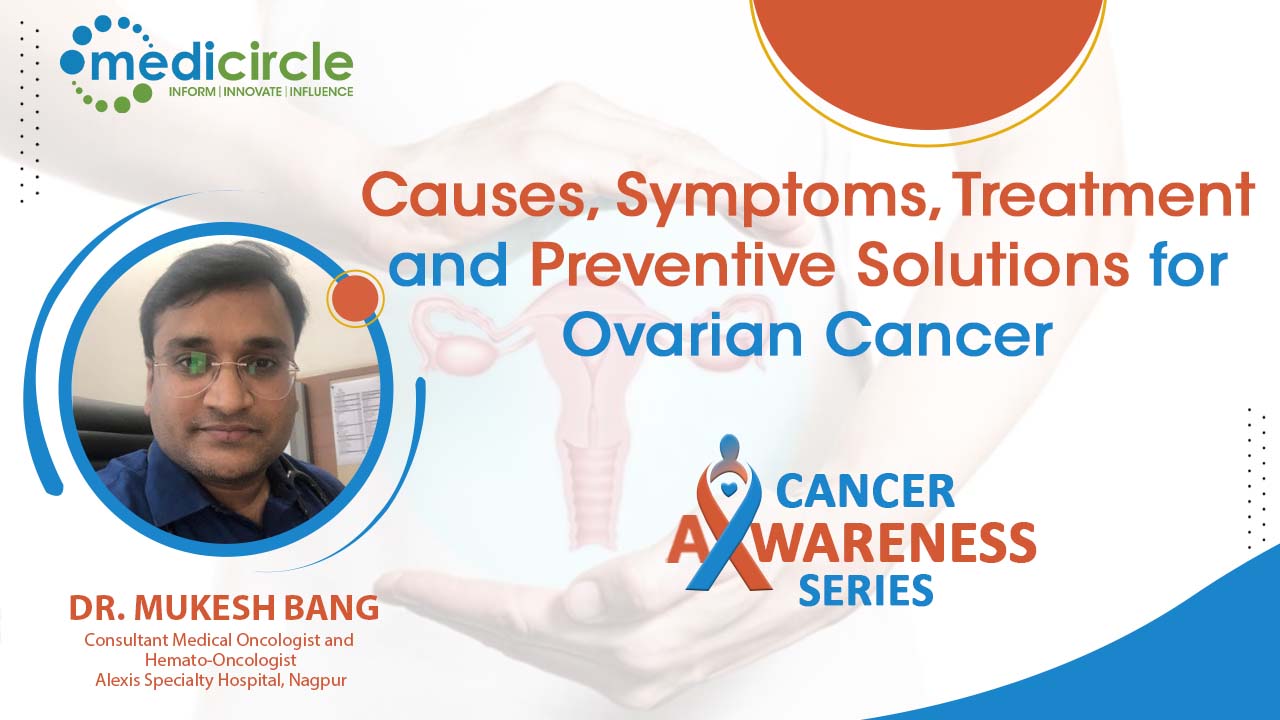
 Ovarian cancer is one of the most common cancers seen in women. Dr. Mukesh Bang gives valuable insights into ovarian cancer. He emphasizes the early detection of cancer at its initial stages for a better prognosis, cure, and control rate of ovarian cancer.




Ovarian cancer is the third most common gynecological cancer in Indian women. The most common gynecological cancer is breast followed by cervical cancer. Ovarian cancer was estimated to be the third most common cancer among Indian women and eighth overall as per the Globocan 2018 Fact sheet, constituting 3.44% (36170) of all cancer cases. A woman's risk of getting ovarian cancer during her lifetime is about 1 in 78.
Dr. Mukesh Bang is a renowned Consultant Medical Oncologist and Hemato-Oncologist in Nagpur and currently practicing at Alexis Multispecialty Hospital, Nagpur. For the past 6 years, he has been working in this field.
All you need to know about ovarian cancer
Dr. Mukesh Bang says, “In females, the eggs are generated by reproductive organs. Ovaries are the organs for the production of eggs. So, cancer developing in ovaries is known as ovarian cancer.”
Warning signs for detection of Ovarian Cancer
Dr. Mukesh Bang informs, “Most cases of ovarian cancer are detected in the advanced stage. In the early stages, there are no signs and symptoms of cancer. That is why ovarian cancer incidence is most likely seen in Stages 3 & 4. Accidentally doing ultrasonography for any reason may help detect ovarian cancer in some cases at an early stage.”
Causes of ovarian cancer
Dr. Mukesh Bang states, “The main causes of ovarian cancer are as follows-
- Elderly population
- Family history of breast, colon, or ovarian cancer with familial syndromes
- Gene mutations like BRCA gene mutation
- Morbid obesity
- Sedentary lifestyle
- Post-menopausal hormonal replacement therapy
Effective treatments for Ovarian Cancer
Dr. Mukesh Bang informs, “ Ovarian cancer treatment depends on the stage of the ovarian cancer.
- Stage 3a & 3b - Surgery and removal of the tumor from ovaries
- Advanced stages of cancer with fluid in the abdomen (ascites) - Neoadjuvant Chemotherapy + Surgery post chemotherapy
- Advanced Stage 4 - Surgery after chemotherapy depending on response.
Prevention of Ovarian Cancer
Dr. Mukesh Bang emphasizes, “ The preventive measures for ovarian cancer are as follows-
- The pre-disposing risk factors should be avoided like obesity, sedentary lifestyle, hormonal replacement therapy
- Screening regularly in case of a family history of breast, colon, or ovarian cancer
- Prophylactic surgery in case of positive gene mutation like the BRCA gene
- Screening tools can help like CA 125 and sonography of the abdomen
The fatality rate of ovarian cancer
Dr. Mukesh Bang states, “Ovarian cancer is fatal at Stage 4. Ideally, cancer at any stage is considered fatal cancer. Treating and staging cancer correctly is important. Stage 4 cancer has a higher chance of recurrence even after the treatment. This may require different modalities of treatment like chemotherapy, newer antibodies, or oral tablets post-chemotherapy for maintenance therapy. “
Rapid fire
At what age, does ovarian cancer start? Dr. Mukesh Bang states, “The age group is 55-65, however, it may come early with higher genetic predisposition factors.
Can ovarian cancer happen suddenly? Dr. Mukesh Bang states, “It may not occur suddenly as the patient may have abdominal fullness and may consult a physician for the same. But, later evaluation through ultrasonography may show something wrong.”
Is ovarian cancer completely curable? Dr. Mukesh Bang informs, “In early stages up to stage 3, it is completely curable if treated properly. Stage 4 cancer may need multiple lines of treatment and can be controlled with newer drugs”
Is ovarian cancer painful? Dr. Mukesh Bang states, “Yes, it is painful in a localized and advanced stage as it causes abdominal distension, lower back pain, and pelvic pain. It is not only painful in terms of somatic pain but painful mentally, psychologically, and physically too.
Edited By: Dr. Rati Parwani
Contributed By: Dr. Mukesh Bang, Consultant Medical Oncologist, and Hemato-Oncologist, Alexis Multispecialty Hospital





.jpeg)








.jpg)
.jpg)
.jpg)
.jpg)
.jpg)
.jpg)


.jpg)
.jpg)
.jpg)