 Saturday, October 10, 2026
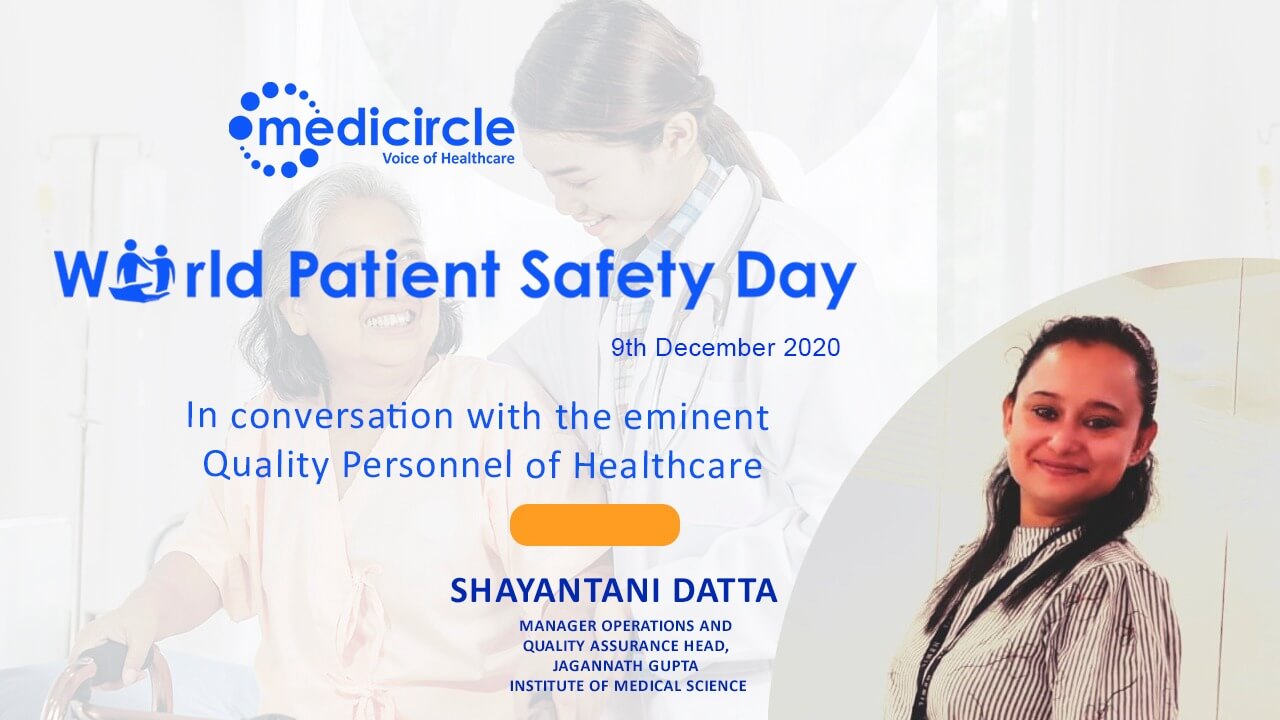
 “Patient Safety definitely was the first priority when we had to divide our non-contagious patient with our contagious patient and we have to treat them,” says Shayantani Datta, Manager Operations and Quality Assurance Head, Jagannath Gupta Institute of Medical Science




Patient safety is the absence of preventable harm to a patient during the process of health care and the reduction of the risk of unnecessary harm associated with health care to an acceptable minimum.
Shayantani Datta, Manager Operations and Quality Assurance Head, Jagannath Gupta Institute of Medical Science, is a Lean six sigma Greenbelt and has worked with brands like BM Birla Heart Research center and Calcutta Medical Research Centre.
Jagannatha Institute of Medical Science and hospitals, Kolkata is a private medical college of 150 MCI approved seats and it's a 550 bedded Medical College.
Training is very much important
Shayantani speaks on the subject, “Patient safety is all about your internal training, thought process, motivations, leadership, and programs. So when it becomes a communicable kind of disease and people having fear even we had a lot of trouble to encourage our healthcare workers to do the duty. Patient Safety definitely was the first priority when we had to divide our non-contagious patients with our contagious patients and we have to treat them. As a medical college, we had a lot of other patients as well but the number of patients did not dip as compared to other states, it was the same, we ran at 75% of the occupancy for the entire pandemic. Hence, keeping in mind patient safety with our leadership and motivation, we are capable enough to train them. I'm repeatedly saying that the training is very much important. Moreover, when the infection control training and guidance are from all the levels, starting from CEO to the vice-chairman to housekeeping, this becomes a united work,” she says.
Contribution towards the safety of the health workers
Shayantani explains, “When we joined as a healthcare worker nine years ago, we understood what our job role and responsibilities are. In our organization, there are two aspects all together one is your personal which is your managerial skill, another your infrastructural skill. So I am grateful that this hospital where I'm working does not have centralized AC which helps our workers to not get infected as much as when there is central AC. Second, maintaining protocol. If we were doing hand hygiene practice training, say once a week, it has now gone to thrice a week. And next is communication, now people are talking with the COVID patient’s relative and are counseling the patient, which makes our staff safety as well as patient’s satisfaction to a different level through this communication,” she says.
Digital transformation supports patient safety
Shayantani talks on digitalization, “This transformation definitely supports patient safety in terms of patient rights and responsibility. Previously, we didn’t allow people to take their mobile phones in the hospitals or the telemedicine concept, now health care workers are using telemedicine to try and get less communicable diseases when coming to the OPDs. If I ask my all OPD patients to come with testing to maintain every protocol, it is not possible for them as it is located in a rural area where people work on daily wages, they hardly have a mask, and they are using the mask for more than seven days. Instead, we can support by supplying masks, also, we have made an E-camp, where we have sent one person with the telemedicine concept and they connect these patients to our general physician. Also, they are educating them to keep their hands clean; it's a kind of social activity. That is one, second is if the person is detected COVID positive, we are taking the help of the technology and suggesting the medicines though home isolation concept, the satellite treatment. So in this pandemic the technology is helping us a lot in healthcare and is giving us more power to protect ourselves and the society,” she says.
Shayantani speaks on diagnostic errors healthcare-acquired infections, re-admissions, wrong-site surgery, and communication, “All the topics that you have taken up is all about your training, audit training in the hospital, as most of the people will be aware what is MCI approval is, it is all about teaching. So, if we see, in eastern India, there are a few numbers of medical colleges that develop NABH and NABL because the number of patients is more in medical colleges. So sometimes it becomes a quantity-oriented than quality in the present scenario and the western part of India has a different way to deal with it because every region has its own way to deal with this healthcare. When I joined here a year back, I found that the quality of care is good but capturing error or capturing data is zero. Unless you capture the data, you cannot make your facts proper, let it be your own department, say, for example, they if they want to capture bedsore so there is a team, who goes to the ward and ask the nurses, is there bedsore? The nurses say no. So this is a training issue or a communication issue. We can treat bedsore, but somebody has to confirm it, it is not a crime, it has developed because of the clinical condition. So, that fear is supposed to be taken out of the minds of an organization as the nurses, doctors, and staff is the pillars of the organization, so you have to make your communication proper to make them understand that this is not a fault-finding but fact-finding. Because whatever we are doing we are doing for the patient, only our first customer and the last customer is a patient. But for patient safety, even for medication error also, there are a number of initiatives which we have taken personally in my one year of career in this Medical College,” she says.
Edited By- Rabia Mistry Mulla





.jpeg)










.jpg)
.jpg)
.jpg)
.jpg)
.jpg)
.jpg)


.jpg)