Wednesday, October 28, 2026
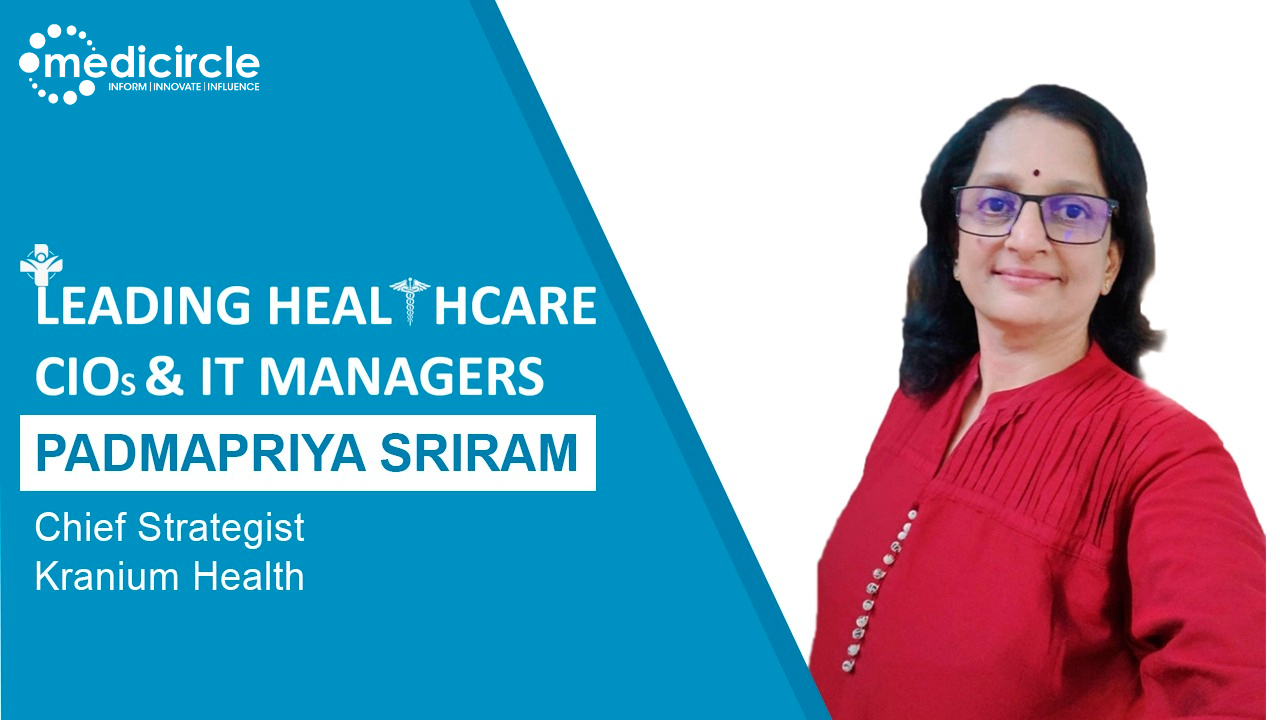
 Padmapriya Sriram provides insights into the role of IT Managers in transforming and digitalizing the Indian healthcare ecosystem. Information and Technology with its innovative tools have been very much useful in tackling second wave of the COVID pandemic. We should be ready to adapt to the changing technical environment and should stay updated




We have been seeing a new advancement in the healthcare IT space just after COVID. A lot of things in and around are changing, a lot of people are becoming tech-friendly. The healthcare IT space is brimming with new advancements, as information and technology have revolutionized patient care and healthcare services across the world not just in India.
Healthcare IT provides secure sharing of patient information for healthcare providers to better manage patient care. Telemedicine provides a 24/7 lifeline for patients to connect to their providers. This offers great comfort and assurance to the patients in these tough times. In this pandemic, the use of healthcare IT was felt much more valuable than ever before. We at Medicircle are conducting the 'Leading Healthcare CIOs & IT Managers’, Series showcasing the Movers and Shakers, and change-makers of the healthcare industry.
Padmapriya Sriram is currently the Chief Strategist at Kranium Health, a healthcare IT company pioneering in Healthcare IT Solutions and Innovations. Kranium Health provides next-generation enterprise healthcare information platform, specialty hospital solutions, artificial and business intelligence solutions for hospitals ranging from small hospitals to super specialty to tertiary care hospitals across India and Abroad.
She has been heading the IT operations of major Super Specialty and tertiary care hospitals like Madras Medical Mission, Global Hospitals, Sri Ramachandra Medical University, and Ganga Hospitals. She has 24+ years of post-qualification experience of which has over 18+ years of experience as senior management personnel involved in Business Analysis & Innovation, Strategic planning and Designing, Technology implementation, Client Relationship Management, Process Analysis, Program Management, Budgeting, Vendor Relationship, Implementation Planning and Systems Integration for the services organization and leading Transformational Initiatives in Health Care sector.
COVID and technology
Padmapriya says, “Technologies introduced especially during the pandemic time are also being used now. The solution that occupies the center stage is remote consultation, remote patient care. Remote patient care was of great importance because when a patient is being admitted to the COVID care ward, the patient caretakers were not allowed to visit them. So, we enable the live video streaming of the patient from the ward to their caretakers. So, these kinds of solutions became very popular during the pandemic time.”
Challenges in Indian healthcare
Padmapriya informs, “I started my career as a post-graduate in computer science way back in the 1990s but I switched my career from IT industry to healthcare just to understand what's happening. Here it was day-to-day learning for me, from setting up the IT infrastructure to developing and deploying the hospital automation software. Talking about challenges, we should be ready to adapt to the changing technical environment. If we don’t give 24/7 uninterrupted support, the primary functioning of the hospital will become a challenge. The challenge is like we have to be always available for updating.”
COVID Challenges – Fighting the second wave of pandemic
Padmapriya speaks, “The availability of a help desk for a hospital was very important during COVID time. Anyone calling up the hospital asking whether the bed is available, there should be a person to tell them instantaneously whether it's available or not.
A set of people formed the group and established a helpline. We published our numbers on social media. And in a day, we used to get 300-400 calls, we were able to counsel the patients, direct them, guide them to the appropriate hospital. The infection was progressing very fast. And every minute counted. So, organizing this care was very important.
We also used social media, WhatsApp, cloud telephony, and so many different tools that are still available. It was a big, massive help desk that was functioning during the second wave. Saving the lives of 20-30 people per day was a moment of satisfaction.”
From physical to digital healthcare
Padmapriya explains, “Many hospitals are making attempts to make an end to end digital i.e complete digital transformation in their hospitals. On the other hand, doctors are expecting everything to be available on their desktops while they are consulting patients. And now tools are also available. Mobile application development has become very affordable nowadays. And almost everyone has got mobile application support. EMR can be seen on mobile. So, the data capture is happening, we just have to bring in a correct strategy for pushing appropriate technology. Nowadays, bridging different systems is also possible. Even small hospitals are excellently using the applications. Cloud-enabled applications are also being used. The current generation of doctors is using IT devices with ease. They understand the importance of data. They understand the importance of machine learning, artificial intelligence. The awareness is spreading and adoption is happening. In a span of 10 years, we will see a complete digital transformation at least in all large enterprise hospitals.”
Journey so far
Padmapriya concludes, “My journey is like everyday learning. In today’s world, information is wealth. We should use the appropriate technology and appropriate tools to safeguard the information that we are managing. All IT managers are wealth managers. An IT manager should think end to end, they should know how to protect the complete infrastructure end to end from the gateway level to the user endpoint level. They should know how to establish security and with more people bringing their own devices to the hospital, be it laptop or mobile. Security should be paid attention to. The IT personnel have to spread the awareness that the information is very important. So, you have to be a technocrat, a good interpersonal, interactive person. The policies and protocols should be in place. So, the role of an IT manager includes the adoption of newer technology to bring advancements along with safeguarding them. So, that's the learning I have got in my 20 years of journey.”
(Edited by Renu Gupta)




-23-300x250.png)

.jpeg)
.jpg)
.jpg)
.jpg)
.jpg)
.jpg)
.jpg)
.jpg)
.jpg)
.jpg)