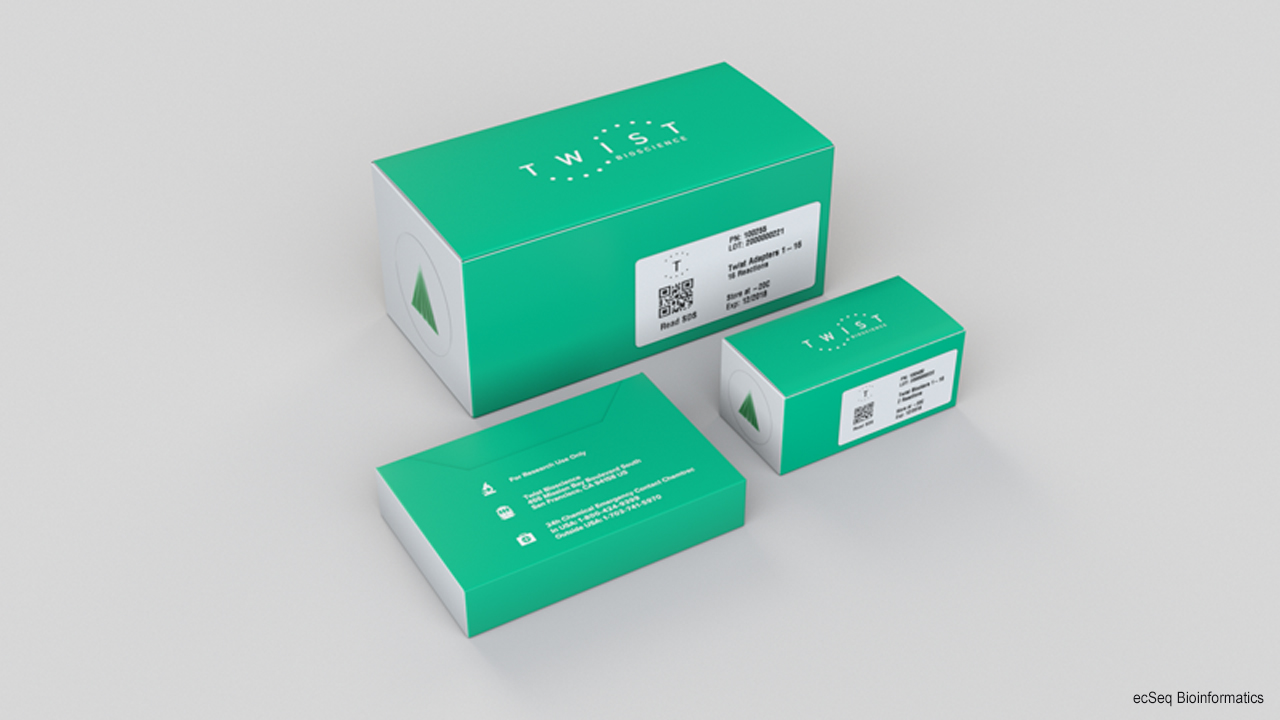
Twist Bioscience expands gene product line with launch of Clonal-Ready Gene Fragments


Deprecated: strlen(): Passing null to parameter #1 ($string) of type string is deprecated in /home/medicircle/public_html/script_newsdetails.php on line 75
▴ Twist Bioscience expands gene product line with launch of Clonal-Ready Gene Fragments
It can be used to build constructs and minimize the time and cost of screening for perfect clones


Twist Bioscience Corporation, a company enabling customers to succeed through its offering of high-quality synthetic DNA using its silicon platform, today announced the launch of Clonal-Ready Gene Fragments, providing customers with a complete offering for genes. Twist’s best-in-class Gene Fragments, with and without adapters, can be used to build constructs and minimize the time and cost of screening for perfect clones.

“Our industry-leading production process delivers high-quality Gene Fragments quickly, reliably, and affordably so that our customers can order the DNA that they want exactly how they want it,” said Emily M. Leproust, PhD, CEO and co-founder of Twist Bioscience. “Importantly, we are now able to better address a segment of the synthetic biology market who make their own Clonal Genes rather than purchasing them, reaching the large number of customers that need smaller amounts of DNA to facilitate their experiments seamlessly.”

Gene Fragments begin as oligonucleotides synthesized on Twist Bioscience’s proven semiconductor-based silicon platform. The oligonucleotides are then annealed together and PCR-amplified to produce a double-stranded DNA fragment and error-corrected through an enzymatic reaction. The resulting product is a ready-to-use Gene Fragment that is compatible with many applications including cloning, gene and protein expression, pathway and enzyme engineering and enzyme optimization.

Based on a comparative study conducted by Twist, Twist Gene Fragments demonstrated the lowest error rate, with a nearly 2-fold improvement across all Gene Fragment size ranges at 1:5,300. For shorter oligonucleotides 300 to 800 base pairs in length, the error rate was 1:6,200. Low error rates translate into the selection of fewer colonies, saving time and budget.


Tags : #TwistBioscience #LatestNewsonTwistBioscience11thDec #LatestPharmaNews11thDec #Clonal-ReadyGeneFragments

About the Author


Team Medicircle

Related Stories

Loading Please wait...

-Advertisements-


Trending Now

Why Modern Lifestyle Causes Chronic InflammationAugust 05, 2026
Endometriosis Awareness: Understanding the Silent Condition Affecting Millions of Indian WomenAugust 05, 2026
A Complete Guide to Pregnancy Health Tips for Indian Women: Nutrition, Wellness, and What Every Expectant Mother Should KnowAugust 05, 2026
Why Preventive Healthcare for Children Is One of the Most Important Investments India Can MakeAugust 04, 2026
The Role of Pathology in Healthcare: From Diagnosis to Disease PreventionAugust 04, 2026
Pathophysiology of Psoriatic Arthritis: Clinical Presentation, Joint Damage Mitigation, and BiologicsAugust 04, 2026
Comprehensive Evaluation of Syncope: Cardiac vs. Neurological Origin WorkupsAugust 04, 2026
Common Medical Terms Explained: A Plain-Language Guide for Indian Patients and Healthcare SeekersAugust 03, 2026
Why Radiology Is the Backbone of Modern Medical Diagnosis and TreatmentAugust 03, 2026
Managing Urban Stress: Science-Backed Strategies for Mental Resilience in 2026 August 01, 2026
Managing Chronic Inflammation: The Role of Anti-Inflammatory Indian SuperfoodsAugust 01, 2026
Pathophysiology of Psoriatic Arthritis: Clinical Presentation, Joint Damage Mitigation, and BiologicsAugust 01, 2026
Early Markers of Glaucoma: Structural vs. Functional Ophthalmic Diagnostic ProtocolsAugust 01, 2026
Managing Complex Diabetic Foot Ulcers: Multidisciplinary Wound Care, Offloading, and RevascularizationAugust 01, 2026
The Future of Preventive Medicine: How India Is Moving From Cure to PreventionAugust 01, 2026
Why Young Indians Are Facing Heart Problems: Causes, Symptoms, and PreventionAugust 01, 2026
The Future of Preventive Screening: AI-Driven Early Cancer Detection in IndiaJuly 31, 2026
The Impact of Climate Change on Allergic Respiratory Diseases in Indian Cities July 31, 2026
Electronic Medical Records: What They Are, Why They Matter, and How India Is Embracing ThemJuly 31, 2026
Heatwave Health Risks in India: Symptoms, Treatment, and Prevention StrategiesJuly 31, 2026