 Thursday, October 08, 2026
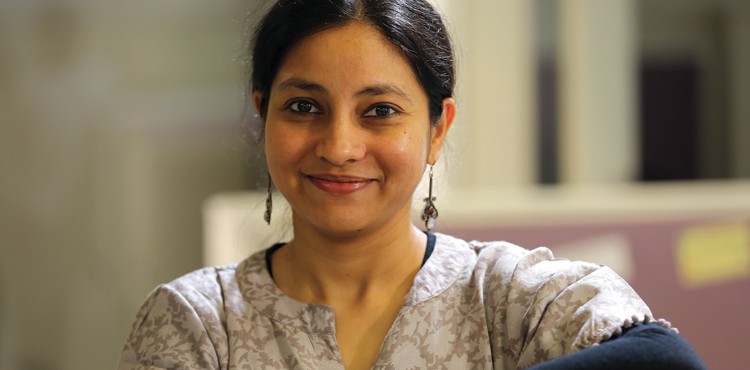
 Dr Arpita Ghosh is a Senior Research Fellow on Big Data at the George Institute for Global Health India. Her work involves quantitative research cutting across multiple areas of public health including childhood vaccination, nutrition, elderly health, and chronic diseases, particularly cancer.




Dr Arpita Ghosh is a Senior Research Fellow on Big Data at the George Institute for Global Health India. Her work involves quantitative research cutting across multiple areas of public health including childhood vaccination, nutrition, elderly health, and chronic diseases, particularly cancer. She has extensive experience of working with secondary data sets and of conducting epidemiological studies and randomized trials.
Q. What is the importance of data for public health in India?
Local disaggregated data, generated in a timely manner, is crucial for an effective public health programme. Data helps us to objectively decide on the priorities and forge a reasonable plan that can then be monitored, evaluated and modified, using data. Data helps us see patterns and gain insights that may not be intuitive or may even be contrary to common knowledge. At the same time, for drawing meaningful inferences, data needs to be examined with the understanding of the context in which it is generated. To address the current public health challenges in India, it is imperative that we build a culture of data use and sharing.
Q. What are the nuances we should keep in mind while developing a data science strategy for India?
Any data science strategy for a country like India will have to keep in mind, the research priorities, data availability and opportunities including incorporating region-specific goals.
Q. How can this thrust on data science help achieve our larger goals?
This thrust will encourage us to explore the less traditional sources of data, integrate data from different sources and come up with innovative ways to utilize data. We hope that this effort to glean information from all available data, however heterogeneous and noisy, will add to our understanding and help deliver better care and improve patient outcomes.
Q. Who all are being invited to the data science consultation and what we hope to achieve out of the same?
Keeping in mind the interdisciplinary nature of data science and the complexity of the public health problems, we have invited stakeholders from diverse backgrounds – Government, NGOs, public and private hospitals, academic institutes, research organizations, policy think tanks, pharmaceuticals, consulting firms and funding bodies. We hope to understand from this eminent group of researchers and practitioners the opportunities and challenges of health data in India, the different sources of data that can mined to glean information about the health of the population, how best to integrate the heterogeneous data and analyze them, and finally how data can be leveraged for accountability and action.






.jpeg)










.jpg)
.jpg)
.jpg)
.jpg)
.jpg)
.jpg)


.jpg)