 Thursday, October 08, 2026
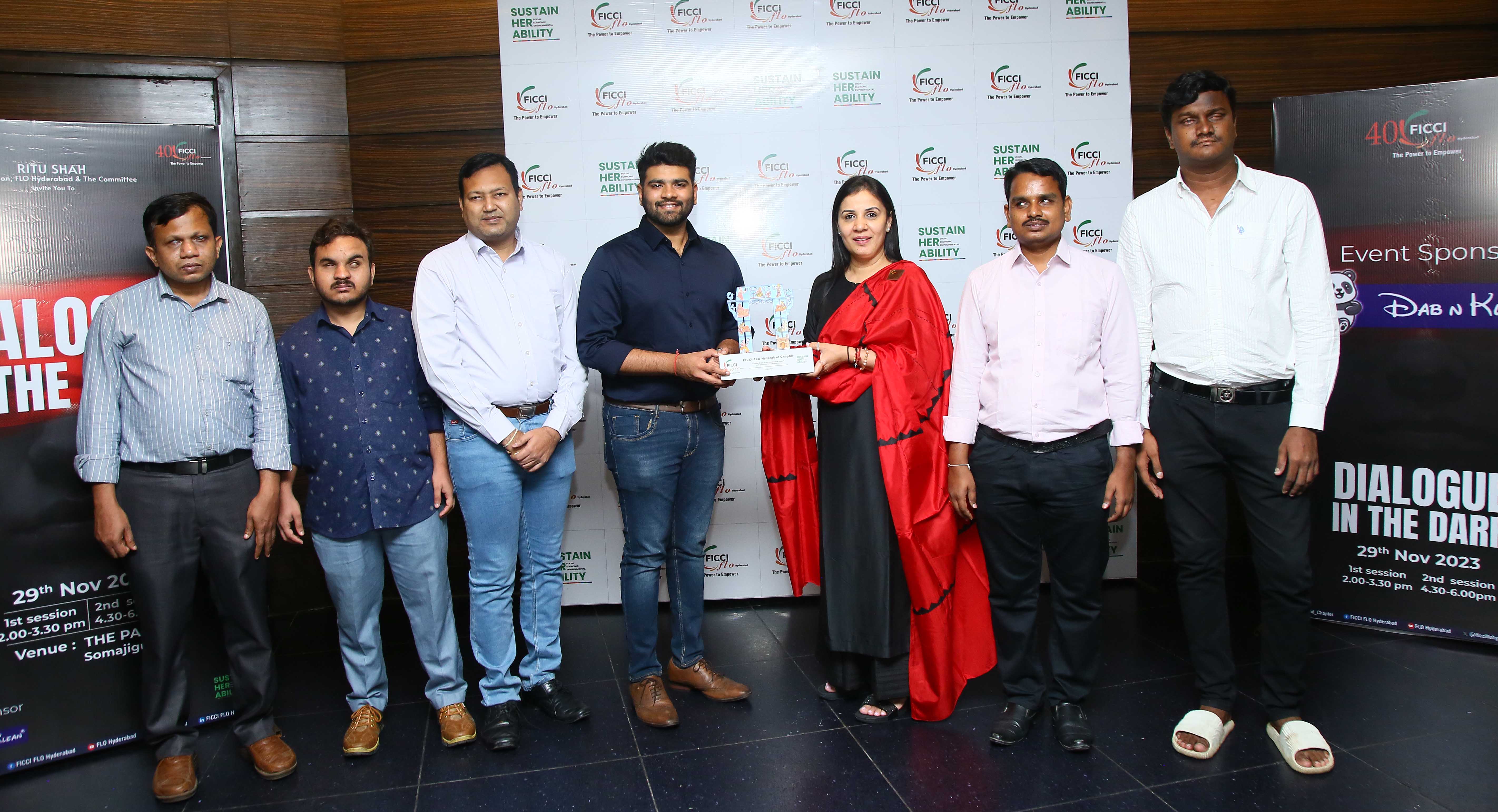
 This novel initiative sensitized so much that nearly 4000 disabled got employment, informed Anand, representative of Dialogue in the Dark. We want the corporate world to be more inclusive. We want more MNCs to hire more disabled: Vinod, Pavan, Kiran, Sharath, and Faizal, the visually challenged who were behind the Dialogue in the Dark program at Hyderabad




Hyderabad, November 29, 2023..... FICCI Ladies Organisation(FLO), Hyderabad Chapter organised a unique program, a program of its kind called "Dialogue-in-the-dark'. It was organised as part of the 'Sustain-Her-Ability" goals of the chapter. “Inclusivity” is one of the key areas of these goals. This program was conceived as part of inclusivity, said Ritu Shah, Chairperson of FLO. The program was organised on Wednesday afternoon in two batches, comprising 40 in each.
Dialogue-in-the-dark is a beautiful experience that can give you a new perspective on the senses.
‘The best and most beautiful things in the world cannot be seen or even touched – they must be felt with the heart’, Ritu Shah said quoting Helen Keller
Dialogue in the dark is a new way of seeing the world, commented one of the FLO members speaking at the end of the program.
It was a completely unlit dining experience featuring the serving of refreshments. Five blind guides Vinod, Pavan, Kiran, Sharath, and Faizal, led FLO members in a queue, in small groups, through a dark tunnel to their respective tables in the banquet hall of the Park, which was made pitch dark. It was dreadful, an awesome experience with a brilliant purpose and message. The "Dialogue in the Dark" was an awareness-raising, experiential experience and a social experiment.
This unique and surprising experiment was founded by Andreas Heinecke in 1988 in Germany. Since then, hundreds of programs have been organised across the world. Nearly 500 to 600 programs are held in India in about 63 cities. It now has a presence in Mumbai India. This program was scheduled to sensitize society to be more inclusive.
The program created a lot of impact. It has so far helped nearly 4000 disabled people get jobs. The aim of this program was to create empathy and understanding towards disability
Anand led by his team of five guides Vinod, Pavan, Kiran, Sharath, and Faizal interacted with the participants at the end of the experience.
Replying on how it works, one of the visually challenged guides said, when one sense organ of yours doesn't work we tend to sharpen others. As a child, we faced many challenges. But, now grown-ups, and in the age of 25 to 35 years, we are now comfortable and blindness doesn't bother us much, they added.
We have a couple of crore blind people in India. We have to be competitive to survive in this cut-throat competition. So, technology is enabling us to be independent. Thankfully society, government and corporations are also becoming inclusive. We can book our own cab, do online shopping, do coding, and use AI tools. Now some tools and apps are available at our disposal, making us self-reliant, said all the five visually challenged who travelled for the show from different cities.
Faisal said that technology integration enabled us to become more acceptable and also get into the corporate world. Now we are able to deliver on par with the sighted people. Faisal further added that the fastest train in the Indian Railways, the Vande Bharat Express, came out with a host of amenities. They are visually challenged and friendly. We travel independently without anybody's help and support. Further, the IRCTC Website is compatible with “NVDA” software (NonVisual Desktop Access is a free and open-source, portable screen reader for Microsoft Windows) which is primarily used by Visually Impaired users for booking tickets. IRCTC Rail Connect mobile app is compatible with the “Google talk back” accessibility feature
With so much technology around we can track trains, book our tickets, board trains, we can find out coach positions etc they added.
We don't need sympathy. We need empathy. Accept us as your equals. Provide us with more employment opportunities in the corporate world. The visually challenged are on par with the best-sighted people.
When asked what their predominant wish was, was it light or anything else? Surprisingly none of them said 'light'. All said, ‘We need equal opportunities, and more challenging jobs’, which obviously portrays their confidence in their abilities. Currently, MNCs hire just 4 to 5% of disabled. They need to hire more they demanded, Vinod, Pavan, Kiran, Sharath, and Faizal,






.jpeg)










.jpg)
.jpg)
.jpg)
.jpg)
.jpg)
.jpg)


.jpg)