 Thursday, October 08, 2026
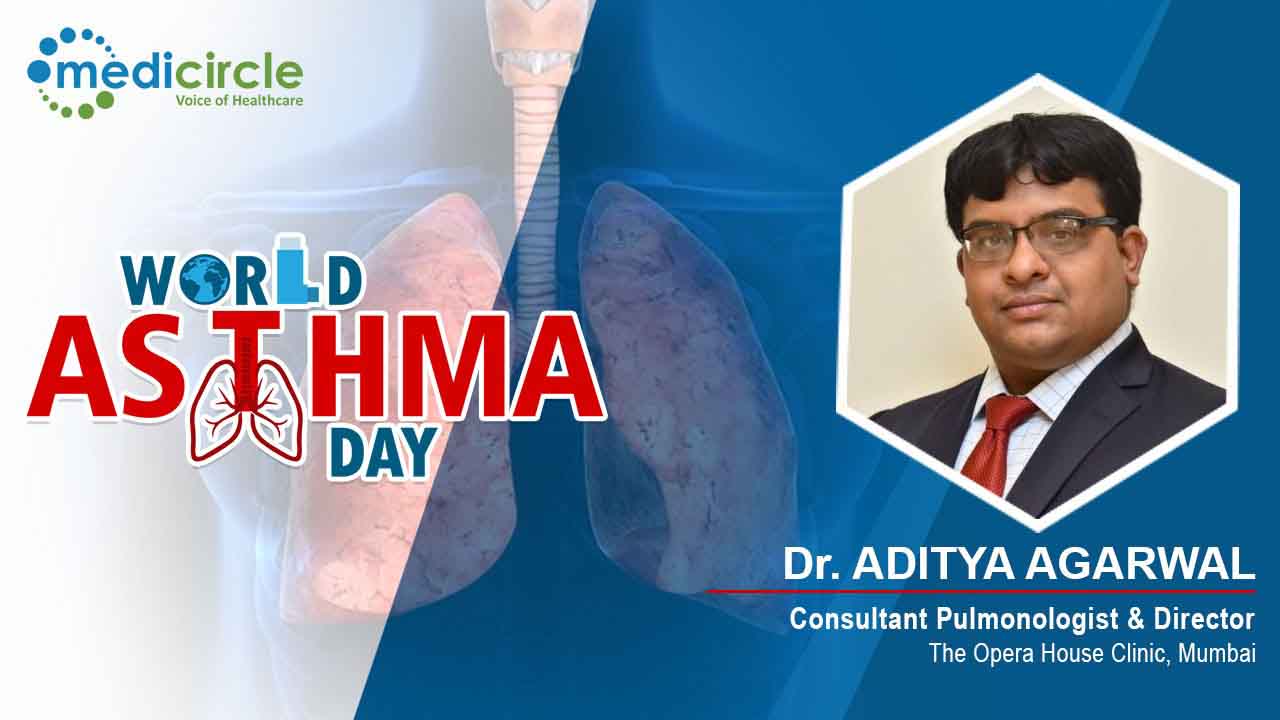
 Dr. Aditya Agrawal shares his example of asthma which is treated successfully by him. He explains that asthma control by a professional doctor is a must.





Asthma is an inflammation and obstruction of the bronchial tubes, a passage that allows air to enter and leave the lungs. During an asthma attack, muscles surrounding bronchial tubes constrict, narrowing the air passage, making it difficult to breathe. The duration of the attack may vary depending upon the cause. At Medicircle, on the occasion of World Asthma Day, we are speaking to eminent Pulmonologists, Respiratory therapists, Paediatricians to build awareness regarding respiratory-related diseases and their available treatments.
Dr. Aditya Agarwal is a passionate respiratory physician at Bombay Hospital in Mumbai and Opera House clinic. Dr. Aditya Agarwal has done his MD in respiratory medicine followed by DNB. He has done a senior residency at the National Institute of Tuberculosis and Respiratory Medicine in New Delhi. He is a prolific researcher and several papers to his name. He thoroughly enjoys patient education and respiratory medicine.
The real reason behind asthma
Dr. Aditya Agrawal says, “Asthma, aptly described as the disorder in breathing tubes called the bronchioles which constrict. This constriction happens as a reaction to abnormal stimulus entering the lungs. Now, this stimulus could be anything like an irritant, dust, cold air, hot air, smoke, strong perfume, cooking flavors. When these irritants enter the bronchial tubes, it results in the constriction of tubules to form a bottleneck. The amount of air going into the lungs and coming out of the lungs reduces. This results in hyperinflation where the lungs become full of air. This causes chest tightness and asthma attacks. Lungs are so full and the air is not able to come out of the lungs. This results in the air not able to move out of the lungs. The pent-up air contains less oxygen making a person feel breathless lack oxygen. Hence the symptom of an asthmatic attack is wheezing. Wheezing is a whistling sound in the chest. This occurs when air passing the bronchioles is at higher pressure. So somebody who has an asthma attack will suffer from shortness of breath, coughing, chest pain, chest tightness, and wheezing.”
Better asthma control is a must
Dr. Agrawal informs, “Asthmatic patients are going to be breathless all the time. There are many professional athletes like David Beckham, the famous footballer of Manchester USA. It is important to understand that if you can perform at that level of physical activity from your stomach, it means you are a normal person. Every asthmatic person is as normal as everybody. It is just his body and lungs which are sensitive to certain changes. It is important for the doctor treating such asthmatic patients to identify the reason why somebody goes into the constriction of bronchioles. A person with asthma will have no symptoms for days and few days with symptoms. It is important to control your asthma symptoms well. You need to see a respiratory physician for better asthma control.”
Diagnosis of asthma
Dr.Agrawal states, “It is important to listen to your patient. If you listen to your patient carefully, he will be able to tell you in simple terms but you will be able to point indicators. For example, as a child, I have been asthmatic. Once, when I came home from school, I informed his father about weird chest tightness and coughing. I also informed him that he could not breathe out. My father who is a doctor suspected this as asthma. A pulmonary Functional Test was done which proved asthma and accordingly the treatment was started. The problem was the allergens exposed which are the real triggers of asthma. Please make sure to avoid them.”
Treatment of asthma
Dr.Agrawal explains, “The treatment of asthma revolves around bronchodilators and inhaled corticosteroids. The best way to treat asthma is by delivering the medicines directly into the lungs. Delivering the medicines in the form of tablets of liquid syrup can choke an asthmatic patient. The solution is to try inhaling medicines. Inhaling the medicines in gaseous form is effective and this results in reducing the dodge of medicines as well with reduced side effects. This helps to give instant relief to asthmatic patients. The asthmatic patient during the attack may feel like losing life and constriction of the chest. If you can rely on an asthmatic patient, we will thank you for the rest of your life. The most commonly used treatment for asthma is inhaled corticosteroids. The choice of treatment and inhalers should depend on the nature of the disease, severity of disease, and several other factors.
Reliability of inhalers for asthmatic attacks
Dr.Agrawal says, “Inhalers are reliable and gold standard treatment of asthma There are a lot of myths about inhalers that you get addicted to. A lot of patients and their relatives are usually reluctant to start with inhalers. We have spent 25 years explaining to the world that inhalers are not addictive. The nature of asthma is chronic and lifelong. A patient may or may not have any symptoms but he requires inhalers or inhaled medicines till the inflammation settles down in the lungs. If the asthma is well controlled, then inhalers can be put off. So the treatment goes by how much you can control and identify the triggers. Good asthma control can help reduce the use of inhalers. And this happens with most of my patients who have chronic asthma have to rarely use inhalers. A timely follow-up is a must.
Triggers of asthma
Dr.Agrawal explains, “Triggers are subjective. It depends on the person. For example, hot air, cold air, strong smell, the stench of cooking smell, the smell of the moldy room. Triggers are super strong smells that make you difficult to breathe.”
(Edited by Dr.Rati Parwani)





.jpeg)








.jpg)
.jpg)
.jpg)
.jpg)
.jpg)
.jpg)


.jpg)
.jpg)
.jpg)