 Tuesday, October 27, 2026
 The patient had multiple high-risk conditions - including obesity, diabetes, hypertension, hypothyroidism, and a blood clotting condition, making surgery and anaesthesia highly challenging.




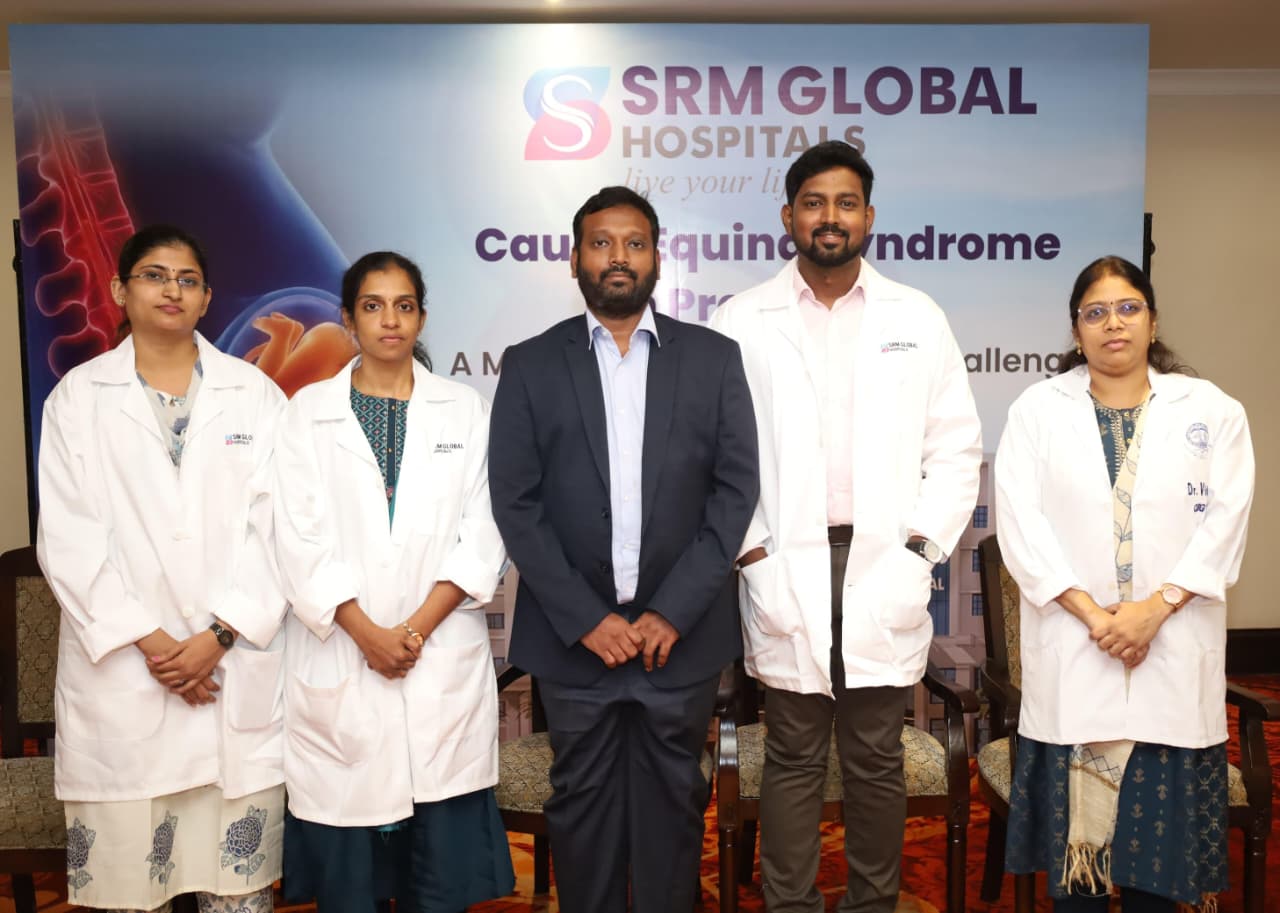
Chennai, March 25, 2026: In a rare medical feat, one that is exceptionally uncommon in global medical literature, doctors at SRM Global Hospitals successfully performed a high-risk, dual emergency surgery on a 32-week pregnant patient who developed a severe spinal condition that left her unable to walk and resulted in loss of bowel and bladder control. The team first delivered the baby safely through an emergency Caesarean section, followed immediately by a complex spine surgery to relieve critical nerve compression and prevent permanent paralysis. Post surgery, the mother has regained her ability to walk and the baby is safe.
The condition was diagnosed as Cauda Equina Syndrome, a rare but life-threatening neurological emergency caused by a lumbar disc extrusion at the L4-L5 level. The inner portion of the spinal disc had bulged out significantly, compressing the cauda equina, a bundle of nerves at the lower end of the spinal cord responsible for movement and control of bladder and bowel function. This compression led to progressive weakness in the lower limbs, inability to walk, and loss of sensation and control over bladder and bowel function.
The surgery was led by Dr. Yogesh, Senior Consultant, Spine Care, and supported by Dr. R.K. Vidhyalakshmi, Senior Consultant, Obstetrician and gynaecology, Dr. D. Abinaya, Consultant, Clinical Haematology, Dr. Ashok C, Senior Consultant, Neonatology and Dr. Shanmitha R, Consultant, Anaesthesiology, SRM Global Hospitals.
It is a medical emergency with a critical window of only a few hours. If not treated urgently, Cauda Equina Syndrome can result in irreversible nerve damage, leading to permanent paralysis and lifelong loss of bladder and bowel function.
The case was further complicated by multiple high-risk factors. The patient was obese (weighing approximately 130 kg) and had coexisting conditions including diabetes, hypertension, and hypothyroidism. Additionally, she had antiphospholipid antibody (APLA) syndrome, a blood-clotting disorder requiring anticoagulation (blood-thinning medication), which significantly increased the risk of bleeding and added complexity to surgical and anaesthetic management.
Despite these challenges, a multidisciplinary team comprising obstetricians, spine surgeons, anaesthetists, haematologists, and paediatric intensivists carefully planned and executed the procedure under stringent safety protocols. The coordinated intervention successfully saved both mother and child, with the mother regaining her ability to walk and the newborn remaining stable under specialised care.
In his comments, Dr. Yogesh Kumar, Senior Consultant - Spine Care, who performed the spinal surgery, said, “This was an extremely rare and complex case, involving a 32-week pregnancy along with obesity, diabetes, hypertension, hypothyroidism, antiphospholipid antibody syndrome, and cauda equina syndrome - all occurring together. The surgical approach itself was highly challenging, as Caesarean sections are performed with the patient on her back, whereas spinal surgeries require a face-down position. Carefully repositioning a patient immediately after a C-section is a delicate and high-risk process. There was an increased risk of non-stop bleeding, as the patient was on blood-thinning medication. Managing this risk across two surgical sites simultaneously required meticulous anaesthetic planning and monitoring. It was equally critical to precisely balance medications, including antibiotics, pain management, nerve-supporting drugs, and anticoagulants, based on her condition. Despite these challenges, the surgery was successful, thanks to the coordination of multiple specialties.”
In his comments, Dr. P. Sathyanarayanan, President said, “This was truly a team effort. The gynaecologist led the pregnancy care and made the critical decision to proceed with the Caesarean section. The spine surgeon performed the emergency procedure to relieve pressure on the nerves. The haematologist carefully managed blood thinners due to her clotting condition. The anaesthetist handled a very difficult airway and ensured safe anaesthesia throughout. The paediatric intensivist cared for the baby in the NICU. Without seamless coordination among all these specialists, this outcome would not have been possible.”





-23-300x250.png)

.jpeg)







.jpg)
.jpg)
.jpg)
.jpg)
.jpg)
.jpg)
.jpg)
.jpg)
.jpg)

