Friday, October 23, 2026
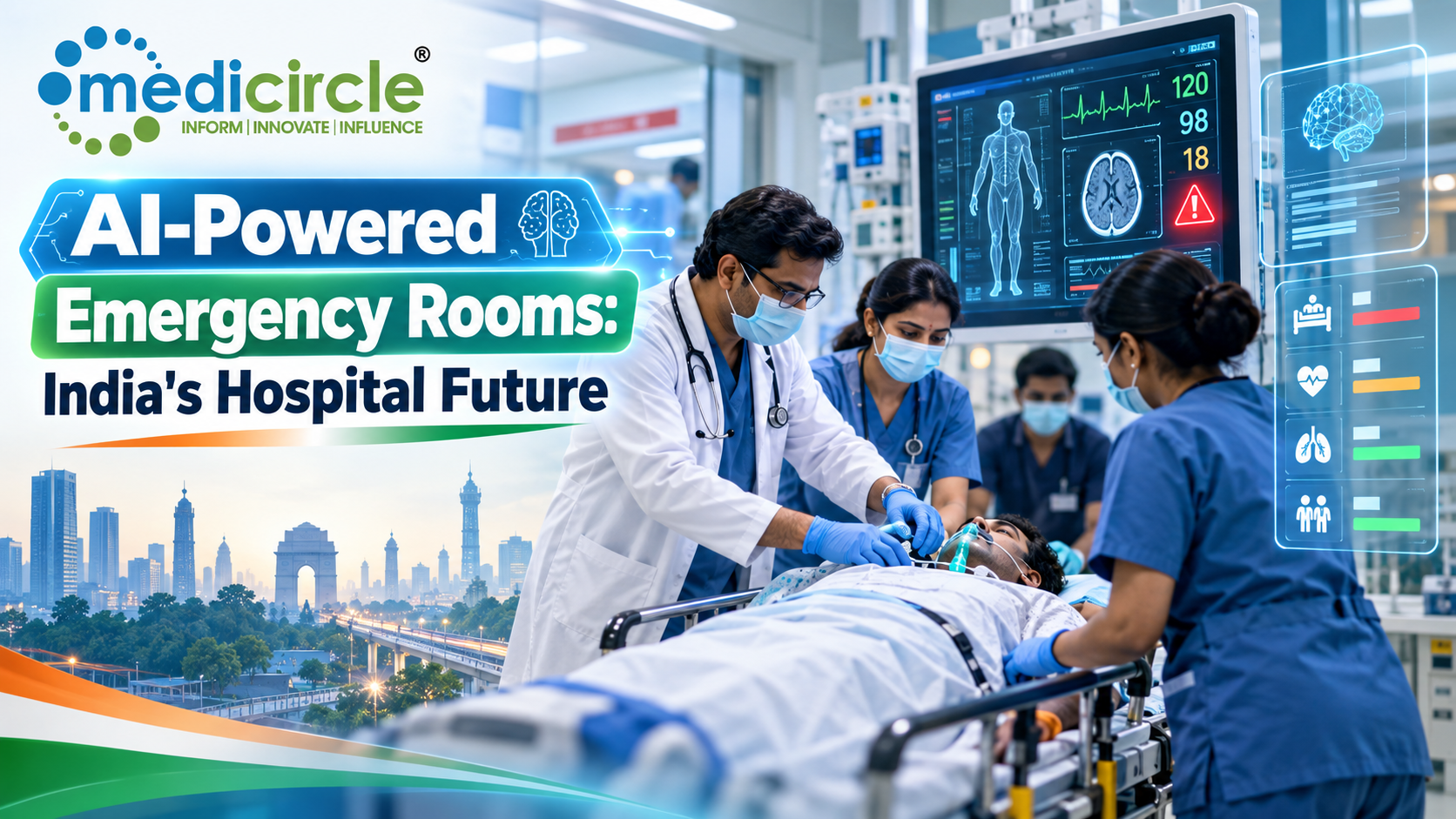
 AI-powered emergency rooms are transforming hospital care in India through intelligent triage, predictive diagnostics, and real-time clinical decision support, offering life-saving potential for an overburdened emergency care system.





Introduction
Every minute counts in a hospital emergency room. A patient arriving with crushing chest pain, a child with a high fever and altered consciousness, a road accident victim with multiple injuries, all of them arrive at the same door, often at the same time, with nurses and doctors forced to make critical decisions under intense pressure and with limited time. This is the reality of emergency departments across India every single day.
India's emergency care infrastructure is under significant strain. The country faces an acute shortage of emergency medicine specialists, and most government hospitals are overwhelmed by patient volumes that far exceed their designed capacity. Tier 2 and Tier 3 cities often lack even basic emergency triage protocols. Against this backdrop, artificial intelligence is beginning to offer something genuinely transformative: the ability to assist clinicians in making faster, more accurate, and better-informed decisions precisely when lives are on the line.
AI-powered emergency rooms are not a distant concept from science fiction. They are becoming an operational reality in leading hospitals globally and are beginning to take shape in India's most advanced healthcare institutions. Understanding what this transformation means, how it works, what it can deliver, and where its limitations lie is essential for every healthcare professional, hospital administrator, policymaker, and informed patient in India today.
Understanding AI in the Emergency Department
At its core, an AI-powered emergency room is one where machine learning models, natural language processing tools, and real-time data systems are embedded into clinical workflows to support the decisions that doctors, nurses, and paramedics make. These systems do not replace clinical judgment. They augment it.
Emergency departments operate under constant time pressure, diagnostic uncertainty, and cognitive overload. AI-driven clinical decision support systems promise to enhance diagnostic accuracy, risk stratification, and workflow efficiency, though the translation from algorithmic performance to bedside integration has remained inconsistent.
The most important areas where AI is being deployed within emergency rooms include automated triage support, predictive early warning for life-threatening conditions, medical imaging analysis, and clinical documentation. Together, these tools form a digital layer that wraps around the human clinical team, providing real-time intelligence that can spell the difference between a good outcome and a preventable death.
In India, the promise of this technology is especially significant. Data and AI in healthcare can potentially add 25 to 30 billion dollars to India's GDP by 2025, according to a NASSCOM Data and AI report. More than the economic case, however, it is the clinical case for AI in emergency medicine that is most compelling for a country where emergency care remains inaccessible for millions.
How AI Triage Systems Are Changing Emergency Workflows
Triage, the process of quickly assessing the severity of a patient's condition and prioritizing care accordingly, is the most critical function at the entrance of any emergency room. In traditional settings, this depends entirely on the skills and experience of the triage nurse or duty doctor, who must assess dozens of patients rapidly and under enormous workload pressure.
AI triage systems process multiple data streams simultaneously, including vital signs, chief complaints, age, comorbidities, and even the results of rapid point-of-care tests, to generate a risk score that guides clinical priority. AI-based triage systems present a transformative opportunity for enhancing emergency care delivery, with evidence supporting improvements in diagnostic accuracy, triage efficiency, and decision support.
A notable quality improvement study published in NEJM AI demonstrated measurable impact. The AI-informed triage clinical decision support tool provided individualized triage recommendations and rationale based on predicted risk of acute outcomes. Across 174,648 emergency department visits, the triage acuity distribution changed meaningfully after the intervention, with low-acuity visits increasing by 48.2 percent and mid-acuity visits decreasing by 18.7 percent. This shift indicates that the AI tool helped clinicians better distinguish between patients who truly needed urgent attention and those who could safely wait, reducing the risk of both overtriage and undertriage.
For India, where overtriage and undertriage are endemic problems in crowded public hospital emergency rooms, this kind of decision support could have an enormous impact on patient flow, safety, and outcomes.
Predictive AI: Detecting the Crisis Before It Happens
Perhaps the most medically significant application of AI in emergency rooms is its ability to predict life-threatening events before they fully develop. Conditions like sepsis, cardiac arrest, and acute respiratory failure often show early warning signs in vital data hours before they become clinically obvious. Traditional monitoring systems catch these signs only when a nurse or doctor reviews the numbers. AI systems never blink.
A 2024 research paper on wearable AI systems found that machine learning models could predict sepsis onset several hours in advance using continuous vital-sign monitoring. Another study examining wearable sensors in critical-care environments suggested that AI-supported monitoring may improve how hospitals assess patient acuity and prioritise interventions.
The results for cardiac arrest prediction are similarly encouraging. Machine learning algorithms have shown promising results, with AUC values ranging from 0.73 to 0.96, in predicting cardiac arrest across different settings, including critically ill ICU patients, patients in the emergency department, and patients with sepsis. An ML model incorporating heart rate variability was found to predict cardiac arrest within 72 hours with an AUC of 0.781, outperforming conventional early warning methods.
For real-time cardiac risk assessment in the ED, an AI prediction model using the random forest method produced an area under the curve of 0.915 for predicting acute myocardial infarction and 0.999 for all-cause mortality within one month in emergency department patients presenting with chest pain. These are extraordinary levels of predictive accuracy that have real potential to save lives if integrated responsibly into clinical workflows.
In India, where delays in identifying critical patients in crowded emergency departments cost lives daily, predictive systems powered by deep learning and real-world data continuously analyze patient information to anticipate medical events, resource demands, and treatment outcomes. The shift from reactive medicine to predictive care is not just a technological upgrade. It is a fundamental change in how healthcare thinks about the emergency room.
AI in Diagnostic Imaging and Real-Time Clinical Decision Support
Beyond triage and prediction, AI is making significant inroads in emergency radiology and rapid diagnostics. When a patient arrives with a suspected stroke, a pulmonary embolism, or a traumatic brain injury, the speed of imaging interpretation can determine whether the patient recovers fully or suffers permanent damage.
AI-powered radiology tools can flag critical findings such as intracranial bleeds, pneumothorax, or aortic dissection within seconds of a scan being completed, alerting the clinical team immediately rather than waiting for a radiologist to review the image in a queue. In hospitals where specialist radiologists are not present at night or in smaller cities where radiology support is limited, these tools function as a critical safety net.
AI-driven clinical decision support systems integrate electronic health records, physiological signals, laboratory data, and medical imaging to generate dynamic, real-time predictions that help emergency physicians act with greater confidence and speed.
In India, leading hospital groups have recognized this potential. Apollo Hospitals has committed to investing more in artificial intelligence tools to ease the workload for its doctors and nurses by automating routine tasks, including medical documentation. Other Indian hospitals, including Fortis Healthcare, Tata Memorial Hospital, Manipal Hospitals, Narayana Health, Max Healthcare, Medanta, and Aster DM Healthcare, have also invested in AI-powered tools.
Apollo Hospitals has also opened an advanced ICU integrating acute care and monitoring technologies, with plans to use it as a real-world innovation hub to generate clinical insights that can inform the development of future acute care technologies. These developments signal a clear direction for Indian hospital care.
Challenges in Implementing AI-Powered Emergency Care in India
The promise of AI in emergency rooms is real, but so are the challenges. India's healthcare system faces a unique combination of infrastructure gaps, workforce constraints, and data limitations that make AI adoption more complex than it might appear in well-resourced Western healthcare settings.
The barriers India must address include:
- Data infrastructure gaps: Most Indian hospitals, particularly in government and semi-urban settings, still do not have fully functional electronic medical record systems. AI systems require structured, high-quality data to function effectively, and without it, their performance degrades significantly.
- Cost of implementation: Challenges such as high technology costs, diverse data sources and formats, limited availability of electronic medical records, and profitability concerns have made it difficult for hospitals to accelerate AI adoption.
- Workforce readiness: Introducing AI tools into emergency rooms requires training clinical staff not only to use the technology but also to understand when to trust it and when to override it.
- Regulatory frameworks: India is still developing its regulatory approach to AI medical devices. Clear guidelines from the Central Drugs Standard Control Organisation (CDSCO) and alignment with the Ayushman Bharat Digital Mission (ABDM) are needed to provide hospitals with legal clarity before they invest in these systems.
- Algorithmic bias: AI models trained on data from Western or urban populations may not perform equally well in Indian populations, where disease presentation, comorbidity patterns, and genetic profiles can differ significantly.
Despite these challenges, integrating AI into emergency medicine has the potential to significantly improve diagnostic speed and accuracy, clinical decision-making, and patient management. AI should be implemented thoughtfully to complement rather than replace human expertise.
The Road Ahead: What India's Emergency Rooms Can Realistically Achieve
India's emergency medicine landscape is at an inflection point. The National Medical Commission (NMC), the Ayushman Bharat Digital Mission, and forward-thinking hospital chains are all beginning to create the conditions for AI-assisted emergency care to become more widespread.
The concept of a virtual hospital is already emerging through digital-first health systems, and over time, AI hospitals will become hybrid ecosystems where digital and physical care merge seamlessly, empowering continuous, data-driven wellness across geographies.
For India specifically, the path forward requires investment in three areas simultaneously. First, hospitals must prioritize digital infrastructure, particularly electronic health records and interoperable data systems under ABDM. Second, medical education must incorporate emergency AI literacy so that the next generation of Indian emergency physicians and nurses understands how to work alongside these tools. Third, the government must develop a clear regulatory and reimbursement framework that incentivizes hospitals to invest in AI emergency systems without fear of legal ambiguity.
The potential gains are significant. Reduced time to diagnosis, earlier identification of critical patients, more accurate triage, fewer preventable deaths, and more efficient use of scarce emergency resources are all within reach. For a country where emergency medicine is still an underdeveloped specialty and where millions of patients arrive at overwhelmed hospital doors every year, AI-powered emergency rooms represent one of the most promising opportunities in Indian healthcare today.
Platforms like Medicircle play an important role in this evolving landscape, bringing expert voices, clinical perspectives, and hospital innovation stories to a wider audience, helping healthcare professionals, hospital leaders, and the public stay informed about the changes that are reshaping Indian healthcare from the inside.
Conclusion
AI-powered emergency rooms are not a replacement for skilled, compassionate emergency medicine. They are a powerful extension of it. By combining machine learning with real-time clinical data, predictive systems, and intelligent triage support, hospitals can fundamentally improve how they care for patients in their most vulnerable moments. For India, where emergency care infrastructure must rapidly scale to meet a growing population's needs, AI represents an extraordinary opportunity. The transformation has begun. The challenge now is to ensure that it is implemented equitably, thoughtfully, and in a manner that genuinely serves every Indian patient, not just those in elite urban hospitals.
Frequently Asked Questions
Q1: What is an AI-powered emergency room?
An AI-powered emergency room is one where machine learning systems, real-time data analytics, and clinical decision support tools are embedded into emergency workflows. These tools assist doctors and nurses with triage decisions, early detection of critical conditions, diagnostic imaging interpretation, and patient risk prediction, without replacing the judgment of the clinical team.
Q2: How does AI help with triage in emergency departments?
AI triage systems analyze a combination of vital signs, chief complaints, patient history, and diagnostic data to generate risk scores that help clinical staff prioritize patients more accurately and quickly. This reduces both the over-triage of low-risk patients and the dangerous under-triage of high-risk ones.
Q3: Can AI predict sepsis and cardiac arrest in advance?
Yes. Research shows that machine learning models can detect early patterns of sepsis several hours before clinical deterioration becomes obvious. Similarly, AI models have demonstrated strong predictive performance for in-hospital cardiac arrest in emergency department settings, giving clinical teams additional time to intervene.
Q4: Which Indian hospitals are using AI in emergency and critical care?
Hospitals including Apollo Hospitals, Fortis Healthcare, Manipal Hospitals, Narayana Health, Max Healthcare, Medanta, and Aster DM Healthcare have all invested in AI-powered clinical tools. Apollo has been particularly active, committing to expanded AI investment for clinical documentation, diagnostic support, and reducing clinician workload.
Q5: What are the main challenges for AI adoption in Indian emergency rooms?
The key challenges include limited electronic health record infrastructure across government and semi-urban hospitals, high implementation costs, the need for clinical staff training, absence of clear regulatory frameworks for AI medical devices in India, and the risk that AI models trained on non-Indian data may not perform optimally for Indian patient populations.
Resources
- Indian Council of Medical Research (ICMR): Guidelines and research publications on healthcare technology and clinical innovation in India
- World Health Organization (WHO): India Country Office reports on health systems strengthening and digital health
- Ayushman Bharat Digital Mission (ABDM): National digital health infrastructure framework and interoperability guidelines
- PubMed / National Center for Biotechnology Information (NCBI): Peer-reviewed research on AI applications in emergency medicine and triage
- National Board of Examinations in Medical Sciences (NBEMS): Resources on emergency medicine specialty training and standards in India
Interlinking Keywords:
AI in Indian hospitals, emergency medicine India, hospital triage systems, clinical decision support tools, digital health India, AI diagnostics, predictive healthcare, Ayushman Bharat Digital Mission, emergency department AI, machine learning in healthcare
Medical Disclaimer:
This article is intended for informational and educational purposes only. It does not constitute medical advice, clinical guidance, or a substitute for professional medical opinion. Readers should consult qualified healthcare professionals for any medical concerns. All clinical decisions must be made by licensed practitioners based on individual patient circumstances.
Last medically reviewed by:
Dr. Manthan Tripathi, Editorial and Medical Advisory Team, Medicircle.in on 08, September 2026





-23-300x250.png)

.jpeg)
.jpg)
.jpg)
.jpg)
.jpg)
.jpg)
.jpg)
.jpg)
.jpg)
.jpg)