Wednesday, November 11, 2026
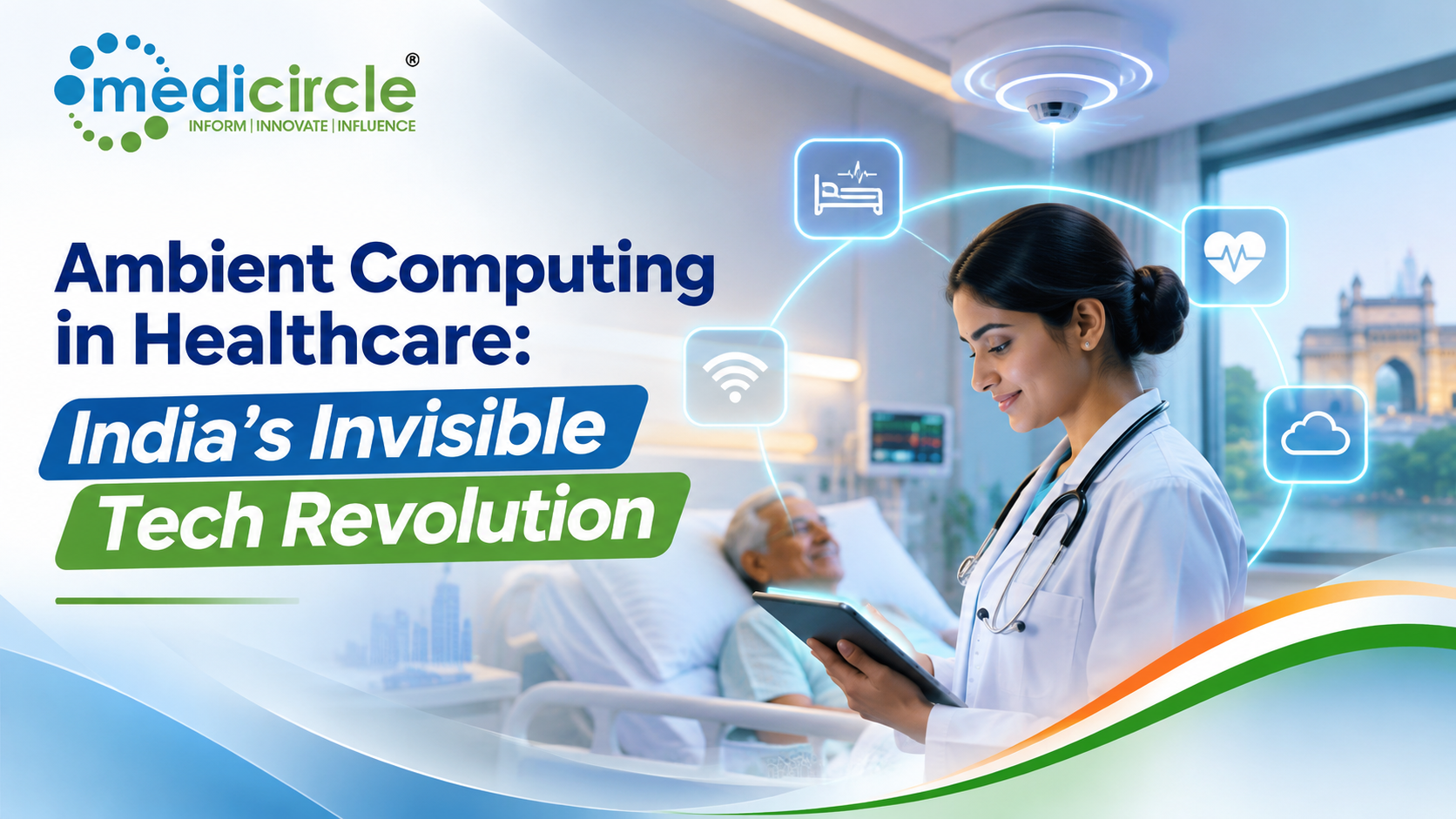
 Ambient computing embeds invisible AI-powered systems into healthcare environments, automating documentation, enabling continuous patient monitoring, and transforming clinical workflows to improve care delivery across India.





Introduction
Healthcare has always been driven by the tools available to its practitioners. From the stethoscope to the MRI machine, every technological leap has redefined what it means to deliver care. Today, a new kind of transformation is unfolding, one that is not defined by a single device or a single invention, but by an entirely new philosophy of how technology exists within clinical spaces. That philosophy is ambient computing, and it is quietly rewriting the rules of modern medicine.
Ambient computing in healthcare refers to the seamless integration of intelligent, interconnected systems into the environment around patients and clinicians. These systems work in the background, continuously collecting data, interpreting context, and responding to needs, without requiring a person to press a button, open an application, or look at a screen. The technology is there, but it is invisible. The intelligence is present, but it is unobtrusive.
For a country like India, where the healthcare system serves over 1.4 billion people with a doctor-to-patient ratio far below the World Health Organization's recommended benchmark of 1 doctor per 1,000 patients, the promise of ambient computing is not just exciting. It is essential.
Understanding Ambient Computing and How It Works in Clinical Settings
Ambient computing is not a single product. It is an ecosystem of technologies that work together to create an intelligent environment. At its core, it combines the Internet of Things, artificial intelligence, machine learning, natural language processing, edge computing, and sensor networks to build a system that perceives, learns, and acts.
In a clinical setting, this might look like a hospital room where sensors embedded in the walls and ceiling monitor a patient's vital signs continuously without the need for wired monitoring equipment attached to the body. It might look like a consultation room where an AI-powered ambient clinical intelligence system listens to the conversation between a doctor and a patient, automatically transcribing it, organizing it into structured medical notes, and updating the electronic health record in real time.
The core components that make ambient computing functional in healthcare include:
- Sensor arrays that detect movement, sound, temperature, and biometric data
- Edge computing devices that process data locally without sending everything to a remote server
- AI and machine learning models that interpret patterns and generate meaningful clinical insights
- Natural language processing tools that convert spoken words into structured medical documentation
- Integration layers that connect ambient systems with hospital information systems and electronic health records
What makes ambient computing distinct from conventional healthcare technology is precisely its invisibility. Patients do not interact with it consciously. Clinicians benefit from it without being distracted by it. The system is simply present, alert, and responsive.
The Clinical Problem That Ambient Computing Solves
To appreciate why ambient computing matters, it is important to understand the burden that currently exists within clinical workflows.
Doctor burnout in India is a growing crisis. A significant portion of a clinician's working day is consumed not by patient care, but by documentation. Studies across global healthcare systems have consistently found that physicians spend between 30 and 50 percent of their working time on administrative tasks, including writing notes, updating records, ordering tests, and managing correspondence. In India, where government doctors often see upward of 100 patients per day at public health facilities, this documentation burden is particularly severe.
Ambient clinical intelligence directly addresses this problem. By listening to the doctor-patient consultation and automatically generating structured clinical notes, ambient systems can reclaim hours of a clinician's day. The doctor reviews, edits if needed, and approves the note. The result is faster documentation, greater accuracy, and far more time for genuine patient interaction.
Beyond documentation, ambient computing addresses another persistent challenge: continuous patient monitoring. Traditional monitoring systems require patients to be physically connected to equipment, which limits mobility and can be distressing, particularly for elderly patients or children. Ambient sensor systems can track heart rate, respiratory rate, temperature, and even subtle behavioral changes such as gait abnormalities or falls, without any device attached to the patient. This kind of passive, continuous monitoring is especially valuable in intensive care units, geriatric wards, and post-surgical recovery areas.
Ambient Computing Applications Transforming Healthcare in India
India's healthcare sector is at a critical inflection point. The convergence of a large patient population, a growing digital infrastructure backbone, and an urgent need to do more with less makes the country uniquely positioned to benefit from ambient healthcare technology.
Several meaningful applications are already emerging across Indian healthcare settings.
Smart hospital rooms equipped with ambient sensing technology are being piloted in select private hospital chains in cities such as Mumbai, Bengaluru, Hyderabad, and Delhi. These rooms use sensor networks to track patient vitals, detect falls, monitor medication adherence, and alert nursing staff when intervention is needed, all without requiring a nurse to be physically present at all times.
Ambient clinical documentation tools are gaining traction among clinicians at large tertiary care hospitals. By integrating with hospital information systems and electronic medical record platforms, these tools allow physicians to conduct a natural conversation with the patient while the system handles the structured documentation in the background. This is particularly impactful in specialties with high documentation loads such as psychiatry, internal medicine, and primary care.
Remote patient monitoring powered by ambient IoT devices is expanding beyond hospital walls. For patients managing chronic conditions such as diabetes, hypertension, or chronic obstructive pulmonary disease, ambient home monitoring systems continuously collect health data and transmit it to care teams. This model aligns closely with India's National Digital Health Mission and the Ayushman Bharat Digital Mission, which seeks to build a connected digital health ecosystem accessible to every Indian citizen through the Ayushman Bharat Health Account framework.
In rural India, where specialist access remains severely limited, ambient computing has the potential to function as a force multiplier. Community health centers equipped with ambient diagnostic tools can collect comprehensive patient data before a telemedicine consultation, giving the remote specialist far richer information to work with and dramatically improving the quality of remote care delivery.
Privacy, Ethics, and the Regulatory Landscape in India
No discussion of ambient computing in healthcare can ignore the profound questions it raises about privacy and consent. A technology that continuously listens, watches, and records within clinical spaces touches the most sensitive dimensions of personal information. Patient data is among the most protected categories of personal information in every responsible regulatory framework, and India is no exception.
India's Digital Personal Data Protection Act, 2023, establishes a framework for how personal data, including health data, must be collected, stored, processed, and shared. Ambient computing systems deployed in Indian hospitals must align with these requirements, ensuring that patients are informed about what data is being collected, for what purpose, and for how long it will be retained.
Consent in an ambient environment presents unique challenges. Unlike a blood test where a patient signs a specific consent form, ambient systems collect data continuously and passively. Hospitals and technology providers must work together to design consent workflows that are clear, accessible, and meaningful rather than buried in lengthy terms and conditions.
Data security is equally critical. Ambient systems generate enormous volumes of sensitive health data. The infrastructure storing and transmitting this data must meet the highest standards of encryption and access control. The Ministry of Electronics and Information Technology and the Ministry of Health and Family Welfare are both actively developing frameworks that will shape how digital health data is governed, and ambient computing vendors must stay closely aligned with these evolving standards.
The ethical dimension extends beyond regulation. Healthcare providers have a duty to ensure that ambient technologies do not exacerbate existing inequities. If the benefits of ambient computing flow primarily to patients in private hospitals in Tier 1 cities, while the majority of India's population in rural and semi-urban areas remains underserved, the technology will have failed its broader social purpose.
Challenges to Adoption Across Indian Healthcare
Despite its clear promise, ambient computing faces several real challenges on the path to mainstream adoption in India.
Infrastructure readiness is a significant barrier. Ambient computing systems require robust, low-latency connectivity, reliable power supply, and compatible digital health infrastructure. While urban hospitals in major cities are increasingly equipped for this, a large proportion of district hospitals and primary health centers across India still lack the foundational digital infrastructure needed to support ambient systems.
Cost remains a concern. The initial investment required to deploy ambient sensing networks, AI-powered documentation systems, and integration layers can be substantial. For public sector hospitals operating under tight budgets, the case for investment must be made clearly in terms of measurable outcomes such as reduced clinician workload, fewer adverse events, and improved patient throughput.
Clinician trust and training are equally important. Technology adoption in healthcare is never purely a technical challenge. Clinicians must trust that ambient systems are accurate, reliable, and genuinely helpful. Early-stage errors in AI-generated clinical documentation, for example, could erode confidence and slow adoption significantly. Robust training programs, transparent AI performance reporting, and clear protocols for reviewing and correcting ambient system outputs are all necessary components of a responsible deployment strategy.
Language and dialect diversity also presents a unique challenge in India. A country with 22 scheduled languages and hundreds of dialects cannot rely on ambient natural language processing systems trained primarily on English-language medical conversations. For ambient clinical documentation to be truly useful across India, the underlying AI models must be trained on regional language medical data, a challenge that requires significant investment in data collection and model development.
The Future of Ambient Computing in Indian Healthcare
The trajectory of ambient computing in healthcare is clear. As sensor technology becomes smaller and cheaper, as AI models become more accurate and more capable of understanding Indian languages and clinical contexts, and as digital health infrastructure expands through initiatives like the Ayushman Bharat Digital Mission and the National Digital Health Blueprint, ambient computing will move from the periphery to the center of healthcare delivery in India.
The vision is not simply smarter hospitals. It is a fundamentally different relationship between technology and care, one where the system serves the clinician and the patient without demanding their attention, where data flows seamlessly and securely, and where the burden of administration no longer competes with the act of healing.
Platforms like Medicircle, which exist to connect healthcare experts, institutions, and patients through credible information and meaningful conversations, have an important role to play in making this vision legible and accessible. As ambient computing moves into Indian healthcare, the work of educating clinicians, hospital administrators, policymakers, and patients about what this technology is, how it works, and what it means for the future of care becomes genuinely important.
Conclusion
Ambient computing represents a profound shift in the architecture of healthcare. It moves technology from the foreground to the background, from something that must be operated to something that simply works. For Indian healthcare, a system under immense pressure to serve a vast and diverse population with limited resources, this shift carries enormous significance. The invisible intelligence embedded in tomorrow's hospitals and clinics may well prove to be the most powerful tool yet developed in the pursuit of better, more humane, more accessible care for every Indian.
Frequently Asked Questions
Q1: What is ambient computing in healthcare?
Ambient computing in healthcare refers to the integration of invisible, interconnected technologies such as sensors, AI, and IoT devices into clinical environments to continuously monitor, assist, and support patients and healthcare providers without requiring active interaction.
Q2: How does ambient computing reduce doctor burnout in India?
Ambient computing automates documentation, transcribes consultations in real time, and handles routine monitoring tasks, freeing doctors from administrative burdens and allowing them to focus on clinical decision-making and patient interaction.
Q3: Is ambient computing technology available in Indian hospitals?
Several leading hospitals in Tier 1 cities such as Mumbai, Delhi, Bengaluru, and Hyderabad have begun piloting ambient computing solutions. Wider adoption across Tier 2 cities is expected to grow as costs reduce and infrastructure matures.
Q4: What are the privacy risks of ambient computing in hospitals?
The primary privacy risks include unauthorized access to patient data captured by sensors and microphones, data storage vulnerabilities, and the potential misuse of continuous monitoring. India's Digital Personal Data Protection Act, 2023, provides a regulatory framework to address these concerns.
Q5: How does ambient computing support India's Ayushman Bharat Digital Mission?
Ambient computing aligns with the Ayushman Bharat Digital Mission by enabling seamless digital health record creation, real-time data integration with the ABHA framework, and supporting interoperable healthcare ecosystems that improve care access and quality across India.
Resources
- Ayushman Bharat Digital Mission (ABDM): Official government platform for India's national digital health ecosystem, covering ABHA framework and digital health policies.
- Ministry of Health and Family Welfare, Government of India: Central authority for health policy, national health programs, and regulatory frameworks governing healthcare delivery across India.
- World Health Organization: India Country Office: WHO's India-specific health data, policy guidance, and research publications relevant to digital health transformation and health system strengthening.
- Indian Council of Medical Research (ICMR): India's apex body for biomedical research, providing evidence-based guidelines, health data, and clinical research relevant to healthcare technology adoption.
- Ministry of Electronics and Information Technology (MeitY): The nodal ministry governing India's Digital Personal Data Protection Act, 2023, and digital infrastructure frameworks relevant to ambient computing deployments.
Interlinking Keywords
ambient computing in healthcare, ambient clinical intelligence India, smart hospital technology, AI in Indian hospitals, digital health India, IoT in healthcare, Ayushman Bharat Digital Mission, electronic health records India, doctor burnout solutions, remote patient monitoring India, healthcare AI technology, Digital Personal Data Protection Act healthcare, hospital innovation India, healthcare technology trends, ambient intelligence patient monitoring
Last reviewed by:
Dr. Manthan Tripathi, Medicircle Editorial and Medical Advisory Team on 10, November 2026.
Disclaimer
The information provided in this article is intended for general awareness and educational purposes only. It does not constitute medical advice, diagnosis, or treatment recommendations. Readers should not rely on this content as a substitute for professional medical consultation. Always seek guidance from a qualified and registered medical practitioner for any health-related concerns or decisions. Medicircle does not endorse any specific technology product, vendor, or healthcare service mentioned in this article.





-23-300x250.png)