Tuesday, October 27, 2026
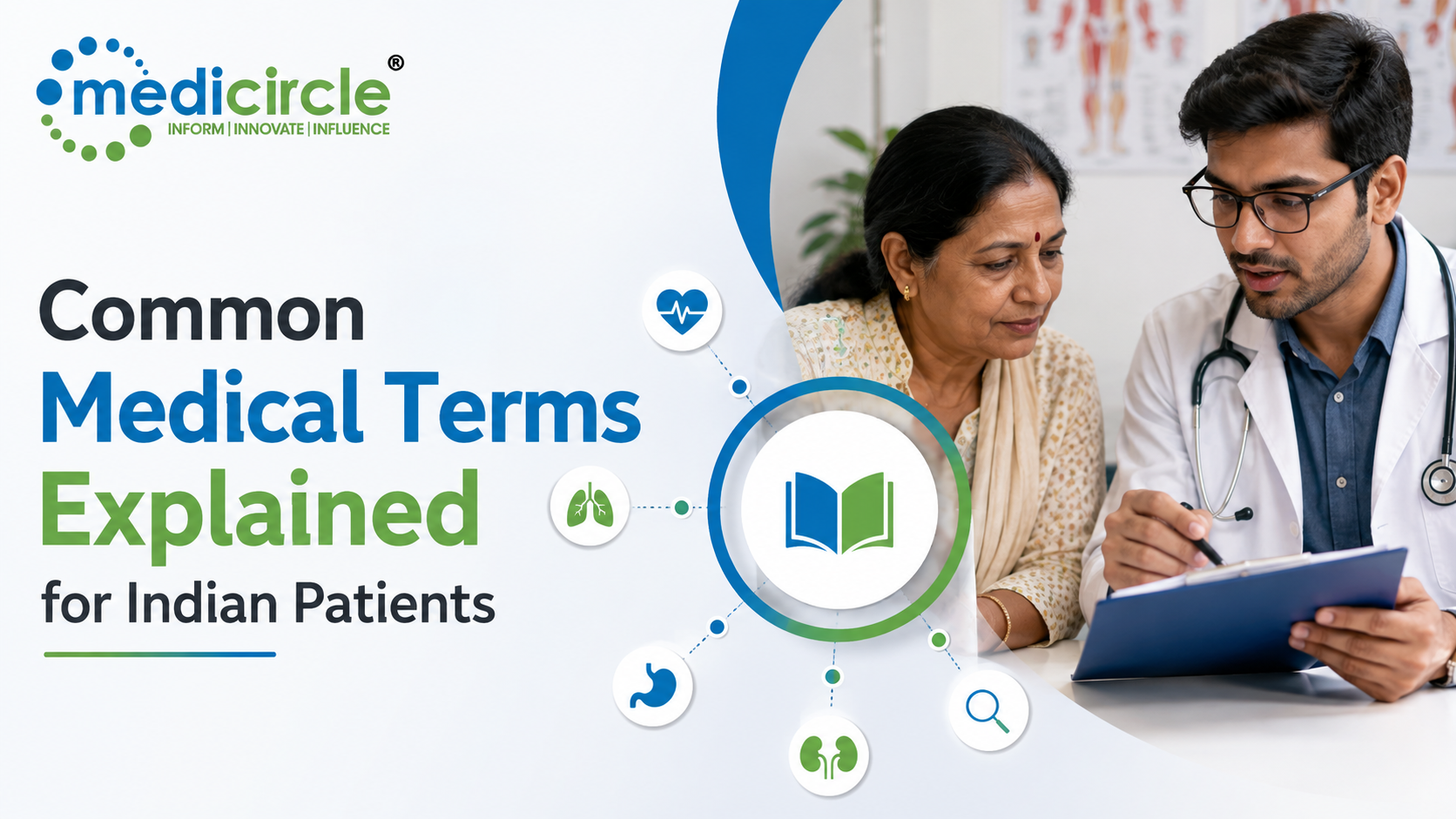
 This article explains common medical terms, prefixes, suffixes, and abbreviations in simple language, helping Indian patients understand clinical vocabulary for better healthcare decisions and communication.





Introduction
Anyone who has sat across from a doctor and nodded along politely while quietly feeling lost in a sea of unfamiliar words knows how disorienting the medical world can feel. Terms such as "idiopathic," "malignant," "contraindicated," or "prognosis" appear regularly on prescriptions, discharge summaries, diagnostic reports, and hospital consent forms. Yet for most patients, these words might as well be a foreign language.
This gap between medical language and patient understanding is not a small problem. In India, where millions of patients navigate a vast and complex healthcare system every year, the inability to understand basic medical terminology can lead to missed diagnoses, medication errors, incomplete treatment adherence, and anxiety around health decisions. The National Health Portal of India and healthcare bodies consistently emphasise that informed patients tend to achieve better health outcomes, ask more relevant questions, and cooperate more effectively with their treating physicians.
Medicircle believes that healthcare knowledge should be accessible to everyone, not just those with a medical degree. This guide breaks down the most commonly used medical terms, explains the logic behind medical language, and helps patients, caregivers, and students approach healthcare conversations with greater confidence.
Understanding the Structure of Medical Language
Medical terminology is built on a logical framework that, once understood, makes even the most complex-sounding words readable. The vast majority of medical terms are derived from ancient Greek and Latin roots. These roots are then combined with prefixes placed at the beginning of a word and suffixes placed at the end to create precise descriptions of body parts, conditions, procedures, and processes.
Consider the word "hepatitis." The root "hepat" refers to the liver, and the suffix "-itis" means inflammation. Together, hepatitis simply means inflammation of the liver. Once a person learns these building blocks, decoding unfamiliar terms becomes significantly easier.
Some of the most clinically important root words include:
- Cardi/o: relating to the heart (as in cardiology or cardiac arrest)
- Neur/o: relating to nerves (as in neurology or neuropathy)
- Nephr/o: relating to the kidneys (as in nephrology or nephrotoxic)
- Gastr/o: relating to the stomach (as in gastritis or gastroenterology)
- Derm/o or Dermat/o: relating to the skin (as in dermatitis or dermatologist)
- Pulmon/o: relating to the lungs (as in pulmonology or pulmonary embolism)
- Oste/o: relating to bone (as in osteoporosis or osteosarcoma)
Understanding this foundation transforms medical vocabulary from an intimidating wall of words into a structured and learnable system.
Commonly Used Medical Prefixes and What They Mean
Prefixes modify or qualify the root meaning. Knowing even a handful of the most frequent prefixes gives patients the ability to interpret a wide range of medical terms they may encounter across specialties.
The prefix "hyper-" means excessive or above normal. This is why hypertension refers to blood pressure that is above the normal range, and hyperglycemia describes blood sugar that is elevated beyond what is considered healthy.
The prefix "hypo-" is the opposite, meaning below normal or deficient. Hypoglycemia therefore refers to low blood sugar, a condition frequently encountered among diabetic patients in India, particularly those on insulin therapy.
"Brady-" means slow, which is why bradycardia describes a heart rate that is slower than normal. "Tachy-" means fast, making tachycardia a condition in which the heart beats too rapidly.
The prefix "intra-" means within or inside. Intravenous (IV) delivery of medication means the drug is administered directly into a vein. "Inter-" means between, while "sub-" or "hypo-" can mean beneath, as in subcutaneous injections given just under the skin.
"Poly-" means many or multiple. Polycystic ovary syndrome (PCOS), one of the most commonly diagnosed hormonal conditions among young Indian women, literally means many cysts on the ovaries.
"Dys-" means abnormal, difficult, or painful. Dyspnea refers to difficulty breathing, while dysphagia refers to difficulty swallowing. "A-" or "an-" at the start of a word signals the absence of something, which is why anaemia describes a condition where haemoglobin levels are insufficient, and apnea refers to the absence of breathing during sleep.
Key Medical Suffixes and Their Clinical Significance
Suffixes at the end of a medical word often indicate whether the term describes a condition, a procedure, a process, or a type of disease.
The suffix "-itis" is one of the most universally recognised. It signals inflammation, which is why arthritis means inflammation of the joints, bronchitis means inflammation of the airways, and appendicitis means inflammation of the appendix. In India, conditions such as hepatitis B and hepatitis C remain significant public health concerns, with millions of individuals affected according to data from the Indian Council of Medical Research (ICMR).
"-ectomy" refers to surgical removal. An appendectomy is the removal of the appendix, a tonsillectomy is the removal of tonsils, and a hysterectomy is the surgical removal of the uterus.
"-ology" refers to the study of a particular branch of medicine. Cardiology is the study and treatment of heart conditions, oncology is the field dealing with cancer, and endocrinology covers hormonal and metabolic disorders.
"-oma" indicates a tumor or mass. A benign oma such as a lipoma is a non-cancerous fatty lump, while a malignant oma such as a melanoma or carcinoma signals cancer. The distinction between benign and malignant is one of the most critical pieces of information any patient receives during a cancer diagnostic workup.
"-pathy" means disease or disease process. Neuropathy refers to nerve damage or disease, nephropathy to kidney disease, and cardiomyopathy to disease of the heart muscle.
"-scopy" describes a visual examination procedure. A colonoscopy involves visual examination of the large intestine using a camera, and a bronchoscopy involves visual inspection of the airways. These procedures are increasingly common in Indian hospitals with the expansion of diagnostic infrastructure under government schemes such as Ayushman Bharat.
Essential Medical Terms Every Patient Should Recognise
Beyond roots, prefixes, and suffixes, there are standalone clinical terms that appear across virtually every medical encounter. Understanding these gives patients a stronger foundation for healthcare conversations.
Acute and Chronic are two of the most fundamental distinctions in medicine. An acute condition begins suddenly and is often intense but short in duration, such as an acute asthma attack or a bout of acute gastroenteritis. A chronic condition is one that persists over a long period, often for years, such as chronic kidney disease or chronic obstructive pulmonary disease (COPD). India carries one of the highest global burdens of chronic non-communicable diseases, with the WHO and ICMR documenting millions of individuals living with diabetes, hypertension, and cardiovascular disease.
Benign refers to a condition or growth that is not cancerous and does not invade surrounding tissue or spread to other parts of the body. Malignant describes a condition, most commonly a tumor, that is cancerous, has the potential to invade nearby tissues, and may metastasize to other organs.
Prognosis is the anticipated course and outcome of a disease based on available evidence. When a doctor discusses prognosis, they are sharing their clinical assessment of what a patient can expect going forward, including the likelihood of recovery, remission, or disease progression.
Idiopathic is a term that often confuses patients. It simply means that the cause of a condition is unknown or cannot be identified. Idiopathic hypertension, for example, describes high blood pressure with no clearly identifiable underlying cause, which accounts for the majority of hypertension cases in India.
Contraindicated means that a particular treatment, medication, or procedure should not be used in a specific patient because the potential risks outweigh the benefits in their clinical situation. Patients may hear this term when a doctor explains why a particular medicine used for one condition cannot be given because of another condition they have.
Triage is a term commonly encountered in emergency departments. It refers to the process of sorting patients according to the urgency of their medical need so that the most critical cases receive care first. In India's public hospitals, which handle high patient volumes, effective triage is an essential mechanism for managing emergency care.
Medical Abbreviations Commonly Encountered in Indian Healthcare
Indian prescriptions, hospital discharge summaries, and diagnostic reports frequently use abbreviations. Knowing what these stand for prevents confusion and helps patients follow their treatment plans correctly.
BP stands for blood pressure, one of the most routinely measured vital signs. HR refers to heart rate, typically expressed as beats per minute. RBS stands for random blood sugar, a screening test frequently conducted at community health centres under government schemes. CBC or FBC refers to Complete Blood Count, a routine blood panel that measures red blood cells, white blood cells, and platelets. USG stands for ultrasonography, a common imaging tool used widely across India for abdominal, obstetric, and musculoskeletal assessments.
OPD means Outpatient Department, where patients are seen and treated without hospital admission. IPD refers to the Inpatient Department, where admitted patients receive care. ECG or EKG refers to an electrocardiogram, a test used to assess the electrical activity of the heart. MRI stands for Magnetic Resonance Imaging, a detailed imaging modality that does not use radiation.
Rx is the universally recognised symbol for prescription. It appears at the top of every formal prescription given by a registered medical practitioner in India. PRN, from the Latin "pro re nata," means "as needed," and appears on prescription labels to indicate that a medicine should be taken only when symptoms require it rather than on a fixed schedule.
Why Medical Literacy Matters for Indian Patients
India is in the midst of a significant healthcare transformation. The Ayushman Bharat Pradhan Mantri Jan Arogya Yojana (PM-JAY) scheme has extended health coverage to hundreds of millions of previously uninsured Indians. The Ayushman Bharat Digital Mission (ABDM) is building a unified digital health ecosystem linking patients, doctors, hospitals, and insurance providers. In this rapidly evolving environment, patients who understand basic medical terminology are far better positioned to use these systems effectively.
Medical literacy also reduces the risk of medical errors. When a patient understands what a prescription says, what a diagnostic finding means, and what a treatment plan involves, they are better equipped to notice discrepancies, ask clarifying questions, and follow instructions accurately. Studies referenced by the WHO India office consistently link higher health literacy to better medication adherence, fewer hospital readmissions, and improved management of chronic conditions.
Platforms such as Medicircle play an important role in this ecosystem by translating expert medical knowledge into clear, accessible language for a wide Indian audience. By bringing credible health education to patients across Tier 1 and Tier 2 cities, and connecting readers to verified medical voices, platforms of this kind contribute directly to India's goal of a more health-literate population.
Conclusion
Medical terminology does not have to be a barrier between patients and the care they need. When the underlying logic of medical language is understood, patients discover that even the most complex-sounding terms follow predictable, learnable patterns. From understanding that "-itis" always signals inflammation to knowing that "hyper-" consistently means above normal, these building blocks unlock the ability to decode a wide range of clinical language encountered in real healthcare settings.
For Indian patients navigating government health schemes, visiting specialists, reading diagnostic reports, or managing chronic conditions, this knowledge is not merely academic. It is a practical tool that improves safety, supports informed consent, encourages meaningful doctor-patient dialogue, and ultimately contributes to better health outcomes. Healthcare in India is evolving rapidly, and an informed patient is one of the most powerful forces driving that evolution in the right direction.
Frequently Asked Questions
Q1: What are the most important medical terms every patient should know?
Every patient benefits from understanding terms such as acute, chronic, benign, malignant, prognosis, diagnosis, inpatient, outpatient, and triage. These words appear regularly during consultations and hospital visits, and knowing their meanings helps patients participate more confidently in their own healthcare decisions.
Q2: How do medical prefixes and suffixes help in understanding terminology?
Medical prefixes and suffixes are word-building components derived from Greek and Latin roots. A prefix such as hyper- means excessive or above normal, while a suffix such as -itis signals inflammation. Recognising these components allows a person to decode the meaning of an unfamiliar medical term without needing to look up every word individually.
Q3: What is the difference between acute and chronic conditions?
An acute condition comes on suddenly and is often short-lived, such as a viral fever or a fracture. A chronic condition is long-lasting and tends to persist for months or years, such as diabetes or hypertension. Both require different management approaches and treatment timelines.
Q4: Why is it important for Indian patients to understand common medical abbreviations?
In Indian hospitals and clinics, prescriptions and discharge summaries are frequently filled with abbreviations such as BP, HR, RBS, CBC, and USG. Understanding these abbreviations helps patients follow their treatment plans accurately, ask better questions during consultations, and avoid errors when following medication or investigation instructions.
Q5: Where can Indian patients find reliable explanations of medical terms in simple language?
Patients can refer to trusted healthcare platforms such as Medicircle, which publishes expert-led, patient-friendly health content in simple language. Official sources such as the Ministry of Health and Family Welfare, the National Health Portal, and WHO India also provide reliable medical information for Indian audiences.
Resources
- Indian Council of Medical Research (ICMR): Guidelines, epidemiological data, and public health publications relevant to disease burden in India
- World Health Organization (WHO), India Country Office: Reports on non-communicable diseases, health literacy, and patient outcomes in India
- National Health Portal of India: Government resource offering patient-friendly health information, disease guides, and medical terminology in multiple Indian languages
- Ministry of Health and Family Welfare (MoHFW): Official policy documents, Ayushman Bharat updates, and public health advisories for Indian patients and practitioners
- Ayushman Bharat Digital Mission (ABDM): Information on India's digital health ecosystem, health ID registration, and electronic health records
Interlinking Keywords:
medical terminology in Hindi, common medical abbreviations India, doctor patient communication, health literacy India, Ayushman Bharat Digital Mission, chronic disease management India, understanding diagnostic reports, medical prefixes and suffixes, outpatient department India, National Health Portal India
Last medically reviewed by:
Editorial Medical Team, Medicircle on 1 August 2026
Medical Disclaimer:
This article is intended for general patient education and awareness purposes only. It does not constitute medical advice, diagnosis, or treatment. The medical terms and explanations provided here are simplified for public understanding and should not be used as a substitute for professional medical consultation. Always consult a qualified and registered medical practitioner for any health concerns, symptoms, or questions regarding your personal health condition or treatment plan.





-23-300x250.png)

.jpeg)






.jpg)
.jpg)
.jpg)
.jpg)
.jpg)
.jpg)
.jpg)
.jpg)
.jpg)