Friday, October 23, 2026
 Understanding standard milestones helps parents make choices rooted in facts rather than worry. Arranging an evaluation with a pediatrician or speech therapist is the best way forward to ensure your child gets the guidance they need.




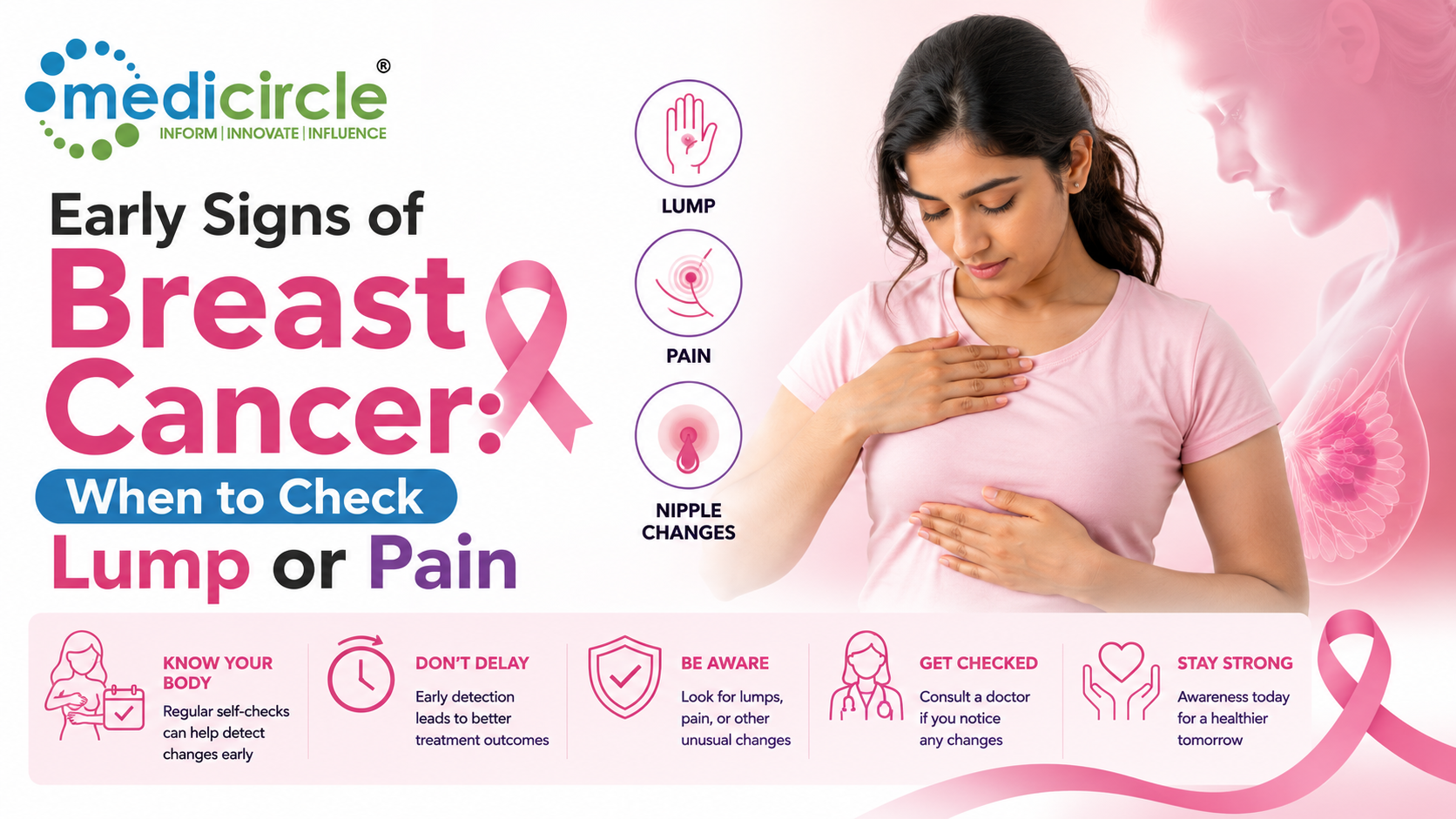
Breast Cancer Awareness: When to Check a Lump or Pain
In many Indian households, conversations around women health are quietly sidelined due to traditional hesitation or social taboos. This silence often leads to minor physical symptoms being ignored until they become major concerns. Today, breast cancer stands as the most frequently diagnosed malignancy among women in both urban cities and rural communities across India. Understanding the early signs of breast cancer is essential for every individual, as early detection completely transforms clinical outcomes.
The most important takeaway for every woman is that a diagnosis does not mean a dead end. When caught in its initial stages, the treatment approach transitions from aggressive crisis management to highly effective, routine care with remarkable recovery statistics. Breast cancer symptoms should be understood rather than feared. Protecting your health is not about living in fear. It is about building a familiar relationship with your body so you can confidently tell the difference between normal monthly fluctuations and signs that need a professional look.
Understanding Breast Cancer Symptoms
A woman body goes through a continuous series of hormonal shifts throughout life. Whether you are navigating your monthly menstrual cycle, going through pregnancy, or entering menopause, your breast tissue naturally reacts to these internal changes. It is entirely normal to feel a bit of generalized tenderness, heaviness, or temporary swelling at various times of the month. Furthermore, naturally dense or fibrocystic tissue can make the breasts feel naturally uneven or textured.
The key to personal health safety lies in identifying a baseline. Normal hormonal changes generally balance out and disappear after your period ends. On the flip side, a symptom that requires immediate investigation is one that stays constant, develops independently of your cycle, or occurs in only one specific area. While most physical irregularities turn out to be completely benign, having an expert clear up any doubts regarding early signs of breast cancer is the best way to safeguard your long-term peace of mind.
Evaluating Breast Cancer Lumps
Discovering an unexpected mass during a self-check or while dressing can feel incredibly startling. However, it is essential to remember that your body can develop various types of tissue irregularities, and the majority of them are not dangerous. Non-cancerous developments, including fluid-filled cysts or smooth fibroadenomas, which are very common in younger women, typically feel soft, distinct, and slide around easily when pressed with your fingers.
Conversely, a malignant breast cancer lump usually possesses a distinct texture and behavior that should prompt you to schedule a medical consultation. Knowing the difference between benign growths and dangerous tumors helps individuals seek timely intervention without experiencing unnecessary delays.
Immovable Tissue Masses
A suspicious breast cancer lump is often characterized by a hard, solid, or stony texture. Instead of moving freely under your touch, it feels firmly fixed to the skin or the underlying chest wall tissue.
Irregular Structural Shapes
Unlike benign cysts that are generally round and smooth, a concerning mass frequently has uneven, rough, or poorly defined borders that feel distinctly jagged.
Underarm Lymph Changes
Because breast tissue naturally extends upward toward the underarms, you should always check the entire region. A firm knot or swelling in the armpit can indicate changes in the lymph nodes, even if the breast itself feels completely normal.
Decoding Breast Pain Signs
One of the most widespread health myths in India is the belief that cancer must hurt. Many women feel a false sense of security when they find a lump that causes no discomfort, thinking that pain is the main indicator of danger. From a clinical standpoint, the reality is quite different.
The earliest stages of breast tumors are almost always completely painless. Mild, aching breast pain, known medically as mastalgia, is incredibly common and usually stems from minor issues like caffeine intake, high stress levels, cyclic hormone shifts, or simply using an unsupportive bra.
With that said, specific patterns of localized breast pain should never be overlooked. If you notice a sharp, burning, or throbbing pain that stays confined to one exact spot and does not fade after your period passes, it is a clear message from your body to seek a professional medical opinion.
Visual Warning Signs
Breast health involves more than just feeling for deep lumps, as visual monitoring is equally vital. Standing in front of a mirror once a month to inspect the surface features of your breasts can reveal subtle changes that might otherwise go unnoticed. Regular inspections allow women to identify abnormalities before they develop into advanced conditions.
|
Visual Category |
Specific Variations to Monitor |
|---|---|
|
Surface Dimpling |
Any new puckering, indentation, or skin texture that begins to look like the rough peel of an orange. |
|
Nipple Inversion |
A nipple that suddenly flattens or pulls inward rather than pointing outward. |
|
Skin Alterations |
Localized redness, peeling, flaking, or a persistent rash directly on the nipple area. |
|
Spontaneous Discharge |
Any fluid leaking from a single nipple without pressure, particularly if it looks clear, watery, or blood-stained. |
Additionally, keep an eye out for any sudden, noticeable asymmetry. While it is perfectly normal for your breasts to be slightly different sizes, a sudden shift in the contour or volume of one side requires an evaluation by a healthcare provider.
Critical Diagnostic Tests
If you ever notice an abnormality, the most crucial first step is to avoid panic and steer clear of alarming, unverified internet searches. Taking a structured, logical path through the healthcare system will give you clarity and direct answers.
- Consult a Qualified Specialist: Make it a priority to see a gynecologist or a surgical oncologist within a couple of days. Be prepared to explain exactly when you noticed the symptom and whether it alters during your menstrual cycle.
- Undergo Precise Diagnostic Imaging: Depending on your age, your doctor will order specific tests. Women under forty years old typically receive a targeted breast ultrasound due to their denser breast tissue, while women over forty years old are referred for a diagnostic mammogram to catch micro-calcifications.
- Proceed with a Medical Biopsy: If the imaging reveals a highly suspicious or ambiguous mass, a specialist will perform a fine-needle or core needle biopsy. This quick procedure collects a tiny sample of cells to be evaluated in a laboratory, providing a definitive answer.
Frequently Asked Questions
- Does wearing an underwired bra increase the risk of developing breast tumors?
No. There is no valid scientific research or clinical data to back up this claim. The idea that tight or underwired bras trap toxins by blocking lymphatic flow is a complete myth.
- Are the majority of newly discovered breast lumps dangerous?
No, quite the opposite. Medical records indicate that over eighty percent of all breast lumps evaluated by clinicians are entirely non-cancerous. Common benign conditions include simple cysts, localized tissue infections, and hormonal fibroadenomas.
- When should a woman in India begin scheduling regular mammogram screenings?
Standard Indian medical protocols suggest that women with an average risk profile should begin routine screening mammograms every one to two years starting at age forty. If you have a family history of breast health challenges, discuss an earlier testing schedule with your physician.
- What is the ideal time of the month to perform a breast self-examination?
For women who are still menstruating, the best window to perform a breast self-examination is roughly three to five days after your period ends. This is when your hormone levels drop, making the breast tissue naturally softer and much easier to examine accurately.
Power of Awareness
Navigating today healthcare environment relies heavily on finding trustworthy, expert-vetted educational resources. For the modern Indian audience, shedding the old social hesitation around oncology and proactive care is a powerful step toward a healthier life. Digital platforms like Medicircle play an invaluable role by cutting through medical jargon and delivering clear, accessible guidance that helps readers take charge of their own medical journeys.
Spotting an unusual change in your body is not a reason to assume the worst. It is simply a reminder to prioritize yourself. By performing quick monthly self-checks, speaking openly with your family, and scheduling timely clinical consultations, you protect your long-term wellness. Being proactive saves lives, simplifies treatment choices, and brings lasting peace of mind to you and your family.





-23-300x250.png)

.jpeg)

.jpg)
.jpg)
.jpg)
.jpg)
.jpg)
.jpg)
.jpg)
.jpg)
.jpg)