Monday, November 16, 2026
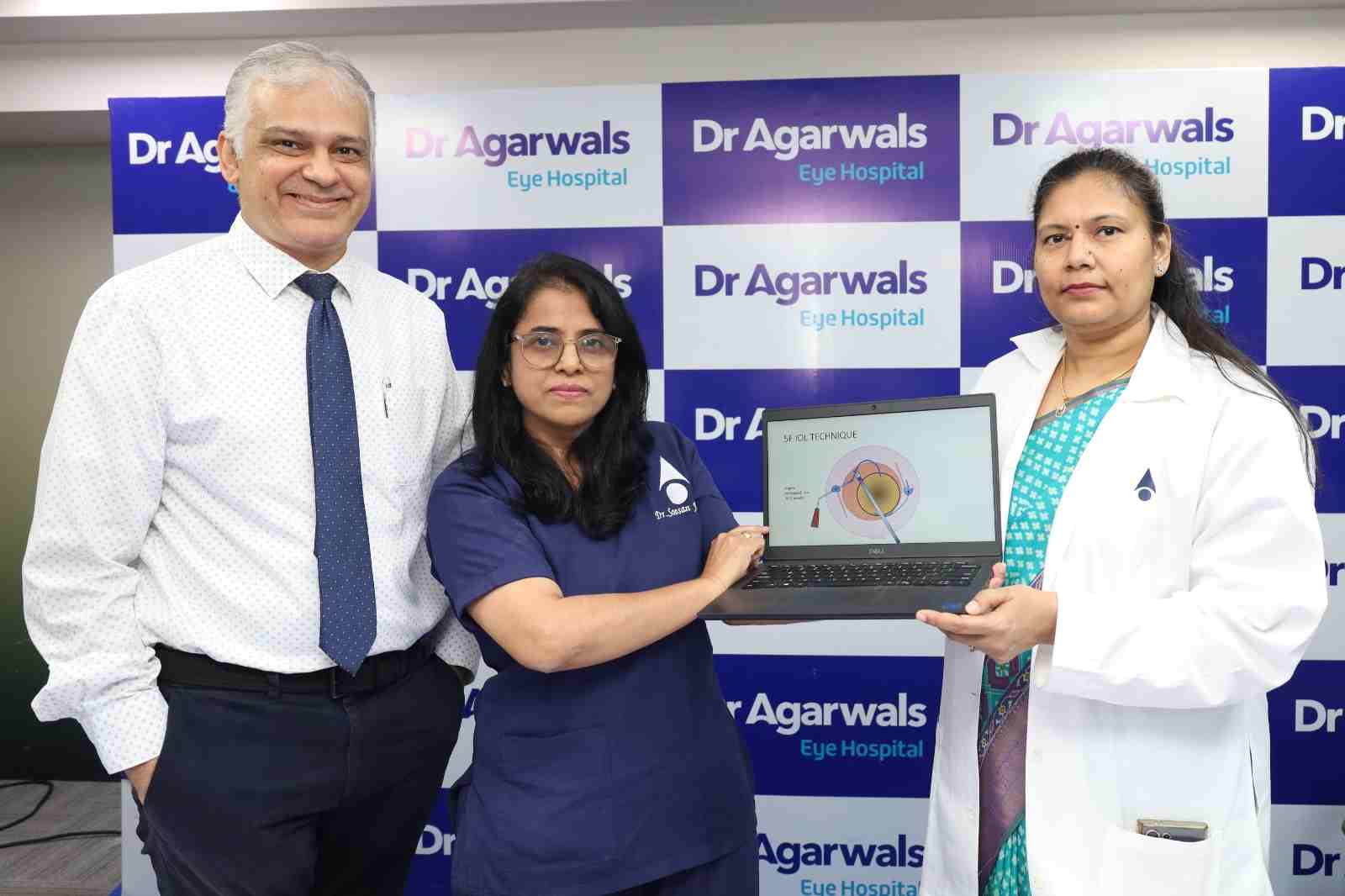
 The hospital performed 5F-ISHF, an advanced IOL implantation technique, along with optical penetrating keratoplasty and structural reconstruction, in a single sitting.





Chennai, February 18, 2026: Dr Agarwals Eye Hospital restored vision to a 44-year-old gynaecologist from Mumbai who had become completely blind in both eyes after ten years of progressive vision loss caused by severe glaucoma and multiple refractory intraocular pathologies, none of which had responded to the several surgeries she had previously undergone.
In a complex, first-of-its-kind surgical intervention in the world, the surgical team performed the advanced 5F-ISHF IOL implantation technique on the patient, to remove a malpositioned artificial intraocular lens (IOL) in her left eye, along with optical penetrating keratoplasty (OPK), the novel 5F scleral fixation technique , and pupilloplasty in a single sitting to address her complex ocular complications.
The patient regained 6/24 vision in her left eye immediately after surgery, a life-changing recovery that enabled her to return to her medical practice. She is further highly likely to gain even more improvement in her vision as the eye heals more after the surgery.
The patient had a history of severe glaucoma, but the immediate cause of her profound vision loss was a malpositioned intraocular lens (IOL) in the left eye that was pressing against the iris and cornea and distorting the eye’s anatomy. This resulted in the front layers of the eye getting fused with each other. The faulty lens was removed and replaced with a new, properly positioned IOL placed using the 5F technique. The accompanying specialised procedures addressed the refractory complications and reconstructed the severely damaged ocular structures, ultimately restoring functional vision.
The press conference was addressed by Dr Soosan Jacob, Director and Chief – Dr Agarwal’s Refractive and Cornea Foundation (DARCF), Dr Soundari S , Regional Head – Clinical Services, Chennai, and Dr Manoj Khatri, Clinical Lead and Head, Department of Vitreo Retina.
In his comments, Dr Ashvin Agarwal, Chief Clinical Officer & Senior Ophthalmologist, said, “It is truly heartening to see this young medical professional return to her practice after years of suffering and progressive vision loss. This was an exceptionally complex case. The complexity and severity of her condition required multiple surgical approaches delivered in a seamless manner. This included extensive reconstruction of the distorted ocular anatomy, the use of the advanced 5F-ISHF technique to securely fix a new intraocular lens, and pupilloplasty. Addressing only one dimension of the problem would not have enabled her to regain functional vision in her left eye. It was the combined expertise, infrastructure, and surgical capability of our team that allowed us to provide a long-lasting solution.”
In her comments, Dr. Soosan Jacob, Director and Chief - Dr Agarwal’s Refractive and Cornea Foundation (DARCF), who performed the surgery, said, “The patient was diagnosed with glaucoma in 2010 and had been undergoing treatment elsewhere for over a decade. Despite sustained care, including cataract surgery, trabeculectomy, and Mitomycin-C therapy, her vision had continued to deteriorate, eventually leading to total vision loss in the right eye and near blindness in the left. When she presented to us, she had only perception of light and projection of rays in her left eye. While she had a history of severe glaucoma, we identified that the immediate cause of her profound visual loss was a malpositioned artificial intraocular lens in the left eye. We therefore adopted a comprehensive approach, removing the faulty IOL, reconstructing the compromised ocular structures, and implanting a new lens using the 5F-ISHF technique.”
The 5F-ISHF technique, developed by Dr. Soosan Jacob, is a precise method for securely placing a new intraocular lens without stitches or large incisions. Instead, the lens is fully tucked inside the eye’s structure, ensuring a stable, flapless fixation. This approach offers patients a safer, easier and more stable solution even in the most complex cases.





-23-300x250.png)