70% of India’s Active Caseload from Maharashtra, Kerala, Delhi, Rajasthan, Uttar Pradesh, Karnataka, West Bengal, and Chhattisgarh


Deprecated: strlen(): Passing null to parameter #1 ($string) of type string is deprecated in /home/medicircle/public_html/script_newsdetails.php on line 75
▴ 70% of India’s Active Caseload from Maharashtra, Kerala, Delhi, Rajasthan, Uttar Pradesh, Karnataka, West Bengal, and Chhattisgarh
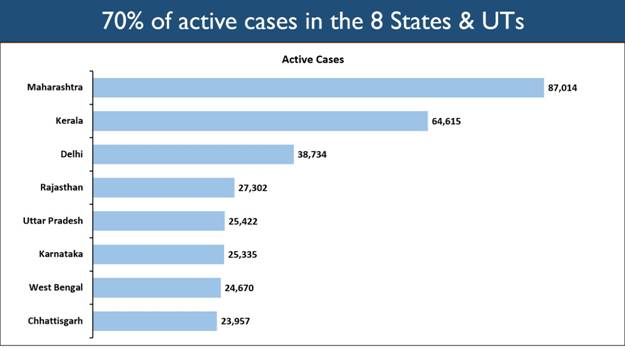
About 70% (69.59%) of the total Active Cases is contributed by eight States/UT i.e. Maharashtra, Kerala, Delhi, Rajasthan, Uttar Pradesh, Karnataka, West Bengal, and Chhattisgarh.

The Active Caseload of India stands at 4,55,555 today The present contribution of Active Caseload to India’s total positive cases is 4.89%.

About 70% (69.59%) of the total Active Cases is contributed by eight States/UT i.e. Maharashtra, Kerala, Delhi, Rajasthan, Uttar Pradesh, Karnataka, West Bengal, and Chhattisgarh.  

Maharashtra leads the tally with 87,014 total active COVID cases, as of today. Kerala has recorded 64,615 active cases, while Delhi follows with 38,734 total active cases.
WhatsApp Image 2020-11-27 at 10.26.59 AM.jpeg

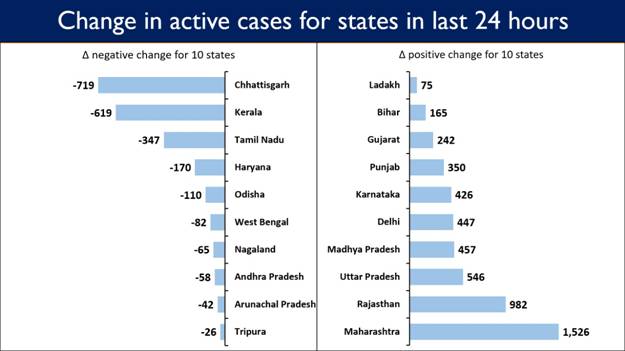
The change in active cases for the States/UTs in the last 24 hours is in the figure given below.

Maharashtra recorded the maximum positive change with the addition of 1,526 cases whereas Chhattisgarh recorded the maximum negative change with a decrease of 719 active cases.
WhatsApp Image 2020-11-27 at 10.35.45 AM (1).jpeg

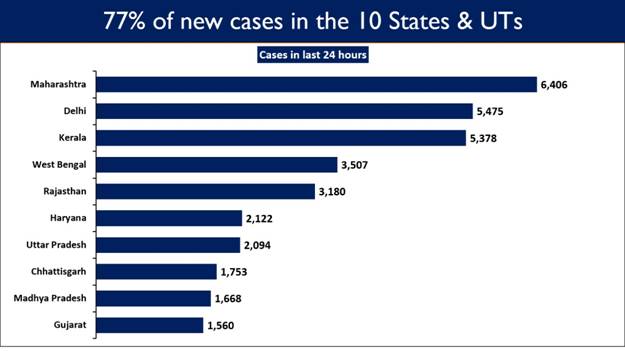
43,082 new confirmed COVID cases have been registered in the last 24 hours in the country.

Of these, 76.93% is contributed by ten States/UTs.

Maharashtra leads the tally with 6,406 new COVID cases. Delhi has reported 5,475 new cases, while Kerala registered another 5,378 new cases in the last 24 hours.
WhatsApp Image 2020-11-27 at 10.16.48 AM.jpeg

Total recovered cases in India have crossed 87 lakhs (87,18,517). The national recovery rate stands at 93.65% today.

39,379 recoveries have been registered in the last 24 hours in the country.

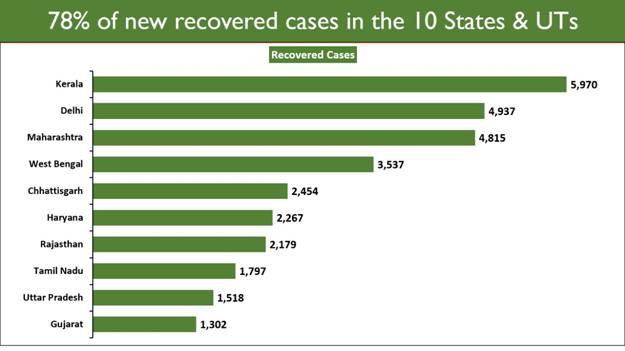
78.15% of the new recovered cases are observed to be concentrated in 10 States/UTs.

Kerala has reported the maximum number of single-day recoveries with 5,970 newly discharged cases. 4,937 people recovered in Delhi followed by 4,815 in Maharashtra.
WhatsApp Image 2020-11-27 at 10.16.49 AM (1).jpeg

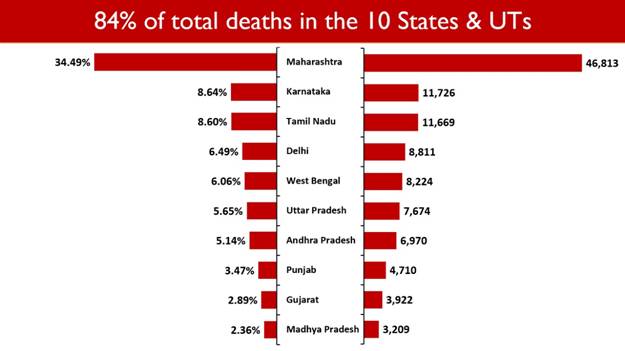
83.80% of the total deaths are concentrated in 10 States/UT viz Maharashtra, Karnataka, Tamil Nadu, Delhi, West Bengal, Uttar Pradesh, Andhra Pradesh, Punjab, Gujarat, and Madhya Pradesh.

Maharashtra contributes a maximum (34.49%) to the total deaths with 46,813 deaths till now.
WhatsApp Image 2020-11-27 at 10.19.10 AM.jpeg


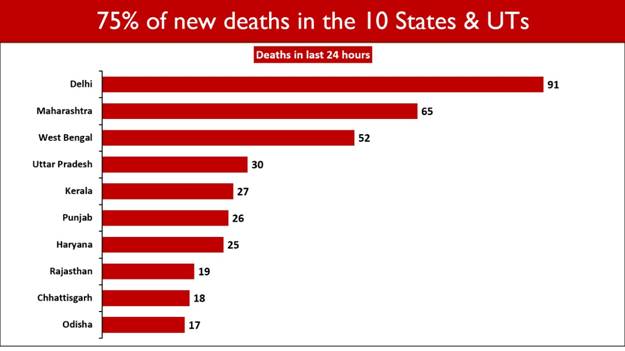
75.20% of the 492 case fatalities reported in the past 24 hours are concentrated in ten States/UTs.

Delhi with 91 deaths reported the maximum new fatalities. Maharashtra saw a fatality count of 65 followed by West Bengal with 52 deaths.

WhatsApp Image 2020-11-27 at 10.16.49 AM.jpeg

Tags : #India #Delhi #Maharashtra #Kerala #Rajasthan #UttarPradesh #Karnataka #WestBengal #Chhattisgarh #Covid19Cases #ActiveCovid19Casehold #CoronaVirus #Covid19Updates

Related Stories

Loading Please wait...

-Advertisements-


Trending Now

Why Modern Lifestyle Causes Chronic InflammationAugust 05, 2026
Endometriosis Awareness: Understanding the Silent Condition Affecting Millions of Indian WomenAugust 05, 2026
A Complete Guide to Pregnancy Health Tips for Indian Women: Nutrition, Wellness, and What Every Expectant Mother Should KnowAugust 05, 2026
Why Preventive Healthcare for Children Is One of the Most Important Investments India Can MakeAugust 04, 2026
The Role of Pathology in Healthcare: From Diagnosis to Disease PreventionAugust 04, 2026
Pathophysiology of Psoriatic Arthritis: Clinical Presentation, Joint Damage Mitigation, and BiologicsAugust 04, 2026
Comprehensive Evaluation of Syncope: Cardiac vs. Neurological Origin WorkupsAugust 04, 2026
Common Medical Terms Explained: A Plain-Language Guide for Indian Patients and Healthcare SeekersAugust 03, 2026
Why Radiology Is the Backbone of Modern Medical Diagnosis and TreatmentAugust 03, 2026
Managing Urban Stress: Science-Backed Strategies for Mental Resilience in 2026 August 01, 2026
Managing Chronic Inflammation: The Role of Anti-Inflammatory Indian SuperfoodsAugust 01, 2026
Pathophysiology of Psoriatic Arthritis: Clinical Presentation, Joint Damage Mitigation, and BiologicsAugust 01, 2026
Early Markers of Glaucoma: Structural vs. Functional Ophthalmic Diagnostic ProtocolsAugust 01, 2026
Managing Complex Diabetic Foot Ulcers: Multidisciplinary Wound Care, Offloading, and RevascularizationAugust 01, 2026
The Future of Preventive Medicine: How India Is Moving From Cure to PreventionAugust 01, 2026
Why Young Indians Are Facing Heart Problems: Causes, Symptoms, and PreventionAugust 01, 2026
The Future of Preventive Screening: AI-Driven Early Cancer Detection in IndiaJuly 31, 2026
The Impact of Climate Change on Allergic Respiratory Diseases in Indian Cities July 31, 2026
Electronic Medical Records: What They Are, Why They Matter, and How India Is Embracing ThemJuly 31, 2026
Heatwave Health Risks in India: Symptoms, Treatment, and Prevention StrategiesJuly 31, 2026