 Friday, November 20, 2026
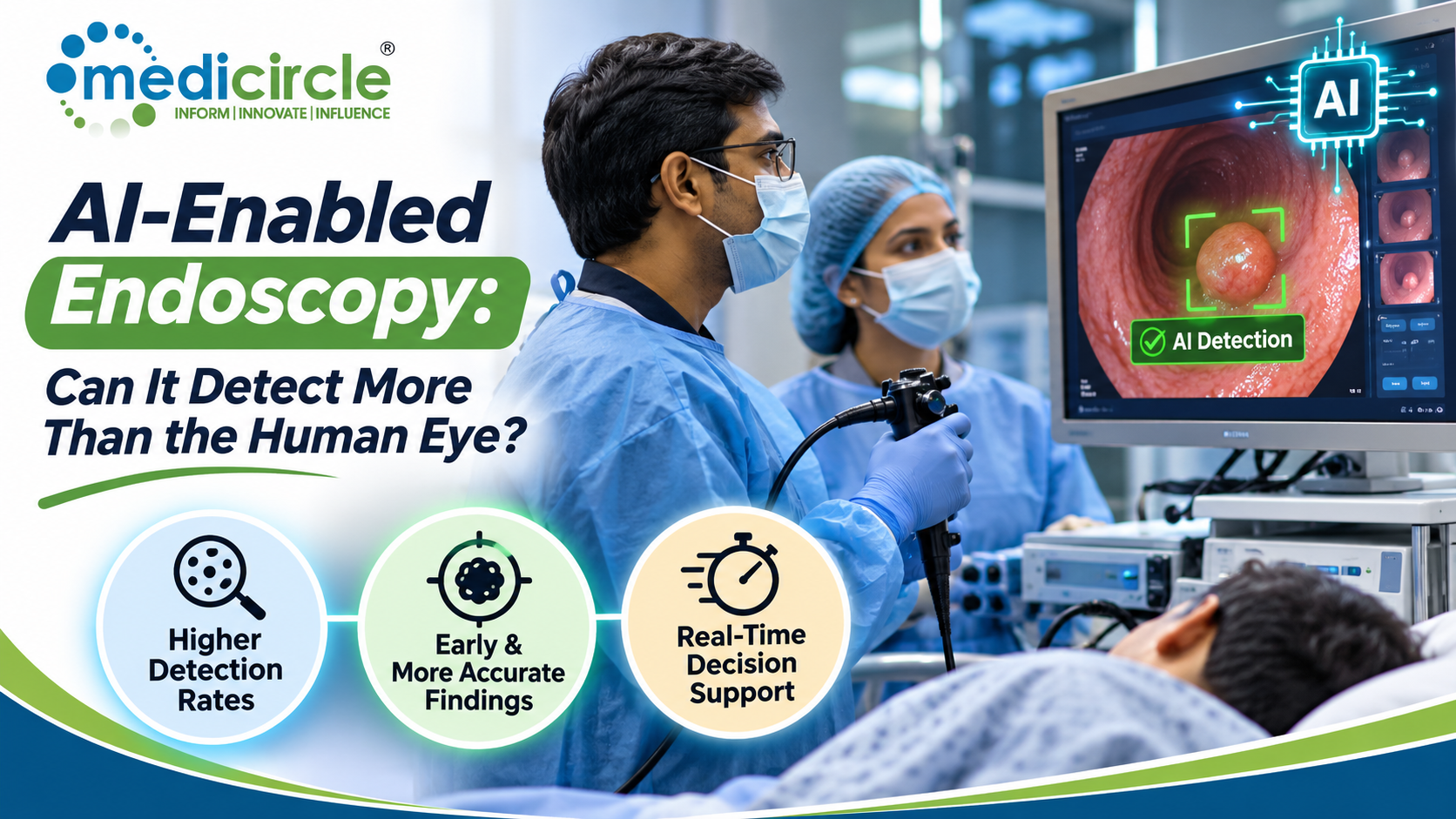
 AI-enabled endoscopy uses real-time machine learning to assist gastroenterologists in detecting polyps, early cancers, and gastrointestinal lesions that conventional human examination might miss.





Introduction
Gastrointestinal cancers remain among the leading causes of cancer-related deaths in India. Colorectal cancer, gastric cancer, and oesophageal cancer collectively affect hundreds of thousands of Indians every year, and the most troubling aspect is that a large proportion of these cases are detected only at advanced stages. The reason is not always a lack of medical facilities. Often, it is a limitation in the human ability to identify subtle, early-stage abnormalities during endoscopic examinations.
Endoscopy has long been the gold standard for examining the inner lining of the gastrointestinal tract. A skilled gastroenterologist can identify polyps, ulcers, tumours, and other abnormalities through a camera-guided tube. However, even experienced endoscopists can miss small or flat lesions, particularly during long procedures or high-volume clinical settings. Studies have consistently shown that adenoma miss rates during colonoscopy can be as high as 20 to 25 percent under standard conditions.
This is exactly where artificial intelligence is stepping in. AI-enabled endoscopy systems are now being designed, validated, and gradually deployed to assist doctors in detecting what the human eye might overlook. For a country like India, where the burden of gastrointestinal disease is immense and where endoscopy volumes at tertiary hospitals can be extraordinarily high, this technology carries enormous implications.
Understanding AI-Enabled Endoscopy: How Does It Work?
AI-enabled endoscopy refers to the integration of machine learning algorithms, particularly deep learning models trained on large datasets of endoscopic images, into the standard endoscopy workflow. These systems work in real time, analysing each frame captured by the endoscope camera as the procedure is ongoing.
The AI model has been trained on thousands or even millions of annotated endoscopic images. It learns to recognise visual patterns associated with polyps, dysplastic lesions, early-stage cancers, Helicobacter pylori infection, Barrett's oesophagus, and other pathological features. When the system identifies a suspicious area during a live procedure, it alerts the gastroenterologist immediately, often with a visual overlay or a bounding box highlighting the region of concern.
The core technology behind most of these systems is a convolutional neural network architecture, which is especially suited to image recognition tasks. Some newer systems also incorporate transformer-based models that can process contextual information across multiple frames, improving the detection of subtle or transient abnormalities.
There are broadly two types of AI assistance in endoscopy:
- Computer-Aided Detection (CADe): This system identifies and flags suspicious lesions in real time, alerting the physician to look more closely at a particular area.
- Computer-Aided Diagnosis (CADx): This system goes a step further by analysing the flagged area and providing a characterisation of the lesion, such as whether a polyp is likely to be adenomatous or hyperplastic, which influences the clinical decision on whether to remove it immediately or monitor it.
Both systems are designed to function as decision-support tools, not as replacements for the endoscopist's clinical judgment.
Why the Human Eye Has Limitations in Endoscopy
To appreciate the value of AI assistance, it is important to understand why human endoscopists miss lesions in the first place. This is not a matter of incompetence. It is a physiological and cognitive reality.
The gastrointestinal tract is a complex, dynamic environment. The bowel wall folds and moves constantly. Lesions can be flat, pale, or hidden behind haustral folds. The difference between a small adenoma and normal mucosal tissue can be visually subtle. During a colonoscopy, the endoscopist examines the colon on the way in and on the way out, often covering several metres of bowel within a 20 to 30 minute procedure. Fatigue, distraction, variable bowel preparation quality, and procedure volume all compound the challenge.
A study published in the journal Gastrointestinal Endoscopy reported that adenoma detection rates vary significantly between endoscopists, ranging from less than 10 percent to over 40 percent even in the same clinical setting. This variability is itself evidence that human perception alone is not a reliably consistent standard for a procedure as consequential as colorectal cancer screening.
AI does not get tired. It does not get distracted. It analyses every frame with the same level of attention regardless of whether it is the first procedure of the day or the twentieth.
Clinical Evidence: What Research Shows About AI Detection Performance
The clinical evidence supporting AI-enabled endoscopy has grown significantly over the past five years. Multiple randomised controlled trials and large-scale prospective studies have evaluated AI-assisted colonoscopy against standard colonoscopy, and the findings have been consistently encouraging.
A landmark multicentre randomised controlled trial published in The Lancet found that AI-assisted colonoscopy increased adenoma detection rates by approximately 14 percent compared to standard colonoscopy. The AI system used in this trial was particularly effective at identifying small and flat adenomas, which are the category most frequently missed during conventional procedures.
Research on AI-assisted upper gastrointestinal endoscopy has also demonstrated meaningful improvements. Studies from China and Japan, where gastric cancer incidence is high, have shown that AI systems can identify early-stage gastric cancer with sensitivity rates exceeding 90 percent in some evaluations. For Barrett's oesophagus surveillance, AI tools have demonstrated accuracy comparable to that of expert endoscopists reviewing high-definition images.
It is important to note that in most of these trials, AI did not replace the endoscopist. It worked alongside the physician, and the combination of human expertise and AI alert systems consistently outperformed either one working alone.
AI-Enabled Endoscopy in the Indian Context
India's gastrointestinal disease burden is substantial. Colorectal cancer incidence is rising, particularly in urban populations with changing dietary patterns. Gastric cancer remains prevalent in several states. Oesophageal cancer clusters are observed in specific geographic regions linked to dietary and tobacco habits. At the same time, early detection rates remain inadequate, partly because of limited access to specialist endoscopy services and partly because high procedure volumes at public hospitals stretch the diagnostic attention of even the most skilled gastroenterologists.
The adoption of AI-enabled endoscopy in India is still at an early stage. A handful of leading private hospital chains and medical institutions in cities such as Mumbai, Delhi, Bengaluru, and Hyderabad have begun piloting or deploying AI-assisted colonoscopy systems. However, widespread adoption faces several challenges:
- Cost of AI-integrated endoscopy equipment, which remains high relative to standard systems
- Need for large, annotated Indian gastrointestinal image datasets to train and validate AI models for Indian pathology patterns
- Training requirements for gastroenterologists and endoscopy nurses to work effectively with AI-assisted systems
- Integration challenges with existing hospital information systems and endoscopy reporting platforms
- Regulatory clarity from the Central Drugs Standard Control Organisation (CDSCO) on the classification and approval pathway for AI-based medical devices
Despite these challenges, the direction of movement is clear. Several Indian healthtech companies and medical device startups are actively developing AI tools for endoscopy. Additionally, international manufacturers who have already received regulatory clearance in the United States, Europe, and Japan are exploring the Indian market.
The government's push through the Ayushman Bharat Digital Mission and the broader National Medical Devices Policy 2023 creates a policy environment that could support the eventual scaling of AI-based diagnostic technologies across public and private healthcare settings.
Impact on Patient Outcomes and Healthcare Quality
The ultimate measure of any diagnostic technology is its impact on patient outcomes. For AI-enabled endoscopy, the pathway from better detection to better outcomes is relatively direct.
When polyps are detected and removed before they progress to invasive cancer, the patient avoids a life-threatening disease. When early-stage gastric or colorectal cancer is identified, treatment options are broader, less invasive, more effective, and less expensive. When Barrett's oesophagus is caught during surveillance, oesophageal adenocarcinoma can often be prevented through endoscopic ablation rather than major surgery.
The health economics are also compelling. Treating early-stage colorectal cancer costs a fraction of what late-stage treatment requires. In a resource-constrained healthcare system like India's, reducing the burden of late-stage cancer presentations through improved early detection has both clinical and economic value.
Beyond cancer, AI-enabled endoscopy is showing promise in improving the detection of non-cancerous but clinically significant conditions such as coeliac disease, inflammatory bowel disease, and Helicobacter pylori-associated gastritis. Each of these conditions, if identified early and accurately, benefits from timely treatment that reduces long-term complications.
The Ethical and Regulatory Dimension
Integrating AI into clinical medicine always raises questions of accountability, transparency, and patient consent. If an AI system misses a lesion that a human endoscopist might have caught, who bears the responsibility? If an AI system flags an area as suspicious and the physician disagrees, whose judgment prevails?
These are not hypothetical concerns. They are active discussions within the global gastroenterology community and among medical regulatory authorities. In India, the CDSCO's draft Digital Health Guidelines and the evolving medical device regulatory framework will need to address these questions as AI-based endoscopy systems seek market approval.
The consensus emerging from international gastroenterology bodies is that AI should be positioned as a support tool, not an autonomous decision-maker. The physician retains full clinical and legal responsibility for the procedure and its outcomes. AI provides an additional layer of vigilance, not a substitution for human expertise.
Transparency with patients is also important. Patients undergoing AI-assisted endoscopy should be informed that an AI system is part of the procedure, just as they would be informed about any other aspect of their care.
Conclusion
AI-enabled endoscopy represents a meaningful and evidence-backed advancement in gastrointestinal diagnostics. The technology addresses a real and documented limitation in human endoscopic performance, and it does so not by replacing physicians but by augmenting their capabilities at a critical decision point. For India, where gastrointestinal cancers are caught too late far too often, the potential of AI-assisted endoscopy to shift the curve toward earlier detection is both clinically significant and deeply important.
The path to widespread adoption requires investment, regulation, training, and the development of India-specific datasets and validation studies. These are achievable goals. What matters is that the medical community, healthcare institutions, policymakers, and technology developers approach this transition with the rigour and responsibility that patient safety demands.
Platforms like Medicircle play a role in this transition by ensuring that accurate, balanced, and expert-informed content about emerging medical technologies reaches both healthcare professionals and the broader public. Awareness is the first step toward informed adoption, and informed adoption is the foundation of safe and effective healthcare innovation.
Frequently Asked Questions
Q1: What is AI-enabled endoscopy and how is it different from standard endoscopy?
AI-enabled endoscopy uses machine learning algorithms to analyse endoscopic images in real time during a procedure. Unlike standard endoscopy, where detection depends entirely on the physician's visual assessment, AI-assisted systems continuously scan each frame for suspicious lesions and alert the endoscopist immediately. The procedure itself is the same, but AI adds an additional layer of detection support.
Q2: Can AI replace a gastroenterologist during an endoscopy procedure?
No. AI-enabled endoscopy systems are designed as decision-support tools, not autonomous systems. The gastroenterologist performs the procedure, makes all clinical decisions, and bears full responsibility for patient care. AI functions as an alert mechanism that flags areas of potential concern for the physician to evaluate.
Q3: Has AI-enabled endoscopy been proven to improve polyp detection rates?
Yes. Multiple randomised controlled trials, including a multicentre study published in The Lancet, have demonstrated that AI-assisted colonoscopy significantly improves adenoma detection rates compared to standard colonoscopy, with the greatest benefit seen for small and flat polyps that are most easily missed.
Q4: Is AI-enabled endoscopy available in India?
AI-assisted endoscopy is currently available at select tertiary care hospitals and leading private healthcare institutions in major Indian cities. Widespread adoption is still in progress, with ongoing work needed in areas of regulatory approval, cost accessibility, and training for clinical teams.
Q5: What types of conditions can AI detect during endoscopy?
AI systems in endoscopy have been evaluated for detection of colorectal polyps and adenomas, early-stage gastric cancer, Barrett's oesophagus, Helicobacter pylori-associated changes, oesophageal abnormalities, and markers of inflammatory bowel disease. The scope of AI detection continues to expand as more specialised models are developed and validated.
Resources
- World Health Organization (WHO): Global Cancer Observatory data on gastrointestinal cancers, including incidence and mortality statistics for India.
- Indian Council of Medical Research (ICMR): Guidelines and national cancer registry reports relevant to colorectal and gastric cancer in India.
- PubMed, National Library of Medicine: Peer-reviewed studies and randomised controlled trials on AI-assisted colonoscopy and upper gastrointestinal endoscopy performance.
- Central Drugs Standard Control Organisation (CDSCO): Regulatory framework and guidelines for medical devices including AI-based diagnostic systems in India.
- American Society for Gastrointestinal Endoscopy (ASGE): Position statements and technology assessments on computer-aided detection and diagnosis in endoscopy.
Interlinking Keywords
AI in gastroenterology, computer-aided colonoscopy, early detection of colorectal cancer, gastrointestinal cancer India, AI medical diagnostics, polyp detection technology, endoscopy innovations India, Barrett's oesophagus screening, AI healthcare India, MedTech India
Last reviewed by:
Dr. Manthan Tripathi, Medicircle Editorial and Medical Advisory Team on 19, November 2026.
Disclaimer
This article is intended for general informational and educational purposes only. It does not constitute medical advice, diagnosis, or treatment. Readers should consult a qualified and registered medical professional for any health-related concerns or before making any decisions regarding medical procedures or treatments. Medicircle does not endorse any specific product, device, or clinical service mentioned in this article.





-23-300x250.png)