 Wednesday, October 28, 2026
 A 37-year-old Bengaluru IT professional, quadriparetic and bedridden, returned from the US to India for complex skull-spine surgery after doctors abroad warned of lifelong weakness and ventilator dependency.




👉 Order now at BestCheapPills and discover exclusive discounts for registeredcustomers!
Bengaluru, 28th August 2025: In a case that truly showcased the technological advancements achieved by Bangalore, India in the field of Neuroscience, Niyati (name changed), a 37-year-old young IT Professional from Bengaluru working at US decided to head home for a complex surgery at the junction on base of the skull and upper part of the spine. She was Quadriparetic, which made her bedridden with complete loss of the ability to walk, use her hands or even control urination. When she consulted the neurosurgical center at the US, she was informed that due to the complexity of the surgery she might end up permanently weak in all four limbs and might even need ventilator support for breathing. This had shattered her self-confidence and increased the burden on her family.
6 months before, she noticed the first symptoms, which started with numbness in the limbs and muscle weakness that eventually progressed to quadriparesis. She was diagnosed with Atlantoaxial Dislocation after she moved to India for her treatment, which is basically loss of stability between the two topmost bones of the vertebrae. This condition usually arises due to a congenital deformity, which leads to the compression of the spinal cord that in turn results in neurological problems - culminating into quadriparesis in her case.
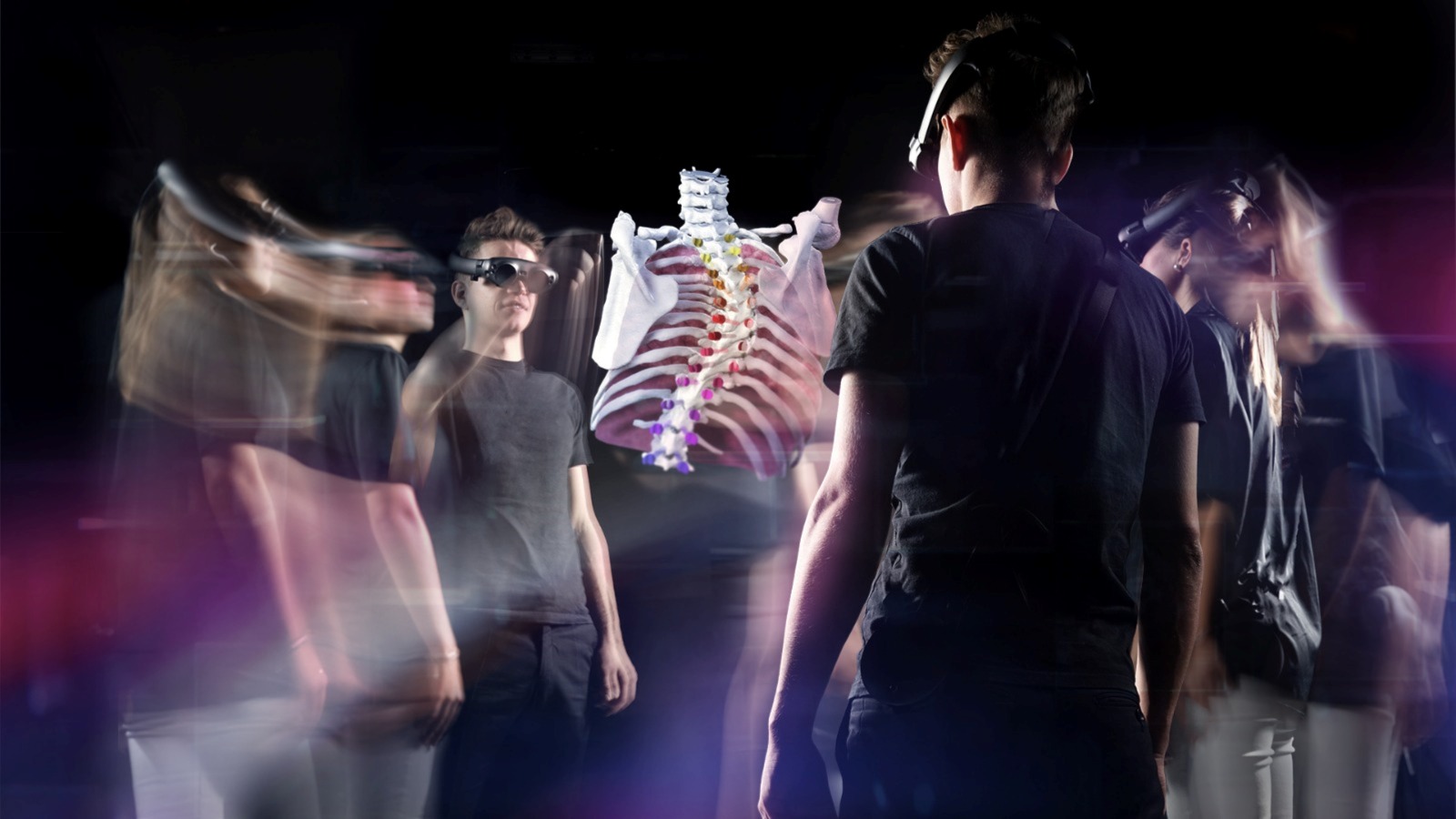
Since both bones are placed in a very complicated position, extremely close to the brain stem, it was imperative to gain a clear idea of where and how to operate. The treatment of such complex disorders requires expertise and technology. Technology played a very significant role at this juncture by providing the doctors with clear images that enabled them to plan the surgery in detail. In one-of-its kind situation, the surgical team at Aster Whitfield Hospital utilized Mixed Reality (Augmented Reality + Virtual Reality) to precisely measure the severity of the compression of the brain stem and spinal cord junction, identified bony compressive elements and to locate the vertebral artery in relation to the bones, understand the anatomy of dislocated bone and also rehearse the surgery first.
Mixed Reality (MR), which blends Augmented and Virtual Reality, provides 3D, immersive visualization of the spine with much greater depth perception and spatial awareness than traditional 2D imaging. It enables physicians to examine complex spinal anatomy, plan operations with precision, and diagnose deformities, fractures, and tumors more accurately. Going beyond assisting surgeons, MR also assists patients and families in understanding complicated conditions and procedures better, decreasing fear and enabling informed decision-making.
“Mixed Reality (Augmented Reality + Virtual Reality) greatly helped us to identify the exact position of the arteries to operate on. It also enabled us to anticipate any problems or complications we might face on the table and to prepare for it better.”, said Dr. Ramachandran G, Consultant – Spine & Deformity Surgeon, Aster Whitefield Hospital, Bengaluru. “It provided clear images of the spinal structures that improved our precision and led to a successful outcome.”
The surgery went on for 5 hours which included repositioning of the displaced bones carefully to achieve normal alignment and stability of the spine along with releasing the contracted tissues surrounding the brainstem and vertebral artery that had compressed or tightened. This allowed for better circulation and a reduction in the risk of neurological disorders as well. However, the procedure presented several challenges. Mid-operation bleeding was meticulously managed by the doctors, while neural damage was mitigated through intraoperative neuromonitoring. The surgical team headed by Prof. Dr Satish Rudrappa, Group Director – Aster International Institute of Neurosciences and Spine Care and Dr Ramachandran Govindasamy, Consultant – Spine & Deformity Surgeon at Aster Whitefield Hospital.
“The surgical screws were fed in to intraoperative navigation and the screw trajectories were guided by us to achieve precision. In addition to helping us, Mixed Reality (Augmented Reality + Virtual Reality) assisted the patient and her family to understand the condition as well. It made understanding the problem and surgical procedure easier through holographic imaging which made them trust the process and agree to the surgery faster. This innovative approach allowed for precise navigation and execution of the surgery, leading to a successful outcome.”, said Prof. Dr. Satish Rudrappa, Group Director – Aster International Institute of Neurosciences and Spine Care, Aster Whitefield Hospital, Bengaluru.
Microsurgery, constant intraoperative neurological monitoring and precise postoperative care enabled the patient to attain good neurorehabilitation and be up by the very next day. She could even walk back home in less than 10 days from the surgery. Niyati has resumed her life in the U.S with no further complications. Her story is a testament of how cutting-edge technology and medical advancements can transform lives as well as establish India as a leader in the healthcare industry.





-23-300x250.png)

.jpeg)






.jpg)
.jpg)
.jpg)
.jpg)
.jpg)
.jpg)
.jpg)
.jpg)
.jpg)

