 Saturday, November 21, 2026
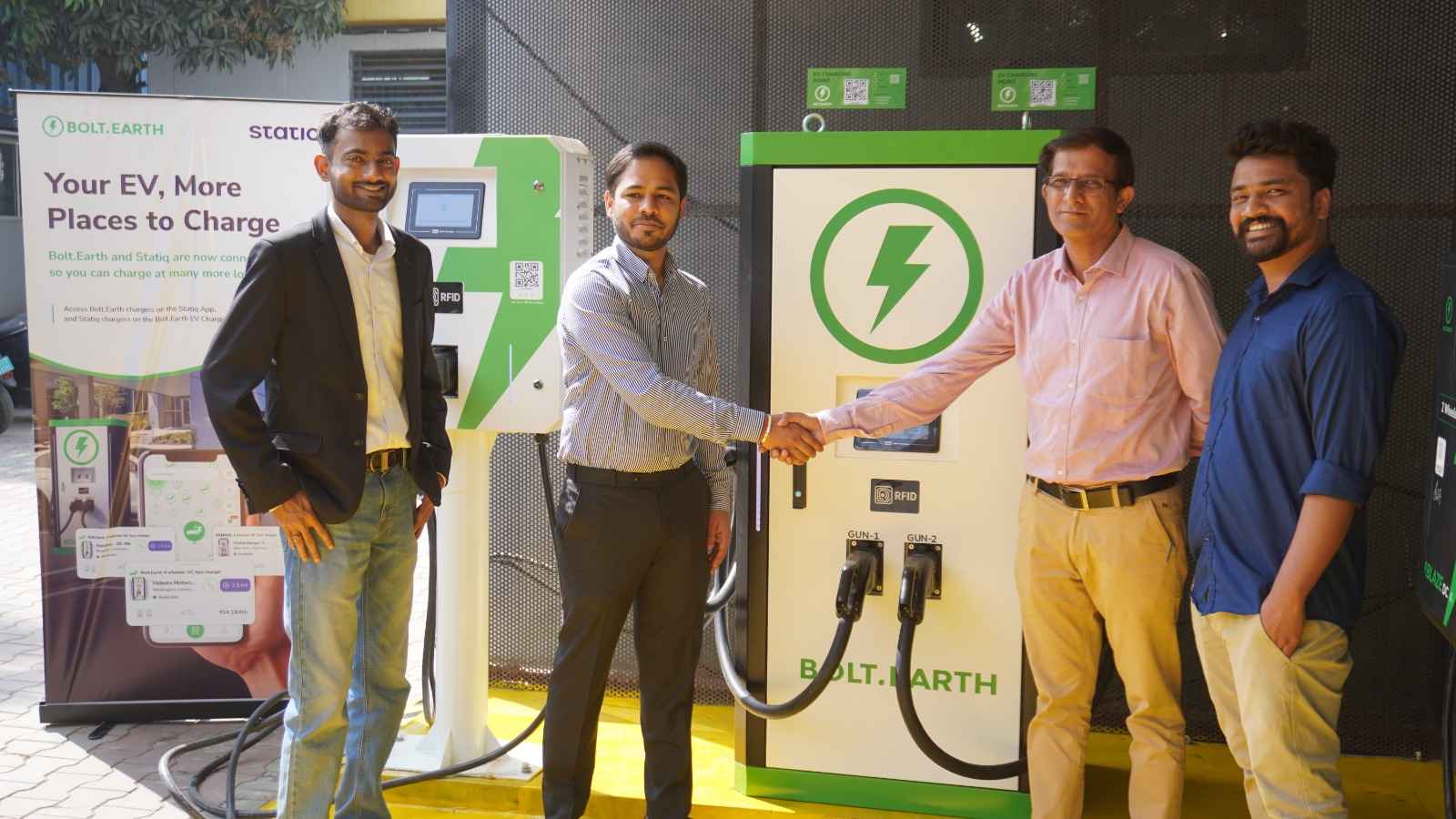
 By integrating Statiq’s fast-charging infrastructure with Bolt.Earth’s universal charging platform, the collaboration offers EV users access to a large and growing network of four-wheeler fast-charging (DC) locations across key cities and corridors in India.





Hyderabad, January 9th, 2026: Bolt.Earth, India’s largest peer-to-peer (P2P) EV charging network, and Statiq, India’s fastest-growing EV charging network, which offers both AC & high-speed DC fast-charging for four-wheelers, today announced a strategic partnership to enhance nationwide EV charging access. The collaboration enables a seamless and interoperable experience, giving four-wheeler users more fast-charging options across the country.
Through this partnership, EV drivers can locate, access, and pay for chargers across both Bolt.Earth and Statiq networks directly within either app, making charging more convenient and universally accessible.
By integrating Statiq’s extensive four-wheeler fast-charging (DC) infrastructure with Bolt.Earth’s universal charging platform, the partnership expands access to a growing network of high-speed charging locations across key cities and highways in India. This delivers a smoother, more reliable charging experience for EV users nationwide.
Statiq operates one of India’s largest and fastest-growing EV charging networks, offering both AC and high-speed DC fast-charging solutions for four-wheelers. With a strong presence across major cities, highways, and commercial hubs, Statiq enables reliable urban and intercity charging, helping EV drivers travel with greater confidence and reduced range anxiety.
Speaking on the partnership, Akshit Bansal, Founder & CEO, Statiq, said, “At Statiq, our vision has always been to make public charging simple, reliable and widely accessible. Partnering with Bolt.Earth enables us to connect two strong networks and providing EV drivers with more fast-charging options through a seamless experience. By reducing the need for multiple apps and bringing more chargers onto a unified journey, we’re taking a meaningful step towards an open, interoperable charging ecosystem that supports faster EV adoption across India.”
The partnership also focuses on solving key user challenges. EV drivers will benefit from a seamless experience, with access to a wider network of chargers through a single app, supported by integrated payments and real-time charging updates.
Bolt.Earth brings a universal charging platform to the collaboration, serving users of two-wheelers, three-wheelers, and four-wheelers. Its network spans 1,900+ cities across India, ranging from standard chargers to fast-charging options. As a community-driven and P2P platform, Bolt.Earth empowers individuals, businesses, and fleets to participate in expanding EV infrastructure.
Speaking on the partnership, S Raghav Bharadwaj, CEO & Founder of Bolt.Earth, said, “Interoperability is the future of EV charging in India, and this partnership is a decisive step toward that future. By uniting Bolt.Earth’s universal network with Statiq’s robust, fast-charging infrastructure, we’re delivering unmatched accessibility and convenience to EV users. This integration aims to ease range anxiety, eliminate the hassle of multiple apps, and provide a single, real-time view of available charging points—making EV charging seamless, reliable, and user-friendly.”
The collaboration with Statiq is set to simplify the EV charging experience, enabling users across India to charge with greater ease and confidence. By bringing together interoperable networks and a seamless digital experience, the partnership helps remove everyday friction from EV charging—bringing India closer to a future where electric mobility is effortless, reliable, and an integral part of everyday life.





-23-300x250.png)




















