Tuesday, October 06, 2026
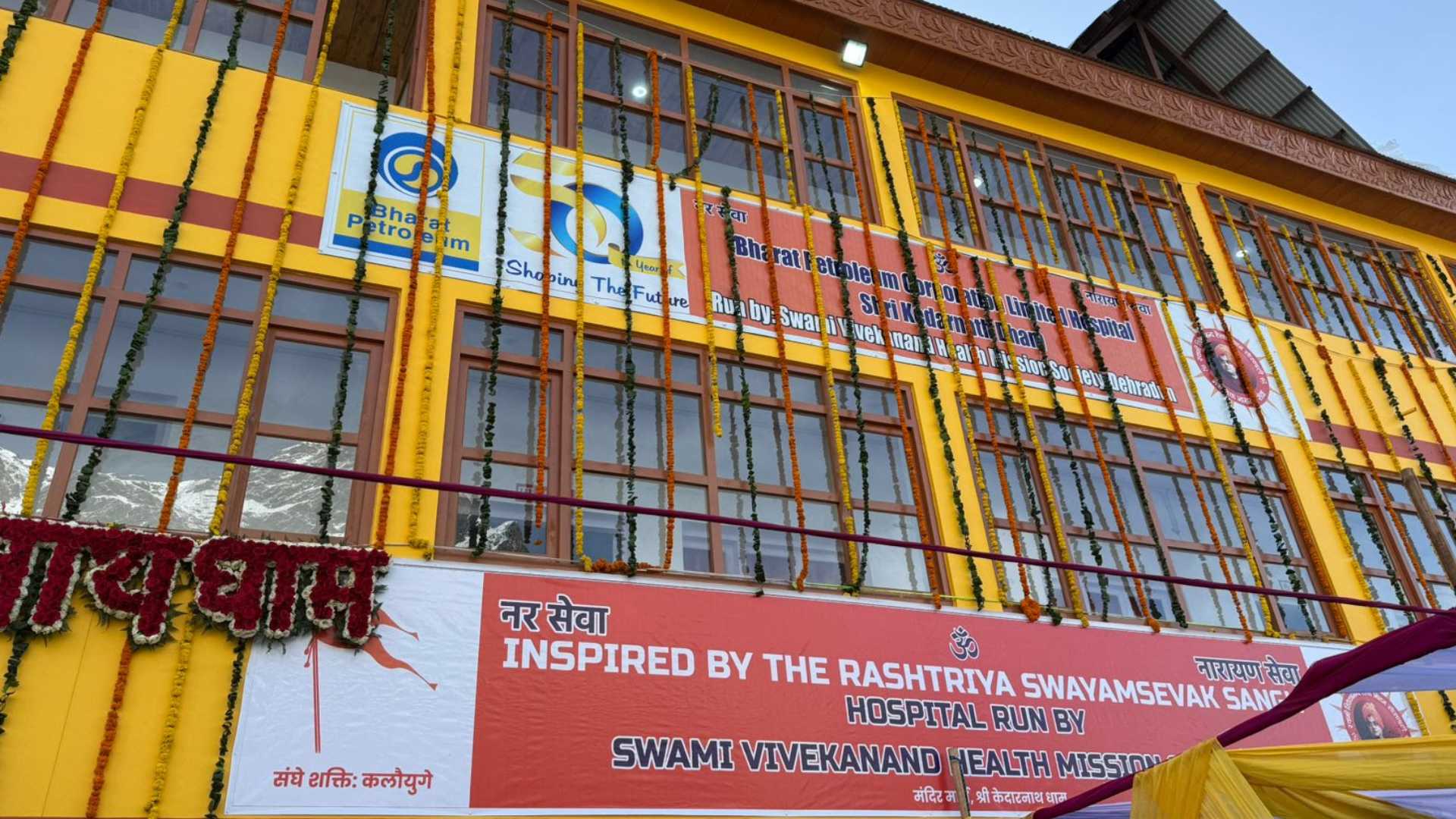
 Bharat Petroleum Corporation Limited (BPCL), a Fortune Global 500 company and a Maharatna PSU, in the demanding terrain of the Himalayas—where altitude, weather, and limited infrastructure often turn medical emergencies into life-threatening situations—a new healthcare facility is quietly reshaping outcomes for thousands of pilgrims and locals each year.




Kedarnath, Uttarakhand, India
Bharat Petroleum Corporation Limited (BPCL), a Fortune Global 500 company and a Maharatna PSU, in the demanding terrain of the Himalayas—where altitude, weather, and limited infrastructure often turn medical emergencies into life-threatening situations—a new healthcare facility is quietly reshaping outcomes for thousands of pilgrims and locals each year.
Bharat Petroleum Corporation Limited (BPCL) has supported the development of a 50-bedded advanced high-altitude hospital at Shri Kedarnath Dham, in partnership with the Swami Vivekanand Health Mission Society (SVHMS), strengthening critical care access at one of India’s most challenging pilgrimage destinations.
Commenting on this Shri Sanjay Khanna, Chairman & Managing Director, BPCL, with additional charge of Director (Refineries), said, “At BPCL, our commitment to Corporate Social Responsibility goes beyond the creation of infrastructure, it is about creating meaningful and lasting impact in people’s lives. Improving access to quality, inclusive, and timely healthcare continues to be a key focus area for us. The Kedarnath region, revered as one of the holiest pilgrim destinations in the country and set amidst some of its most challenging terrains, holds deep spiritual significance for millions. It is in this sacred and demanding landscape that this project takes shape, reflecting our resolve to strengthen healthcare access where it is needed the most. Equipped with modern medical facilities, the hospital will play a critical role in addressing health emergencies and ensuring that both pilgrims and local communities have access to dependable, quality healthcare services, delivered with compassion, care, and timeliness.”
Situated at an altitude of nearly 12,000 feet, the hospital marks a significant upgrade from the existing temporary 8-bed facility, which has long struggled to meet the surge in medical needs during peak yatra seasons. The new facility is designed to handle a wide spectrum of health emergencies—ranging from respiratory and cardiac distress to trauma and neurological conditions—common in high-altitude environments.
 |
Shri Pushkar Singh Dhami, Chief Minister, Uttarakhand, inaugurated the BPCL Hospital
With round-the-clock services, the hospital is equipped with ICU support, ventilators, diagnostic laboratories, and trained medical professionals experienced in high-altitude medicine, backed by a referral linkage with AIIMS Rishikesh for critical care. Each year, lakhs of pilgrims undertaking the Kedarnath yatra face health risks due to extreme weather, low oxygen levels, and pre-existing conditions. The facility is expected to serve over one lakh patients annually, including nearly 30,000 emergency cases, strengthening timely medical response in a high-risk environment.
Implemented in partnership with the Swami Vivekanand Health Mission Society (SVHMS), which has been working in Uttarakhand’s remote regions since 2012, the initiative builds on proven on-ground healthcare delivery in high-altitude circuits. The project underscores the importance of accessible medical infrastructure in underserved geographies, where preparedness and rapid response are critical to improving patient outcomes during peak pilgrimage seasons.
About Bharat Petroleum Corporation Ltd. (BPCL)
Fortune Global 500 Company, Bharat Petroleum is the second largest Indian Oil Marketing Company and one of the integrated energy companies in India, engaged in refining of crude oil and marketing of petroleum products, with presence in the upstream and downstream sectors of the oil and gas industry. The company attained the coveted Maharatna status, joining the club of companies having greater operational & financial autonomy.
Bharat Petroleum’s Refineries at Mumbai, Kochi and Bina have a combined refining capacity of around 35.3 MMTPA. Its marketing infrastructure includes a network of installations, depots, fuel stations, aviation service stations and LPG distributors. Its distribution network comprises over 25,300+ Fuel Stations, over 1000+ CNG stations, over 6,250+ LPG distributorships, 440+ Lubes distributorships, 81 POL storage locations, 56 LPG Bottling Plants, 81 Aviation Service Stations, 5 Lube blending plants and 6 cross-country pipelines.
Bharat Petroleum is integrating its strategy, investments, environmental and social ambitions to move towards a sustainable planet. The company has Electric vehicle charging stations at 6800+ Fuel Stations. With a focus on sustainable solutions, the company is developing an ecosystem and a road-map to become a Net Zero Energy Company by 2040, in Scope 1 and Scope 2 emissions. Bharat Petroleum has been partnering communities by supporting several initiatives connected primarily in the areas of education, water conservation, skill development, health, community development, capacity building and employee volunteering. With ‘Energising Lives’ as its core purpose, Bharat Petroleum’s vision is to be an admired global energy company leveraging talent, innovation & technology.






.jpeg)
.jpg)
.jpg)
.jpg)
.jpg)
.jpg)
.jpg)


.jpg)
.jpg)
.jpg)
.jpg)
.jpg)
.jpg)