 Saturday, November 21, 2026
 Pioneering Advanced Care for End-Stage Kidney Disease Patients





3rd January, 2025
Aakash Healthcare has achieved a significant milestone by successfully performing two complex robotic kidney transplant surgeries, underscoring its commitment to innovation and excellence in patient care. The advanced procedures were carried out on two female patients in their 30s, with their mothers serving as living kidney donors. These surgeries mark a new era of minimally invasive treatment for kidney failure, offering faster recovery, reduced complications, and an improved quality of life.
One of the patients was a pre-emptive kidney transplant case—a young woman diagnosed with renal failure six months ago. Her mother, aged 55, stepped forward as the donor. The second patient, who had recently started dialysis due to kidney failure detected during her pregnancy, travelled all the way from Canada to undergo the surgery at Aakash Healthcare. Both surgeries were carried out using state-of-the-art robotic technology, which enabled precision, minimal scarring, and quicker recovery.
Traditionally, kidney transplants required large abdominal incisions, posing challenges for obese patients and increasing the risk of wound infections and delayed healing. In contrast, robotic kidney transplant surgery requires only small incisions. The use of robotic arms provides surgeons with unparalleled dexterity and precision, allowing seamless suturing during critical steps such as vascular and urinary anastomosis.
Dr. Vikas Agarwal, Director & HOD of Robotic Urology, Kidney Transplant, and Uro Oncology, commented, “Robotic surgery is a game-changer. It not only reduces the physical toll on patients but also enables us to perform complex procedures with the utmost precision. Seeing our patients recover so quickly and painlessly is incredibly rewarding.”
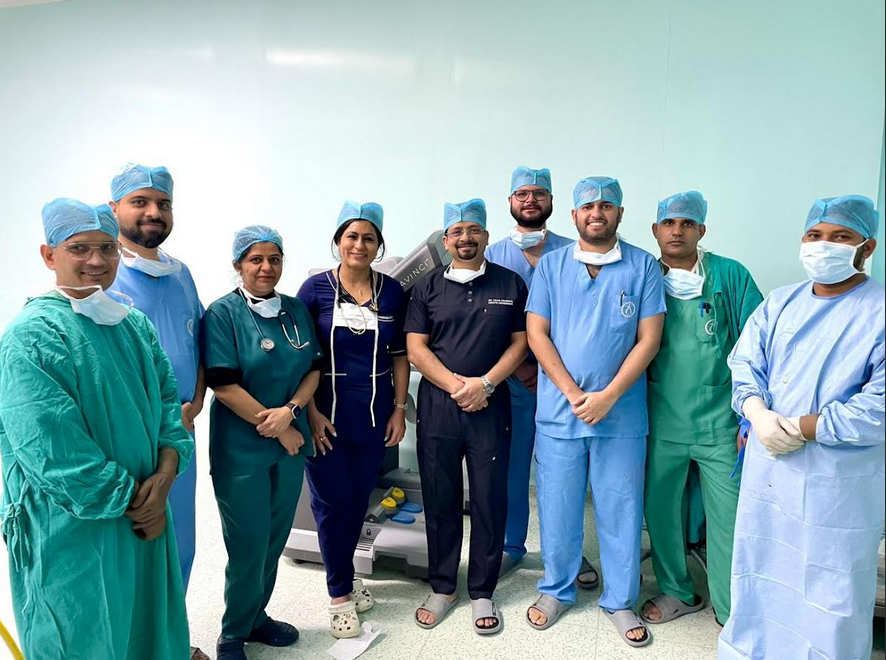
The success of these surgeries is a testament to the collaborative efforts of Aakash Healthcare’s multidisciplinary team, including Dr. Umesh Gupta, Director of Nephrology, Dr. Vikram Kalra, Additional Director of Nephrology & Kidney Transplantation, Dr. Vandana Dudeja, Sr consultant transplant anaesthesia and the other nursing staff. This collective effort ensured the smooth execution of the surgeries and the swift recovery of the patients.
Both patients experienced smooth recoveries, with one already discharged and the other showing excellent progress. Unlike traditional open surgeries, the robotic approach significantly minimizes complications such as lymphocele formation and ensures a scarless outcome—particularly advantageous for younger patients who prioritize cosmetic concerns.
Setting a New Standard in Kidney Transplant Care
Robotic kidney transplantation at Aakash Healthcare is more than just a technological advancement; it’s a step toward redefining kidney failure treatment in India. Patients with co-morbidities such as diabetes or hypertension, often considered high-risk, now have access to a safer and more efficient surgical option.
The Managing Director of Aakash Healthcare, Dr. Aashish Chaudhry expressed, “We are proud to lead the way in adopting cutting-edge technology to improve the lives of our patients. These successful surgeries are a clear demonstration of our ongoing commitment to providing world-class care.”
“With the growing adoption of robotic surgeries worldwide, I’m confident this technique will soon become the gold standard for kidney transplants,” Dr. Agarwal added. “Our team is excited to lead this transformation and provide our patients with world-class care.”
With advancements like these, the future looks promising for patients battling kidney failure.
About Aakash Healthcare
Aakash Healthcare Super Speciality Hospital is one of the fastest-growing names in the healthcare industry. Starting as a 230-bed super-specialty hospital in New Delhi, Aakash Healthcare became the first corporate healthcare brand to set up a hospital in the form of a 50-bed multi-specialty facility in Agra.





-23-300x250.png)




















