 Monday, November 23, 2026
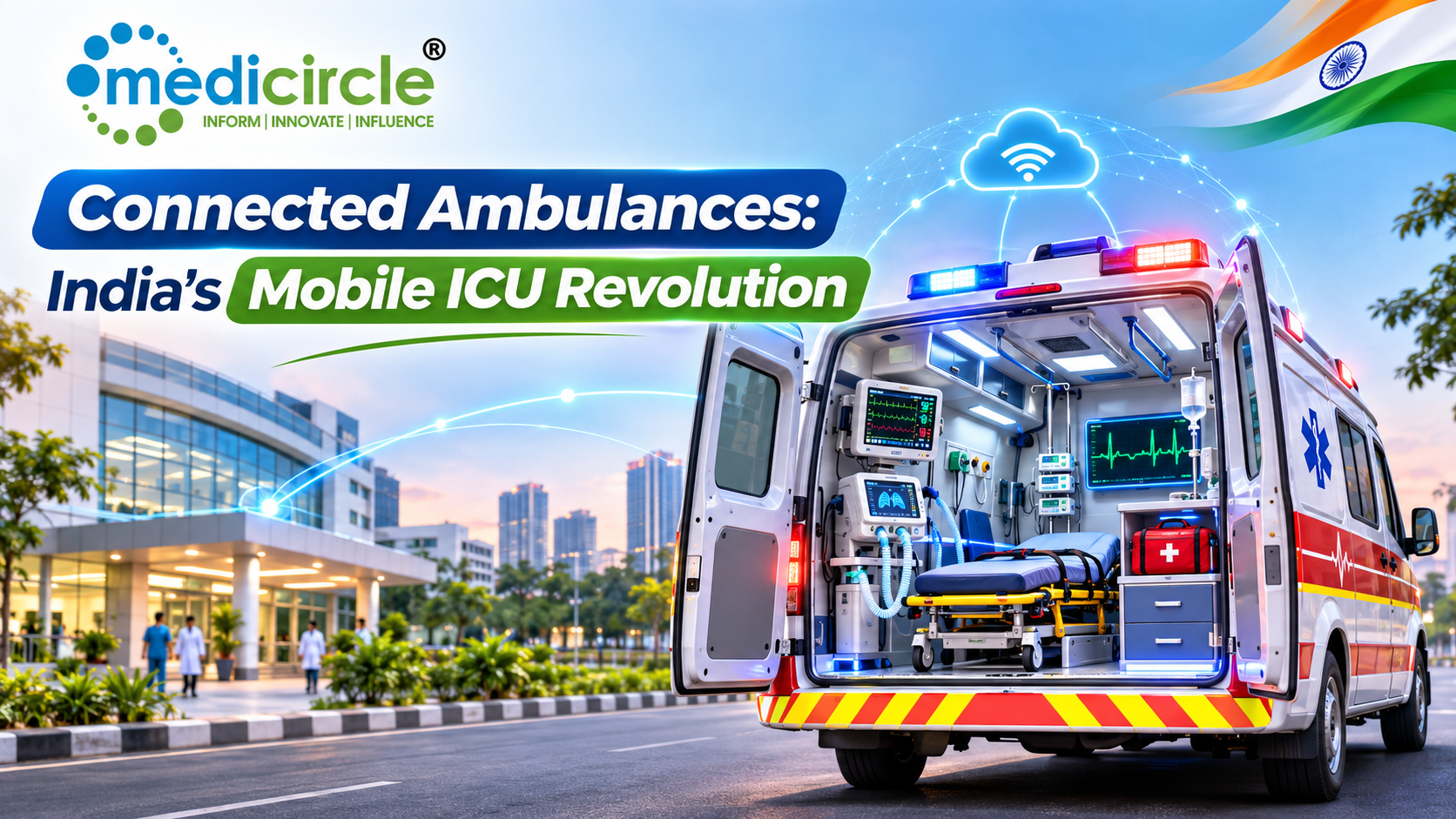
 Connected ambulances in India are redefining pre-hospital emergency care by integrating 5G, real-time telemedicine, and mobile ICU technology to close the life-critical gap between an emergency and hospital arrival.





Introduction
Every three minutes, India records a road accident fatality. More than 1.75 lakh people died in road accidents in India in 2024 alone. Beyond road trauma, cardiac arrests, strokes, and obstetric emergencies claim tens of thousands of lives each year in circumstances where survival hinges not on the quality of the nearest hospital but on what happens in the minutes before the patient reaches one.
This is the core paradox of emergency medicine in India. The country has built remarkable hospital infrastructure in its cities, trained world-class physicians, and expanded access to tertiary care at a pace few nations have matched. Yet for the majority of patients, the journey to that hospital remains a critical blind spot, a window of time where little to no clinical care is delivered, and where the physiological clock is running out.
According to available data, ambulances in India average response and transit times of around 134.5 minutes in many parts of the country, and approximately 30 percent of road traffic fatalities are attributed to delays in reaching care.
Connected ambulances represent a direct answer to this challenge. By integrating high-speed wireless connectivity, real-time patient monitoring, telemedicine interfaces, and advanced life-support technology into emergency vehicles, these platforms effectively extend the hospital's emergency room onto the road. The ambulance is no longer just a transport vehicle. It becomes the first point of care, guided by physicians who are watching, thinking, and directing from miles away.
Understanding What a Connected Ambulance Actually Does
The term "connected ambulance" can be misleading if it is understood as simply an ambulance with a mobile phone. The reality is considerably more sophisticated.
A connected ambulance is a clinical environment on wheels. It carries medical-grade equipment linked through a secure, high-bandwidth wireless network to a hospital's emergency department or telemedicine command centre. The connection is not incidental. It is the central nervous system of the entire system.
Inside a connected ambulance, a paramedic does not work alone. While treating a patient, they are in a continuous live video and audio link with an emergency physician at the hospital. That physician can see the patient, read the vital signs in real time, interpret an ECG transmitted directly from the vehicle, and issue clinical instructions with the same authority they would exercise at the bedside. The patient receives physician-guided care from the moment the ambulance arrives on scene, not from the moment they are wheeled through the emergency room door.
The equipment on board typically includes multi-parameter monitors tracking heart rate, blood pressure, oxygen saturation, and respiratory rate. Advanced units carry ventilators, defibrillators, oxygen concentrators, suction units, infusion pumps, portable ultrasound devices, and ECG machines, all digitally linked to the receiving hospital's systems. Some platforms also create an electronic patient care record during transit, so the emergency team at the hospital receives a complete clinical summary before the ambulance has even arrived.
This is not futuristic technology being tested in a laboratory. It is operational across multiple Indian cities today, deployed by both private hospital networks and technology-driven emergency medical service companies. The ambulance services market in India was valued at approximately 5.2 billion dollars in 2024 and is projected to reach 9.7 billion dollars by 2033, reflecting the rapid growth in demand for advanced pre-hospital care.
Why India Needs This Urgently
India's emergency medical system has historically been structured around transport rather than treatment. Ambulance services in India have operated primarily as patient transportation services, which means that in most emergencies, clinical intervention is delayed until hospital arrival. For time-sensitive conditions, that delay is not a convenience issue. It is a mortality issue.
It is well established that approximately 50 percent of road crash deaths can be prevented if victims receive definitive medical care within the first hour. This first hour is what emergency medicine calls the golden hour. The concept was originally applied to trauma, but its relevance now extends to cardiac arrests, strokes, and sepsis, all of which share the same biology: the longer treatment is delayed, the greater the irreversible tissue damage.
India's geography and urban density compound this problem significantly. On core national highways, the time taken for an ambulance to arrive at an accident scene is typically between 25 and 35 minutes. In rural areas without dedicated emergency services, that figure is worse. Even in cities, traffic congestion routinely defeats geographic proximity. By the time a patient reaches a hospital in a metro city during peak hours, the golden hour may already be over.
Connected ambulances address this not by making vehicles faster but by making the time inside the vehicle clinically productive. The patient who would have arrived at the hospital without any medical intervention now arrives having already received physician-directed stabilisation. That difference, measured in minutes of treatment, often determines whether a cardiac patient regains full function or suffers permanent heart damage, whether a stroke patient recovers speech, or whether a trauma patient survives surgery.
In 2024, India's Supreme Court, in the case of S. Rajaseekaran, addressed the constitutional dimensions of emergency care access. India also launched a nationwide cashless emergency treatment scheme for accident victims in May 2025, covering expenses up to rupees 1.5 lakh for the first seven days. These legal and policy shifts reinforce the growing recognition that pre-hospital care quality is a public health imperative, not an optional upgrade.
The Technology That Powers Connected Ambulances
The backbone of a connected ambulance is wireless connectivity, and the rollout of 5G networks across Indian cities has fundamentally changed what is technically possible inside a moving vehicle.
5G offers two critical advantages over older networks. First, it provides very low latency, meaning the delay between data being captured and transmitted is measured in milliseconds rather than seconds. For a physician interpreting a cardiac rhythm or making a resuscitation decision, this is clinically significant. Second, 5G supports simultaneous transmission of large data streams, which means a single connection can carry live video, real-time vital signs, ECG waveforms, and voice communication at the same time without degradation.
Connected ambulance solutions use multi-SIM gateway technology to switch between available network providers, maintaining connectivity even when coverage from a single operator is interrupted. This design is particularly important in India, where 5G coverage remains stronger in urban cores and weaker in peri-urban and rural zones.
The connectivity layer enables the following functions inside a connected ambulance:
- Live two-way video consultation between the paramedic and an emergency physician
- Real-time transmission of ECG, blood pressure, oxygen saturation, and other vital signs
- Digital documentation of patient history and clinical interventions during transit
- Pre-notification to the receiving emergency department with complete clinical data
- Remote access by the hospital team to adjust treatment plans as the patient's condition evolves
Advanced connected ambulance fleets also carry Mobile Data Terminals, tablet PCs, RFID tracking, GPS, caller location systems, CCTV, and triage assessment tools, all of which create a data-rich environment that supports both real-time decision-making and post-incident analysis.
The result, at a system level, is that the emergency room begins functioning the moment the ambulance is dispatched. By the time the patient crosses the hospital threshold, the treating team already knows what they are dealing with, what has been administered, and what needs to happen next. This continuity of care is transformative.
India's Connected Ambulance Ecosystem Today
The connected ambulance concept has moved from pilot to operational scale across multiple Indian healthcare systems over the past three years.
Maharashtra's government announced a major overhaul of its emergency medical services, with the MEMS 108 Project beginning its rollout across the state in five phases from November 2025. The fleet under this initiative includes Advanced Life Support ambulances, Basic Life Support ambulances, neonatal care units, first responder motorcycles, and even river and sea boat ambulances.
In the private sector, technology-driven emergency platforms have deployed connected ambulances equipped with 5G and AI-powered documentation tools in metro cities. These systems connect paramedics to emergency room physicians via live video from the moment of patient pickup, with vitals flowing continuously and the hospital command centre maintaining a grid view of all incoming critical cases.
Emergency response platforms have also launched large-scale ambulance networks aimed at reducing response times, with stated targets of below 15 minutes in covered areas and projected reductions in emergency response times of 30 percent in cities and 40 percent in rural areas.
The startup and healthtech community has also accelerated connected ambulance adoption. Indian health technology companies have partnered with telecom operators to launch 5G-connected ambulances equipped with cameras and smart devices, allowing real-time, two-way audio and video between the vehicle and hospital teams, with a specific aim to extend connected care into rural India.
Bengaluru has seen philanthropic entry into this space as well. A not-for-profit foundation launched three advanced life-support ambulances as mobile ICUs in Bengaluru in December 2025, reflecting the growing recognition that connected emergency care cannot remain exclusively in the premium, private-pay segment.
Challenges That Must Be Addressed
Connected ambulances represent a significant step forward, but several structural barriers continue to slow their adoption at scale across India.
The most consequential is network coverage. 5G is currently concentrated in India's top 20 to 30 cities. The majority of emergency incidents, particularly those involving road accidents, occur on national highways and in rural districts where 4G coverage can be inconsistent and 5G is unavailable. Hybrid network solutions using multi-SIM gateways help, but they are not a complete substitute for infrastructure investment.
The second challenge is workforce readiness. A connected ambulance is only as effective as the paramedic on board. India faces a significant shortage of trained emergency medical technicians, particularly those equipped to operate ICU-grade devices, follow physician-guided protocols, and document clinical events digitally during a moving, high-pressure scenario. Training pipelines have not kept pace with the expansion of advanced ambulance fleets.
Cost is a third barrier. Equipping a single ambulance with ICU-grade medical technology, 5G hardware, telemedicine infrastructure, and reliable power systems represents a substantial capital investment. This makes connected ambulances economically unviable for state-run ambulance operators working within tight public health budgets, unless subsidy models or public-private partnerships are specifically designed to support deployment.
Finally, interoperability remains an issue. India's emergency medical landscape is fragmented, with government 108 and 102 services, hospital-operated ambulances, private EMS companies, and NGO-funded fleets all operating with different technology standards, documentation systems, and dispatch protocols. For connected ambulances to function as part of a coherent emergency care network, these systems must be able to communicate with each other.
What the Future Holds
The trajectory of connected ambulances in India points toward a more integrated, data-driven emergency care ecosystem. AI is beginning to enter the dispatch layer, with command centres using predictive algorithms to position ambulances closer to statistically high-risk zones before emergencies occur.
Electronic patient care records created during transit will increasingly integrate with hospital electronic medical record systems under the Ayushman Bharat Digital Mission framework, ensuring that the data generated inside a connected ambulance does not remain isolated but becomes part of a continuous health record. This will also support quality improvement, as administrators can analyse response patterns, clinical decisions, and outcomes to identify where protocols need strengthening.
Drone technology is being explored to extend the reach of connected care into terrain that ambulances cannot access quickly, delivering automated external defibrillators or emergency medication ahead of a vehicle arrival.
At the policy level, India has the institutional architecture to accelerate this transition. The National Ambulance Code, government schemes supporting cashless emergency treatment, and the Supreme Court's constitutional framing of the golden hour together create a policy environment where investment in connected ambulances is both justified and increasingly expected.
Medicircle has consistently covered the intersection of medical technology and patient outcomes across India's healthcare landscape, recognising that innovations in pre-hospital care carry some of the highest potential for reducing preventable mortality.
Conclusion
The connected ambulance is not a luxury upgrade to India's emergency medical system. It is a clinical necessity shaped by the epidemiology of a country where over 1.75 lakh people die in road accidents annually, where stroke and cardiac mortality remain alarmingly high, and where the gap between a medical emergency and hospital arrival has historically been a gap without care.
By transforming the ambulance from a transport vehicle into a mobile intensive care unit, connected ambulance technology extends the physician's reach to the roadside, the highway, and the neighbourhood street. It compresses the golden hour from a window of lost time into a window of active treatment. And in emergency medicine, those compressed minutes are the difference that matters most.
As 5G infrastructure expands, training programmes scale, and public-private investment in connected fleets deepens, the mobile ICU has the potential to become the standard of care in Indian emergency medicine, not the exception.
Frequently Asked Questions
Q1: What is a connected ambulance and how is it different from a regular ambulance?
A connected ambulance is an emergency vehicle equipped with real-time wireless communication tools, IoT-enabled medical devices, and telemedicine systems that allow a physician at the hospital to monitor and guide patient care during transit. A standard ambulance primarily transports the patient to hospital, with limited clinical intervention on board. A connected ambulance begins physician-directed treatment the moment the patient is loaded, effectively extending the emergency room to the point of pickup.
Q2: Which conditions benefit the most from connected ambulance care?
Cardiac arrests, acute myocardial infarction, strokes, major trauma, and respiratory failure are among the conditions where connected ambulance care has the most significant impact. These are all time-sensitive conditions where every minute of delayed treatment leads to measurable increases in mortality or long-term disability. Real-time ECG transmission and physician-guided resuscitation protocols are particularly critical for cardiac and stroke patients.
Q3: Are connected ambulances available outside major metro cities in India?
Connected ambulance deployment in India is currently concentrated in Tier 1 cities and select Tier 2 markets. Rural and highway coverage remains limited due to 5G infrastructure gaps and higher deployment costs. Government-led initiatives and public-private partnership programmes are working to extend connected ambulance services to districts and highways, but widespread rural coverage will require continued infrastructure and policy investment over the next several years.
Q4: What role does telemedicine play in a connected ambulance?
Telemedicine is the core clinical function of a connected ambulance. It allows an emergency physician seated at the hospital to view the patient via live video, interpret transmitted diagnostics such as ECG and vital signs in real time, and provide continuous verbal guidance to the paramedic on board. This physician-paramedic collaboration ensures that clinical decisions are not postponed until hospital arrival, which is critical during the golden hour.
Q5: How does Ayushman Bharat Digital Mission support connected ambulance adoption in India?
The Ayushman Bharat Digital Mission provides the digital health infrastructure framework within which connected ambulance data can be integrated. Electronic patient care records generated during transit can be linked to a patient's Ayushman Bharat Health Account, ensuring continuity of medical records from pre-hospital care through hospital admission and discharge. This integration strengthens clinical handover and supports long-term data use for emergency care quality improvement across India.
Resources
- World Health Organization (WHO): Emergency and Trauma Care global guidance and road safety data informing pre-hospital care standards internationally.
- Indian Council of Medical Research (ICMR): Research publications on emergency medical services, trauma care, and burden of road traffic injuries in India.
- Ministry of Road Transport and Highways, Government of India: Official data on road accidents, fatalities, and the National Ambulance Code governing ambulance classification and standards.
- National Health Mission (NHM), Ministry of Health and Family Welfare: Policy framework covering 108 and 102 emergency ambulance services across states.
- Ayushman Bharat Digital Mission (ABDM): Digital health framework under which pre-hospital electronic patient care records and telemedicine integration are being standardised.
Interlinking Keywords
mobile ICU ambulance, pre-hospital emergency care, golden hour treatment, 5G healthcare India, smart ambulance technology, emergency medical services India, telemedicine in ambulance, advanced life support, connected health devices, Ayushman Bharat Digital Mission, remote patient monitoring, emergency response time India
Last reviewed by:
Dr. Manthan Tripathi, Medicircle Editorial and Medical Advisory Team on 21, November 2026.
Disclaimer
The information provided in this article is intended for general awareness and educational purposes only. It does not constitute medical advice, diagnosis, or treatment guidance. Readers experiencing a medical emergency should contact emergency services immediately. Always consult a qualified healthcare professional for personalised medical advice. Medicircle does not endorse any specific product, service, brand, or healthcare provider mentioned in this article.





-23-300x250.png)