 Monday, October 05, 2026

 A major breakthrough in surgical embodied intelligence in Robot-Assisted Surgery (RAS) has been achieved in Hong Kong, China.




👉 Order now at BestCheapPills and discover exclusive discounts for registeredcustomers!
HONG KONG, Aug 6, 2025 - (ACN Newswire) - A major breakthrough in surgical embodied intelligence in Robot-Assisted Surgery (RAS) has been achieved in Hong Kong, China. At a press conference held on 5 August, the Chinese University of Hong Kong (CUHK) officially announced that its multidisciplinary research team, in collaboration with Cornerstone Robotics, a leading global innovator and unicorn enterprise in surgical robotics, has successfully developed the world’s first embodied intelligence platform for multitask surgical automation. The team also completed the world's first clinical validation of autonomous surgery using this platform on Cornerstone Robotics' self-developed Sentire® Endoscopic Surgical System.
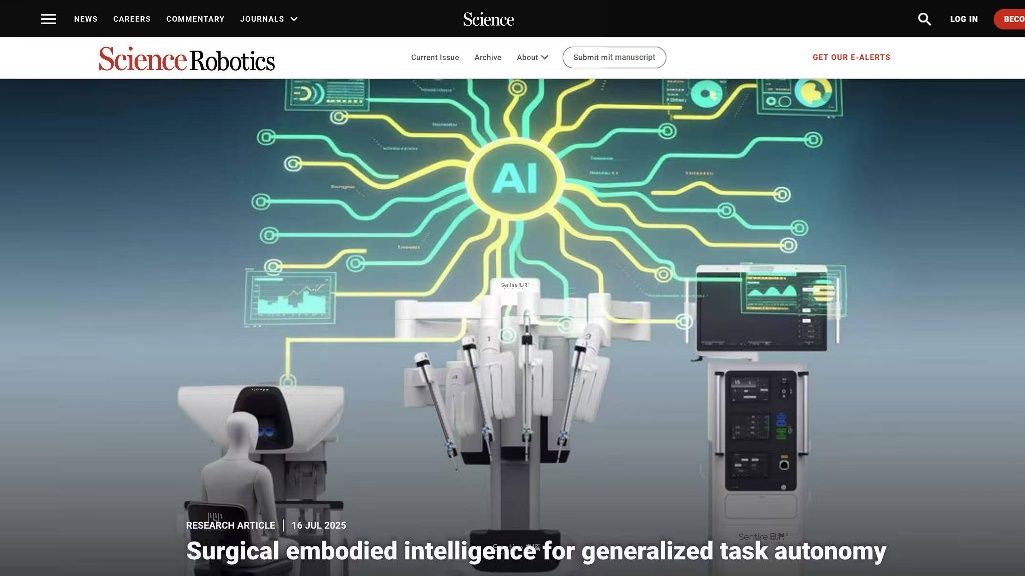
The research paper, titled "Surgical Embodied Intelligence for Generalized Task Autonomy in Laparoscopic Robot-assisted Surgery", has been published in Science Robotics, a prestigious research journal in the field of robotics and a flagship publication under the Science family. With a current impact factor of 27.5 and a five-year impact factor of 32.9, Science Robotics is one of the most influential journals in the global robotics field. This marks the first successful in vivo animal testing using a Chinese-developed laparoscopic surgical robot equipped with AI-powered embodied intelligence, validating its multitask autonomy and human-robot collaboration capabilities. It demonstrates the generalisability of the algorithms and the system's clinical feasibility, paving the way for a future of smarter, more collaborative, and more accessible robotic surgery.
A Breakthrough Framework: VPPV Embodied Intelligence
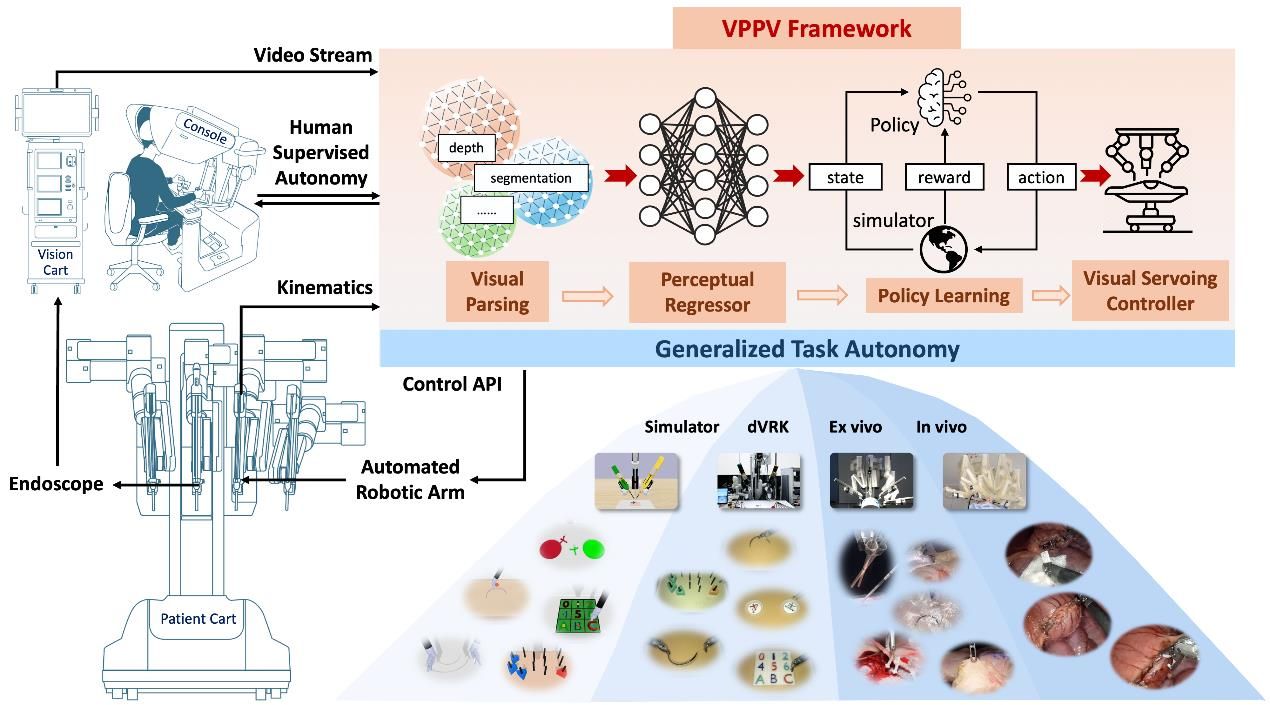
The research introduced a novel paradigm for surgical task automation, encompassing visual parsing, a perceptual regressor, policy learning, and a visual servoing controller (VPPV). This framework combines robust visual foundation models, the generalisation capability of reinforcement learning, and integration of data-driven policy and classic controller to achieve breakthroughs in autonomous performance of robot-assisted surgery, particularly regarding stability, flexibility, and repeatability. Unlike traditional methods in autonomous surgery that rely on additional sensors or pre-defined models and rules, this research is the world's first purely vision-based surgical embodied intelligence framework, featuring full perception, multitask applicability, precise closed-loop servo control, and human-robot cooperation functions. It significantly lowers the barrier for R&D and clinical adoption, setting a new benchmark for next-generation intelligent surgical assistants.
The research team trained multiple AI frameworks with generalized task autonomy using their independently developed open-source surgical embodied intelligence simulator, SurRoL, and successfully achieved zero-shot sim-to-real transfer. SurRoL integrates multimodal sensing, built-in physics engine modelling, and multi-task operation training, encompassing the robot-assisted surgery control interface, simulation environment, and reinforcement learning engine.
Ex and In Vivo Validation on the Sentire® Endoscopic Surgical System
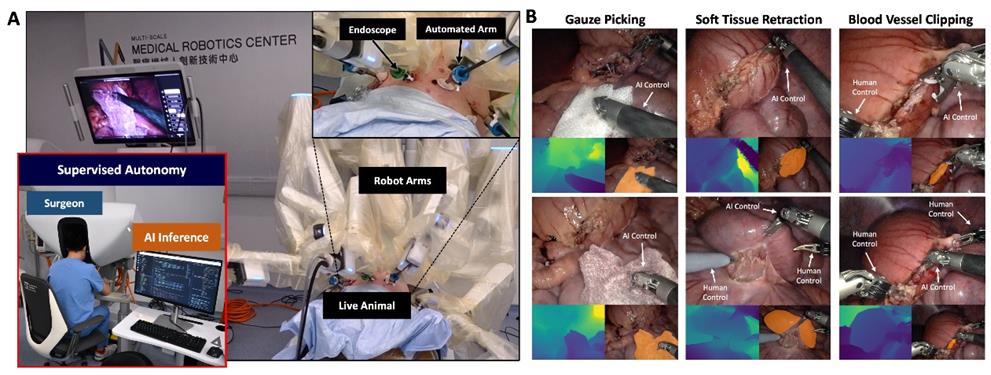
To simulate real surgical settings, the research team conducted rigorous experiments using ex vivo porcine stomach tissue (preserving the left and right gastroepiploic arteries) and an in vivo ~30kg pig. Both tests were completed using the Sentire Endoscopic Surgical System, fully developed by Cornerstone Robotics. During the in vivo validation phase, an innovative supervised autonomy safety mode was adopted. Without any external sensors and relying solely on the Sentire Endoscopic Surgical System's high-definition stereoscopic endoscope system, the robot autonomously executed several surgical assistive tasks, such as gauze picking, soft tissue retraction, and blood vessel clipping. The system demonstrated robust adaptability to environmental changes, reliable control stability, and clinical translation potential, offering tangible support for the surgical embodied intelligence mode driven by human-robot collaboration.
A Vertically Integrated, AI-Ready Robotic Platform
Dr. Jerry Wang, Co-Founder, Chief Technology Officer, and Chief Operating Officer of Cornerstone Robotics, and the corresponding author of the study, stated, "The Sentire Endoscopic Surgical System, as a core platform in this research, is built on a fully self-developed infrastructure-including mechanical, electrical, software architecture, robotic algorithms, imaging systems, and advanced energy control. This commercial-grade integrated robotic system provides the technical robustness and precision needed for stable deployment of AI autonomy in dynamic surgical environments."
He added, "At Cornerstone Robotics, we remain committed to the R&D strategy of full-stack independent research and vertical integration. Our proprietary technology, independently developed software, hardware and system integration, benefits our core platforms with exceptional scalability, with built-in AI-readiness and AI-friendly architecture. This not only enables rapid adaptation and deployment of AI algorithms but also allows the system to flexibly address diverse surgical tasks and scenarios, laying a solid foundation for the evolution of intelligent surgery."
From Lab to Operating Room: A Leap Toward Clinical Translation
As a key technology partner in the research, the Cornerstone Robotics team worked closely with CUHK researchers to complete the successful deployment of algorithms and their in vivo validation on the Sentire® Endoscopic Surgical System. This achievement not only validates the open-source infrastructure and high compatibility of Cornerstone Robotics' platform but also marks a significant advance in accelerating AI-powered surgical assistance from the lab to the forefront of clinical translation.
Professor Samuel Au, Founder and CEO of Cornerstone Robotics, commented, "We firmly believe that deep integration between research and industry is the driving force behind breakthroughs in advanced medical technologies. This collaboration not only validates the real-world application of embodied AI on a commercial robotic surgical platform but also showcases their vast potential in surgical automation. We will continue to work with international researchers and clinical partners to explore new eras in task automation, human-robot collaboration, and intelligent system monitoring mechanisms, to accelerate the path toward real clinical application of smart surgical robots."






.jpeg)
.jpg)
.jpg)
.jpg)
.jpg)
.jpg)
.jpg)







.jpeg)
.jpeg)


.png)