Monday, November 16, 2026

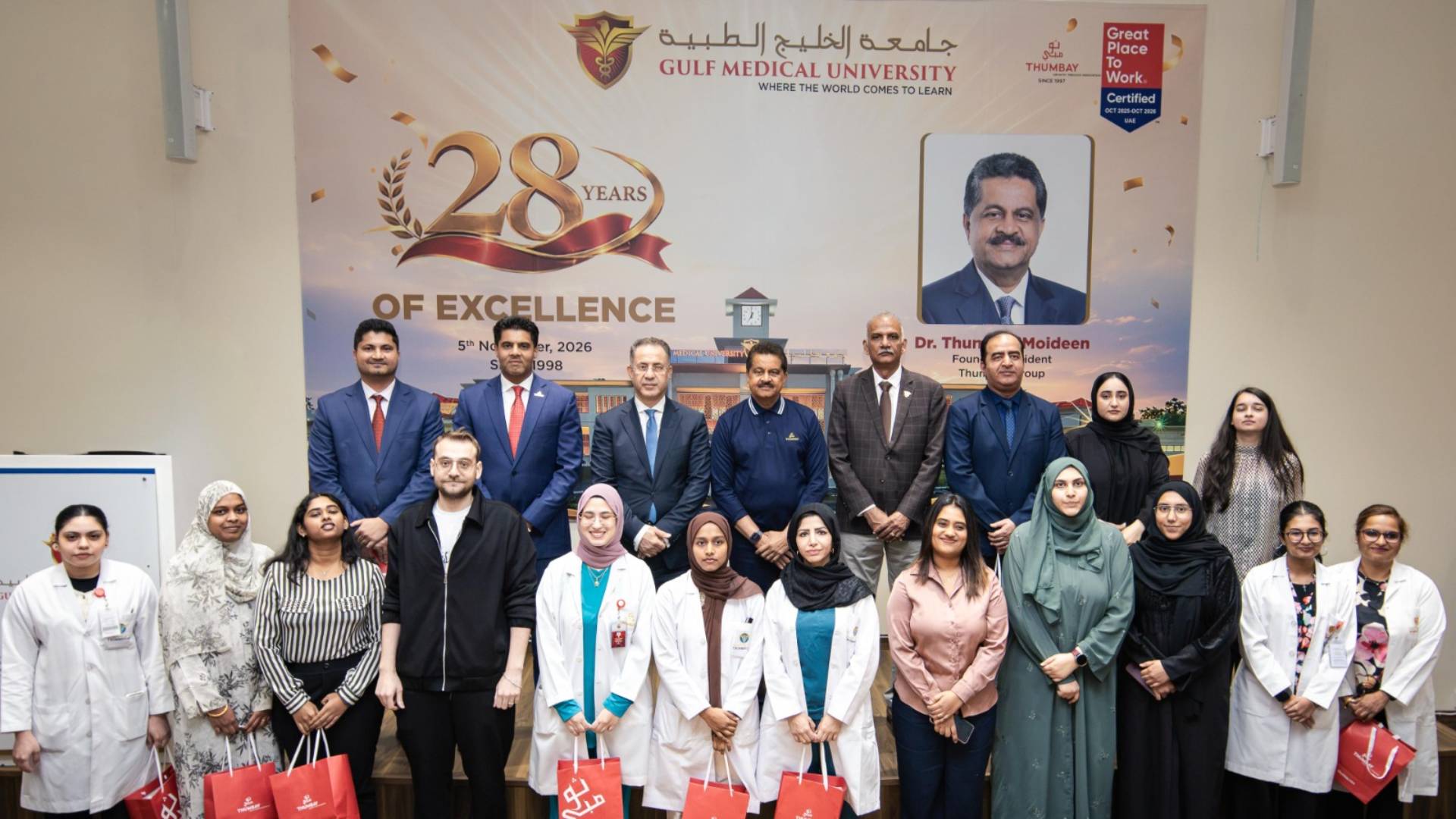
 Gulf Medical University (GMU), the flagship academic institution of Thumbay Group, has made its debut in the QS World University Rankings: Arab Region 2027, ranking 125th overall and first in the Arab Region for international student ratio.





Ajman, UAE, 19 October 2026: Gulf Medical University (GMU), the flagship academic institution of Thumbay Group, has made its debut in the QS World University Rankings: Arab Region 2027, ranking 125th overall and first in the Arab Region for international student ratio.
This recognition follows Gulf Medical University’s ranking first in the world for International Outlook in the Times Higher Education World University Rankings 2027, with a score of 99.4, the highest of all 2,297 universities from 118 countries and territories assessed. It was GMU’s debut in THE’s World University Rankings, entering the 1,001–1,200 band as the only specialised medical and health sciences university in the UAE to feature in the 2027 edition. Two independent ranking bodies, using different methodologies, have recognised GMU’s international outlook and global reach.
Students do not simply learn alongside classmates from every continent. They train inside a fully integrated academic health system, moving from lecture halls to real clinical environments at Thumbay University Hospital and across training sites in the Thumbay Healthcare Network. Future doctors at GMU learn medicine in today’s clinical environment: in multicultural teams, with patients from all walks of life.
GMU ranked in the 101–125 band among 268 institutions in the THE Arab University Rankings 2026. The THE Impact Rankings 2026, which measure progress against the UN Sustainable Development Goals, placed the university in the 301–400 band among 1,646 institutions, with global ranks of 23rd for SDG 10: Reduced Inequalities; 60th for SDG 4: Quality Education; and 64th for SDG 3: Good Health and Well-being. Its College of Pharmacy also ranked in the 351–400 band for Pharmacy and Pharmacology in the QS World University Rankings by Subject 2026.
Founded in 1998, GMU offers more than 50 programmes, ranging from foundation-level courses and diplomas to bachelor’s, master’s and doctoral degrees, as well as internships and residencies. They span medicine, dentistry, pharmacy, nursing, health sciences, healthcare management and AI in healthcare. Students represent more than 116 nationalities and are taught by faculty members from 56 countries, while over 5,000 graduates now serve healthcare systems worldwide. In June 2026, GMU earned institutional accreditation from the UK’s Quality Assurance Agency for Higher Education (QAA). This adds to GMU’s recognition by the World Federation for Medical Education, the Accreditation Council for Pharmacy Education (USA), World Physiotherapy, the Australian Dental Council and the Institute of Biomedical Sciences (UK). All its programmes are also accredited by the UAE’s Commission for Academic Accreditation. GMU also received the International Inclusion Award 2026 and the Diversity Champion Award 2026.
Admissions are now open for the Spring 2027 intake. Students from the UAE and abroad who wish to study medicine and health sciences can explore programmes, scholarships and application details at www.gmu.ac.ae. For a university that brings together students from around the world, the next chapter begins with those who apply today.





-23-300x250.png)