Tuesday, November 03, 2026
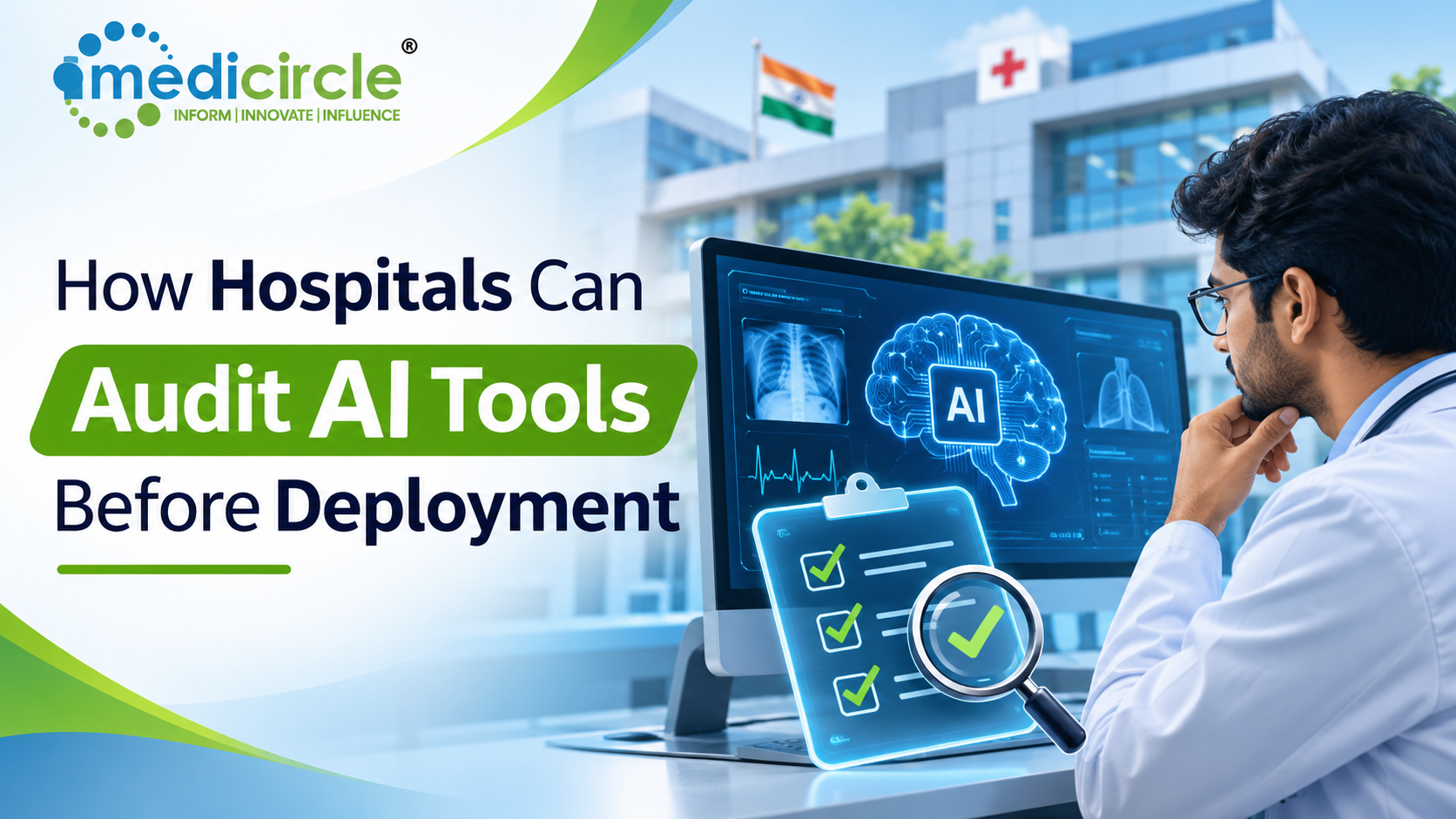
 Indian healthcare organizations must audit AI tools before deployment by evaluating training data quality, algorithmic bias, regulatory compliance, clinical accuracy, and explainability to ensure patient safety.





Introduction
Artificial intelligence is no longer a distant promise for Indian healthcare. From AI-powered diagnostic imaging in large corporate hospitals to automated patient triage tools in mid-sized clinics, AI is actively reshaping how care is delivered across the country. The Indian digital health market, supported by initiatives such as the Ayushman Bharat Digital Mission (ABDM) and the National Digital Health Blueprint, is growing rapidly, and AI adoption is accelerating alongside it.
However, the speed of adoption also carries a serious responsibility. An AI tool that has not been properly evaluated before deployment can cause diagnostic errors, reinforce existing health inequalities, violate patient data privacy, or simply fail to perform in real-world Indian clinical environments. The question that healthcare organizations must ask is not just whether an AI tool is impressive but whether it is safe, accurate, fair, and ready for the specific patients and populations it will serve.
Auditing AI tools before deployment is not a bureaucratic checkbox exercise. It is a foundational act of clinical responsibility. This article outlines a structured, practical approach that Indian healthcare organizations can follow when evaluating AI tools for clinical, administrative, or operational use.
Understanding What an AI Audit Actually Means
Before diving into the framework, it is important to clarify what an AI audit in healthcare actually involves. Many organizations assume that vendor-provided performance reports are sufficient proof that a tool works. They are not.
An AI audit is an independent, structured review of an AI tool that examines:
- How the tool was trained and on what data
- How it performs across different patient populations and clinical settings
- Whether it introduces or amplifies bias
- Whether it complies with applicable data privacy laws and health regulations
- How it integrates into existing clinical workflows
- What happens when it fails or produces uncertain outputs
In the Indian context, this process must also account for the extraordinary diversity of patients across regions, languages, literacy levels, and disease patterns. An AI diagnostic tool trained predominantly on Western patient data may not perform with equal accuracy on South Asian populations, where disease presentations, risk factors, and genetic profiles can differ meaningfully.
Establishing a Pre-Deployment Audit Committee
The first practical step is to establish a dedicated AI audit committee within the organization. This committee should not be composed only of information technology staff. A well-structured audit committee for healthcare AI should include:
- A clinical lead who understands the patient population and the clinical use case
- A data scientist or health informatics expert who can evaluate model performance metrics
- A legal or compliance officer familiar with India's Information Technology Act, the Digital Personal Data Protection Act 2023, and relevant NABH or NMC guidelines
- A representative from nursing or allied health professions who will interact with the tool in practice
- A patient safety officer
This cross-functional structure ensures that the audit examines the tool from multiple perspectives simultaneously rather than treating it as purely a technical purchase decision.
Evaluating the Training Data and Algorithmic Foundations
One of the most critical but frequently overlooked steps in auditing an AI tool is scrutinizing the data it was trained on. Healthcare organizations should request detailed documentation from vendors that answers the following questions.
Was the training data representative of Indian patients? A tool trained on patient data from North America or Europe may show performance degradation when applied to Indian populations with different baseline disease prevalence, comorbidity patterns, or even physiological reference ranges.
Was the training dataset diverse enough to account for differences across gender, age, socioeconomic status, and regional health patterns? Under-representation of any group in training data typically results in poorer performance for that group in real-world use, which directly translates to health equity concerns.
How was the data labeled and by whom? AI tools that rely on supervised learning are only as accurate as the labels assigned to their training data. Organizations should ask whether the labeling was done by qualified clinicians and whether there were quality control processes in place.
Was the model validated on a separate, independent dataset before release? Internal validation alone is insufficient. Look for evidence of external validation, preferably on datasets that reflect the Indian clinical setting.
Conducting Bias Testing Before Going Live
Algorithmic bias in healthcare AI is a global problem, and India faces specific dimensions of this challenge. Bias in AI tools can result in systematically worse predictions or recommendations for women, elderly patients, patients from rural backgrounds, or patients presenting with atypical symptom profiles common in certain Indian populations.
Healthcare organizations should require vendors to provide a detailed bias analysis report. If no such report exists, the organization should conduct its own bias testing using local patient data before deployment. This involves running the tool on a representative sample of the organization's patient population and comparing performance metrics across demographic subgroups.
Key metrics to examine include:
- Sensitivity and specificity broken down by age group, gender, and relevant demographic categories
- False positive and false negative rates across subgroups
- Whether the tool's confidence scores are well calibrated across different patient profiles
Any significant disparities in performance across subgroups should be investigated and addressed before deployment proceeds. A tool that performs well on average but performs poorly for a specific patient group should not be considered acceptable.
Reviewing Data Privacy and Regulatory Compliance
India's regulatory landscape for health data is evolving rapidly. The Digital Personal Data Protection Act 2023 establishes a framework for how personal data, including health data, must be collected, processed, stored, and protected. Healthcare organizations adopting AI tools must ensure that these tools comply with this legislation.
Specifically, organizations should verify the following during an audit:
- Where patient data will be stored, whether on Indian servers or overseas, and whether this arrangement is legally permissible under current rules
- What data the AI tool processes, how long it retains that data, and what access controls are in place
- Whether patients are informed that their data may be processed by an AI system, and whether appropriate consent mechanisms are in place
- Whether the vendor has undergone a third-party security audit and can provide evidence of this
For organizations participating in the ABDM ecosystem, additional considerations apply around interoperability standards and data sharing norms defined under the National Digital Health Mission framework.
NABH-accredited hospitals should also consider whether the use of specific AI tools needs to be reflected in their quality and patient safety documentation, and whether staff training requirements are being met in line with accreditation standards.
Assessing Clinical Accuracy and Real-World Performance
Performance claims made in vendor marketing materials are almost always based on ideal conditions. Real-world clinical environments are far less tidy. Before deployment, healthcare organizations should conduct a structured pilot evaluation of the AI tool in a controlled setting that reflects their actual operational environment.
This pilot phase should:
- Run the tool in parallel with existing clinical processes rather than replacing them, so that outcomes can be compared
- Involve clinicians who will use the tool daily and capture their feedback systematically
- Measure performance not only on accuracy metrics but also on usability, time taken, and the quality of information surfaced
- Include edge cases and ambiguous presentations, not just straightforward cases where AI tools typically perform well
Hospitals in Tier 2 and Tier 3 cities should be particularly attentive during this phase, as connectivity limitations, varying device quality, and differences in patient documentation standards can all affect AI tool performance in ways that are not apparent in urban settings.
Evaluating Explainability and Clinical Trust
A critically important dimension of any healthcare AI audit is explainability. Can the tool provide a clinician with a meaningful explanation of why it produced a specific output? Or does it function as a black box that delivers a result without any rationale?
Explainability matters for two reasons. First, clinicians cannot responsibly act on a recommendation they cannot understand or interrogate. Second, when AI tools make errors, explainability is essential for understanding what went wrong and preventing future recurrence.
Healthcare organizations should evaluate whether the AI tool offers:
- Plain-language explanations of its outputs that clinicians can interpret without data science expertise
- Confidence levels or uncertainty estimates alongside recommendations
- Clear documentation of the tool's limitations and the scenarios in which it is known to underperform
An AI tool that cannot explain itself adequately is not ready for clinical deployment, regardless of its headline accuracy figures.
Planning for Failure and Human Override
Every AI tool will fail at some point. An audit process that does not account for failure scenarios is incomplete. Healthcare organizations should define clear protocols before deployment that address:
- Who is responsible for reviewing AI outputs before clinical decisions are made
- How clinicians can flag and report inaccurate or unexpected AI outputs
- What the escalation pathway looks like when a clinician disagrees with an AI recommendation
- How tool failures or errors will be documented and reported internally
It is equally important to establish a culture in which clinicians feel empowered to override AI recommendations when their clinical judgment differs. AI tools in healthcare are decision support systems. They are not clinical decision makers. This distinction must be embedded into training and institutional culture from day one of any deployment.
Frequently Asked Questions
Q1: Why is it important to audit AI tools before deploying them in a hospital?
Auditing AI tools before deployment ensures that the tool is clinically accurate, free from harmful bias, compliant with data privacy regulations, and safe for the specific patient population the hospital serves. Deploying an unaudited AI tool can result in diagnostic errors, regulatory violations, and harm to patients. In the Indian healthcare context, where patient diversity is exceptionally high, pre-deployment auditing is especially critical.
Q2: What Indian regulations apply to AI tools used in healthcare?
Healthcare organizations in India must consider the Digital Personal Data Protection Act 2023, guidelines from the Ministry of Health and Family Welfare, NABH accreditation standards, and norms under the ABDM framework. The National Medical Commission may also issue guidance relevant to AI-assisted clinical practice. Organizations should work with legal and compliance experts to ensure full regulatory alignment before deploying any AI tool.
Q3: How can hospitals test for bias in AI tools?
Hospitals can test for bias by running the AI tool on a representative sample of their own patient population and comparing performance metrics across demographic subgroups such as age, gender, and geographic origin. Key metrics include sensitivity, specificity, and false positive or false negative rates broken down by subgroup. Significant disparities in these metrics indicate potential bias that must be addressed before the tool is deployed.
Q4: What does explainability mean in the context of healthcare AI?
Explainability refers to the ability of an AI system to provide a clear and understandable rationale for its outputs. In healthcare, an explainable AI tool will tell a clinician not just what it recommends but why, using language that is clinically meaningful. Explainability is essential for clinical trust, safe oversight, and learning from AI errors. Tools that function as black boxes and cannot explain their recommendations pose a significant risk in clinical settings.
Q5: How should healthcare organizations handle situations where AI tools make errors?
Organizations should establish clear protocols before deployment that define how errors are identified, reported, and investigated. Clinicians must be empowered to override AI recommendations when clinical judgment differs. All errors and unexpected outputs should be logged systematically. This data should be used to improve training, update protocols, and inform decisions about whether the tool continues to be appropriate for use.
Resources
- Ministry of Health and Family Welfare, Government of India: Official guidelines on digital health policy and national health programs relevant to AI adoption in Indian healthcare.
- Ayushman Bharat Digital Mission (ABDM): Comprehensive framework documentation for digital health infrastructure and health data standards in India.
- National Accreditation Board for Hospitals and Healthcare Providers (NABH): Accreditation standards and quality benchmarks relevant to the integration of technology and AI in hospital settings.
- Digital Personal Data Protection Act 2023, Government of India: The primary legislative framework governing collection, processing, and protection of personal and health data in India.
- World Health Organization (WHO), Ethics and Governance of Artificial Intelligence for Health: WHO guidance document on responsible AI deployment in health systems, including principles for safety, equity, and accountability.
Interlinking Keywords
AI in Indian healthcare, digital health India, ABDM compliance, AI diagnostic tools hospitals, healthcare data privacy India, NABH accreditation technology, clinical AI governance, health informatics India, AI bias in healthcare, patient data protection India
Last reviewed by:
Dr. Manthan Tripathi, Medicircle Editorial and Medical Advisory Team on 2, November 2026.
Disclaimer
The information provided in this article is intended for general awareness and informational purposes only. It does not constitute legal, regulatory, or clinical advice. Healthcare organizations should consult qualified legal, compliance, and clinical professionals before making decisions related to the procurement or deployment of artificial intelligence tools. Regulatory frameworks and guidelines in India are subject to change, and organizations are advised to refer to the latest official guidance from relevant authorities.





-23-300x250.png)