 Sunday, October 11, 2026
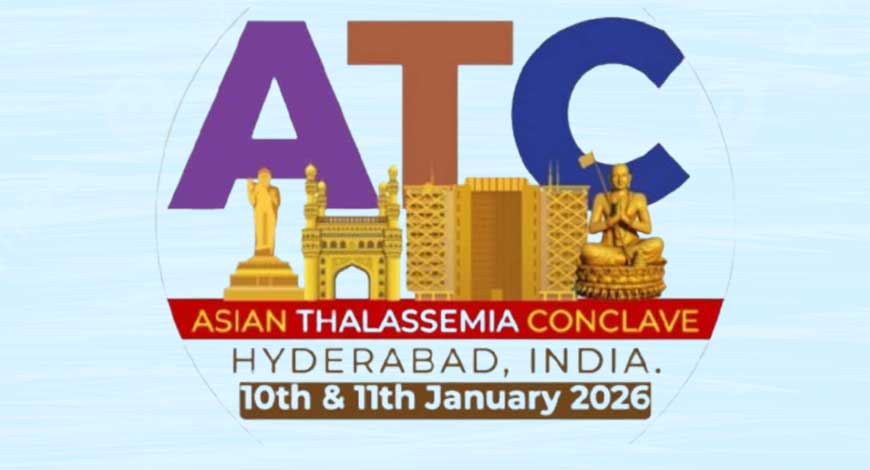
 Hyderabad will host the Asian Thalassemia Conclave (ATC) on January 10 and 11, 2026, bringing together leading doctors, policymakers, researchers, non-governmental organisations and patient groups from India and across Asia to deliberate on a coordinated response to thalassemia, one of the country’s most serious yet preventable genetic blood disorders.





December 17, 2025: Hyderabad will host the Asian Thalassemia Conclave (ATC) on January 10 and 11, 2026, bringing together leading doctors, policymakers, researchers, non-governmental organisations and patient groups from India and across Asia to deliberate on a coordinated response to thalassemia, one of the country’s most serious yet preventable genetic blood disorders.
The two-day conclave is being organised by the Thalassemia and Sickle Cell Society (TSCS), Hyderabad, an organisation that has been closely associated with thalassemia care, prevention and advocacy for more than two decades. TSCS is among the world’s largest non-governmental organisations working exclusively for thalassemia patients and currently provides comprehensive treatment and support free of cost to over 4,350 patients, many of whom depend on the organisation for lifelong blood transfusions and related medical services.
Established over 27 years ago, TSCS has built an extensive ecosystem of patient care, blood transfusion support, counselling services and awareness programmes. Over the years, it has also worked closely with government agencies, healthcare institutions and community groups to strengthen both treatment and prevention efforts. One of its most significant contributions has been in Mahabubnagar district of Telangana, which became the first district in the country to achieve 100 per cent prenatal screening of pregnant women for thalassemia. Public health experts have cited this initiative as a landmark example of how systematic screening and counselling can dramatically reduce preventable thalassemia births.
The Asian Thalassemia Conclave has been conceived against this backdrop, with organisers seeking to take successful local and national models to a wider platform. The conclave has set a clear and time-bound objective: to work towards making India a thalassemia-free country by 2035. India continues to account for one of the highest thalassemia burdens globally, with an estimated thousands of children born every year with transfusion-dependent thalassemia, despite the fact that the disorder is largely preventable through early screening and informed reproductive choices.
Thalassemia places a significant emotional, social and financial burden on families. Children with severe forms of the disorder require regular blood transfusions, iron chelation therapy and constant medical monitoring throughout their lives. Families often face challenges related to the availability of safe blood, access to specialised care and the long-term cost of treatment. Organisers of the conclave say their decades of work with patients have underscored the limitations of a treatment-only approach and the urgent need to place prevention at the centre of public health policy.
Over the two days, the conclave will deliberate on prevention-first strategies aimed at reducing new thalassemia births. Key areas of discussion will include the case for premarital and antenatal screening, strengthening and standardising genetic counselling services and integrating thalassemia screening into existing maternal and child health programmes. Experts will also focus on improving voluntary blood donation systems to ensure a safe, adequate and reliable blood supply for patients who continue to depend on regular transfusions.
Another major focus area will be equitable access to treatment and long-term care. Participants will examine disparities in healthcare access, particularly in rural and underserved regions, where diagnostic facilities, transfusion centres and specialist services remain limited. Discussions will explore practical measures to improve referral systems, expand decentralised care and ensure affordability and continuity of treatment across regions.
A key objective of the Asian Thalassemia Conclave is to bridge the gap between medical expertise and public policy. By bringing clinicians, researchers and policymakers onto a common platform, the conclave aims to translate clinical knowledge and research evidence into implementable policies and uniform national guidelines. Successful prevention and screening models from other countries will also be discussed, with a view to adapting them to India’s social, cultural and healthcare context.
Patient advocates and families living with thalassemia will play an important role in the discussions, sharing their lived experiences and highlighting issues such as social stigma, emotional stress and the challenges of long-term care. Organisers believe that incorporating patient perspectives is essential for shaping policies that are both practical and compassionate.
The conclave is also expected to contribute to the development of a unified national roadmap for thalassemia prevention and control. Emphasis will be placed on improving coordination between central and state governments, medical institutions, blood banks and civil society organisations, so that efforts are aligned and outcomes are measurable.
Organisers said the Asian Thalassemia Conclave is intended to be a catalyst for sustained national action rather than a one-time event. By convening stakeholders from across the region and beyond, the conclave aims to build long-term momentum towards reducing preventable thalassemia births and strengthening prevention-led public health strategies across the country.






.jpeg)










.jpg)
.jpg)
.jpg)
.jpg)
.jpg)
.jpg)


.jpg)