 Thursday, October 08, 2026
 Industry, Academia, and Policymakers Discuss a Resilient Healthcare System for India.





Bodh Gaya, September 14, 2025
The Indian Institute of Management, Bodh Gaya, hosted Convergence 2.0, its flagship healthcare leadership summit, bringing together industry leaders, policymakers, clinicians and innovators to discuss a technology-driven, patient-centric future for healthcare in India. The event, held on September 14, was organised around the theme “Re-imagining Healthcare Ecosystem with Technological Advancements” and brought together experts to share practical insights on how emerging technologies are reshaping the healthcare landscape.
The day opened with inaugural ceremonies, after which Dr. Vinita S. Sahay, Director of IIM Bodh Gaya, emphasised the need for an India-specific healthcare vision, stating “India cannot afford healthcare the way the West does. What we need is a nation that is well, healthy, and strong in body and spirit.” Prof. Swapnarag Swain, Chairperson MBA(Hospital & Healthcare Management) IIM Bodh Gaya, highlighted the purpose of the leadership summit to establish a strong and continued exchange of knowledge between academia and industry. The remarks framed the summit’s focus on scalable, equitable solutions and set the tone for the discussions that followed.
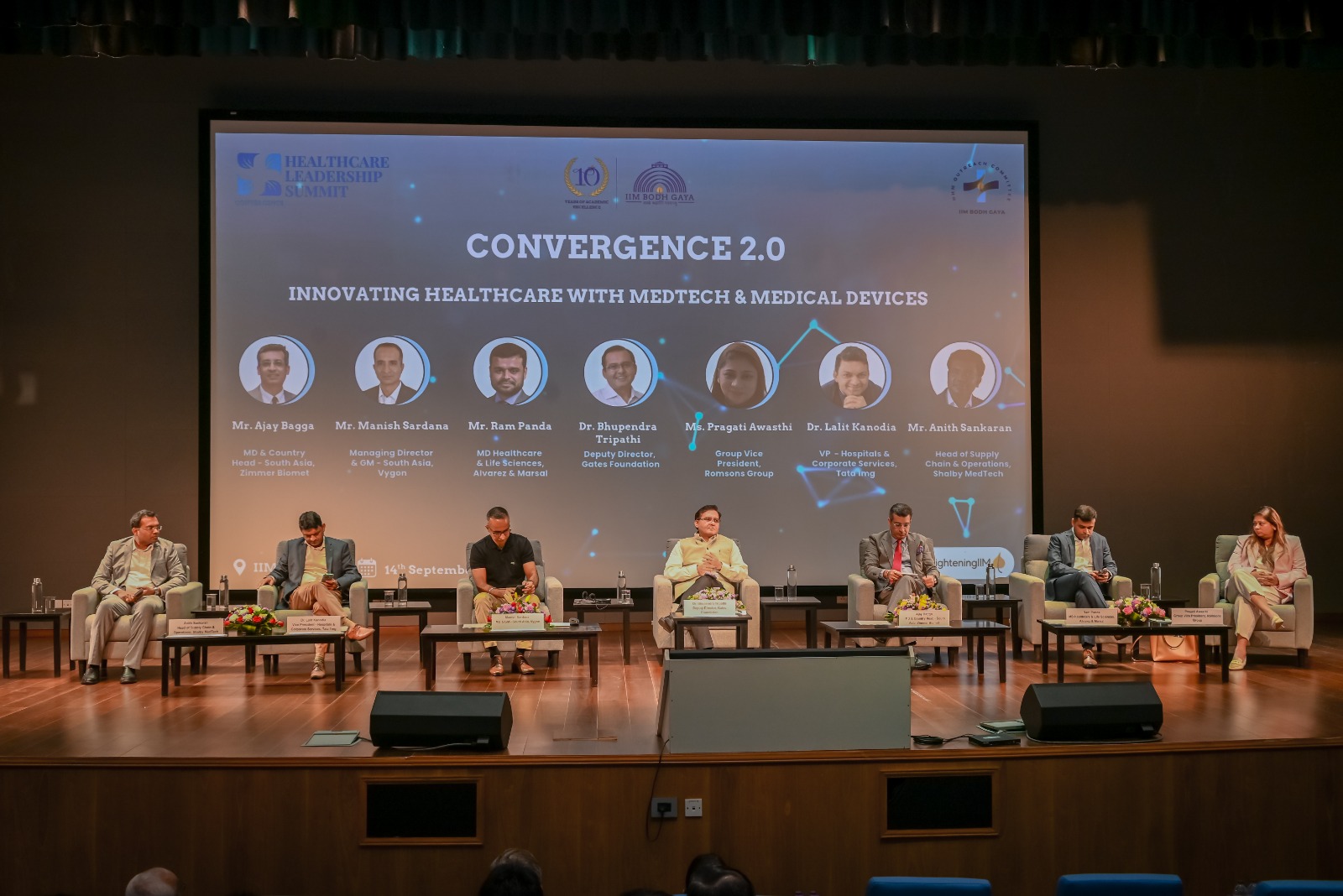
A series of panel discussions led by senior practitioners and thought leaders then examined key aspects of the healthcare ecosystem. The opening panel, “Innovating Healthcare with MedTech and Medical Devices,” examined the R&D-to-deployment lifecycle, the case for indigenous manufacturing under the Make in India initiative, regulatory considerations for ethical adoption, and the role of AI, IoT and robotics in improving device performance and patient outcomes. Panelists included Mr. Ajay Bagga, MD & Country Head, Zimmer Biomet; Mr. Manish Sardana, MD & GM, South Asia, Vygon; Mr. Ram Panda, MD, Healthcare & Life Sciences, Alvarez & Marsal; Dr. Bhupendra Tripathi, Deputy Director, Gates Foundation; Ms. Pragati Awasthi, Group VP, Romsons Group; Dr. Lalit Kanodia, VP, Hospitals & Corporate Services, Tata 1mg; and Mr. Anith Sankaran, Head of Supply Chain, Shalby MedTech.
Another session, “Healthcare Services Redefined through Digital Transformation,” addressed interoperable digital health records, AI and predictive modelling to improve diagnoses and outcomes, and the scaling of personalised care through digital platforms. The panel discussed how telemedicine and wearable technologies are changing patient access and considered strategies for developing a digital-ready healthcare workforce. Speakers included Mr. Navneet Bali, CEO, Clearmedi Healthcare; Dr. Sameer Gupta, Senior Cardiologist, Metro Hospitals; Mr. Vikram Anand, Partner, Healthcare, Deloitte; Mr. Neeraj Lal, Regional Director, Medicover Hospitals; Mr. Durga P. Nayak, Head HR, Aster DM Healthcare; and Dr. Abhishek Pawar, Associate Director, Hosmac India.
The programme also addressed the pharmaceutical and life-sciences sector, with a panel on supply-chain resilience, affordability and access to innovative therapies, the role of clinical trials, and emerging trends in vaccines, immunotherapy and personalised medicine. Panelists included Mr. Manpreet Singh Sodhi, Sr. VP People & Culture, Synthimed Labs; Mr. Rajesh Kumar Pebbilli, Global Head HR, ACG Pharmapack; Mr. Suhas Ram C, Head Talent Management, Aurobindo Pharma; Mr. Gaurav Gupta, Lead HR, Boehringer Ingelheim; Mr. Mausham Kumar, Lead HR Business Partner, Dr. Reddy’s; and Mr. Prithwish PathakAssociate VP Learning, Alkem Labs.
The concluding discussion on provider–payer synergies considered value-based care models, integrated insurance solutions to enhance patient access, financial innovation through digital payments, and the development of sustainable partnerships to improve long-term health outcomes. Contributors to this session included Mr. Vaibhav Arora, Director Healthcare Consulting, KPMG; Mr. Suvendu Shekhar Tripathy, Associate Partner, Cognizant; Ms. Shilpa Arora, Co-Founder & COO, Insurance Samadhan; and Col. Hemraj Singh Parmar, Co-Founder, AyushPay.
Convergence 2.0 highlighted the potential of technology to support a cohesive and resilient healthcare ecosystem. Discussions covered AI-driven diagnostics, telemedicine, connected medical devices and data intelligence, and produced actionable recommendations for improving interoperability, strengthening supply chains and promoting responsible adoption of new technologies. The summit brought together diverse stakeholders, leaving participants with clear avenues for collaboration to advance a technology-enabled, patient-centred healthcare system. IIM Bodh Gaya is committed to shaping its MBA in Hospital and Healthcare Management (HHM) programme as a highly industry-centric, practice-oriented course aligned with the evolving needs of the healthcare sector.
About IIM Bodh Gaya: (https://iimbg.ac.in/)
Building on the grand heritage of the IIM brand, IIM Bodh Gaya fosters a culture and curriculum aimed at creating socially responsible managers and emotionally mature leaders. In addition to classroom learning, the institute emphasises hands-on experience through live projects, industry interactions, and research-driven pedagogy. With a rapidly growing reputation, IIM Bodh Gaya has consistently improved its standing in national rankings and continues to produce professionals who make significant contributions across industries.






.jpeg)










.jpg)
.jpg)
.jpg)
.jpg)
.jpg)
.jpg)


.jpg)