 Saturday, October 10, 2026
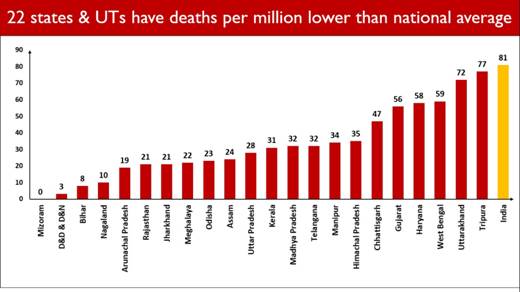
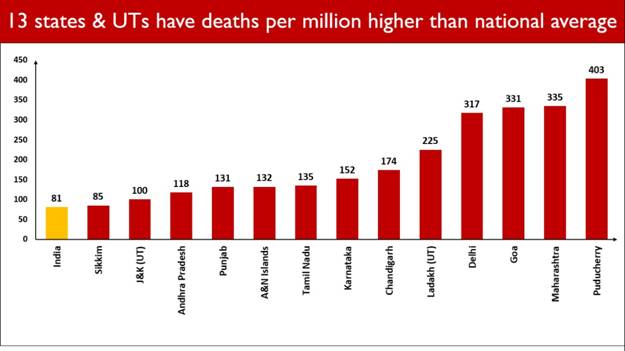
 India continues to report one of the lowest deaths per million population which stands at 81 today.




India continues to report one of the lowest deaths per million population which stands at 81 today.
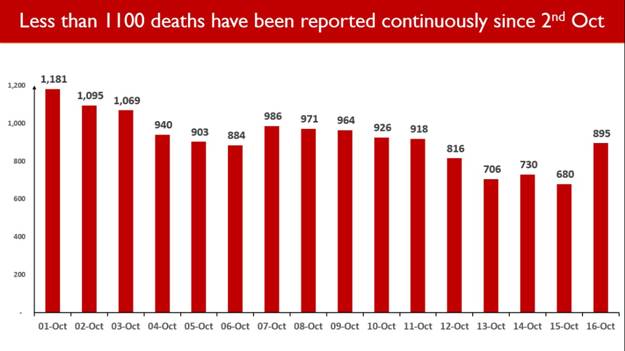
Less than 1100 deaths have been reported continuously since 2nd October.
These results are boosted by 22 States/UTs which had demonstrated better performance and are reporting even lower deaths per million compared to the national average.
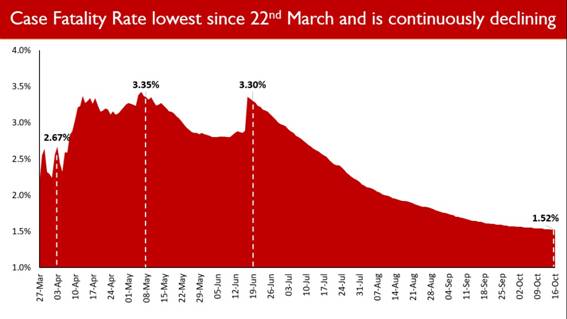
Case fatality rate has been on the downslide continuously. At the current figure of 1.52%, it is the lowest since 22nd March 2020.
As part of the COVID management and response policy, there has been a sharp focus of the Central Government on not only containing spread of COVID, but to reduce deaths and to save lives by providing quality clinical care to the critical and severe patients of COVID. Collaborative efforts of the Union and State/UT governments have resulted in strengthening of the health facilities across the country. 2212 Dedicated COVID Hospitals are providing quality medical care. The Central Government has also issued the Standard of Care guidelines incorporated in the Clinical Treatment Protocol which has ensured standardized quality of medical care for all COVID patients in the government and private settings.
A unique initiative to build the capacities of the ICU doctors in clinical management of critical patients towards reducing the fatality, e-ICU has been started by AIIMS, New Delhi. Twice a week, on Tuesdays and Fridays, tele/video -consultation sessions are held by knowledge and domain experts for the doctors manning ICUs in the State hospitals. These sessions started from 8th July 2020.
Till date, 23 tele-sessions have been held, and 334 institutions across 34 Sattes/UTs have participated in them.
Maintaining the spree of registering more recoveries than the new confirmed cases, 70,338 single day recoveries were registered in last 24 hours as against 63,371 new confirmed cases. The total recovered cases stand at 64,53,779. The gap between Recovered cases and Active cases has crossed 56 lakh (56,49,251). The recovered cases are 8 times more than the active case now.
The Active Cases are sliding continuously. Presently the active cases comprise merely 10.92% of the total positive cases of the country standing at 8,04,528. Higher number of recoveries has aided the national Recovery Rate to further improve to 87.56%.
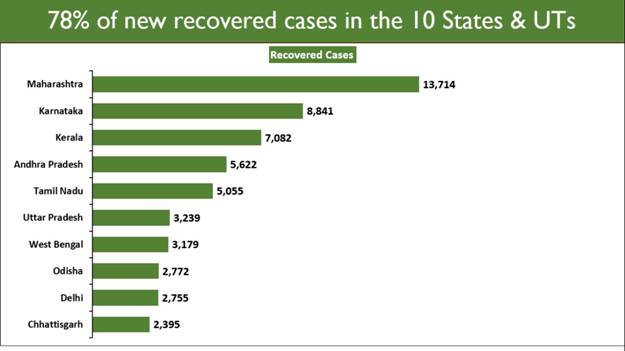
78% of the new recovered cases are observed to be concentrated in 10 States/UTs. Maharashtra alone has contributed the maximum with more than 13,000 single day recovery.
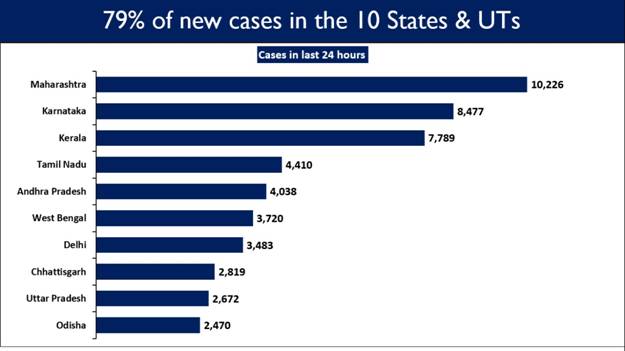
79% of the new cases are from 10 States and UTs. Maharashtra continues to be the State reporting a very high number of new cases with more than 10,000 cases followed by Karnataka with more than 8,000 cases.
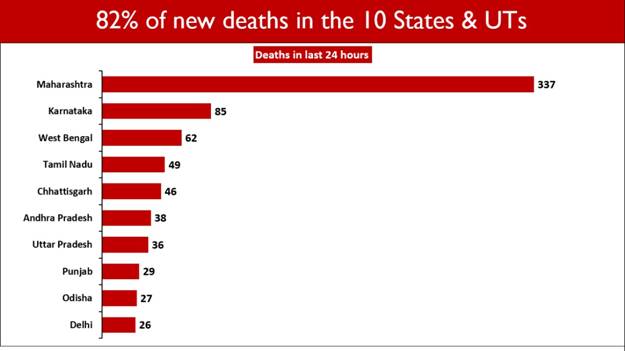
895 case fatalities have been reported in the past 24 hours.
Of these, nearly 82% are concentrated in ten State/UTs of Maharashtra, Karnataka, West Bengal, Tamil Nadu, Chhattisgarh, Andhra Pradesh, Uttar Pradesh, Punjab, Odisha and Delhi.
More than 37% of new fatalities are reported are from Maharashtra (337 deaths).
13 States/UTs are reporting deaths/million population more than the national average.





.jpeg)










.jpg)
.jpg)
.jpg)
.jpg)
.jpg)
.jpg)


.jpg)