 Thursday, October 08, 2026
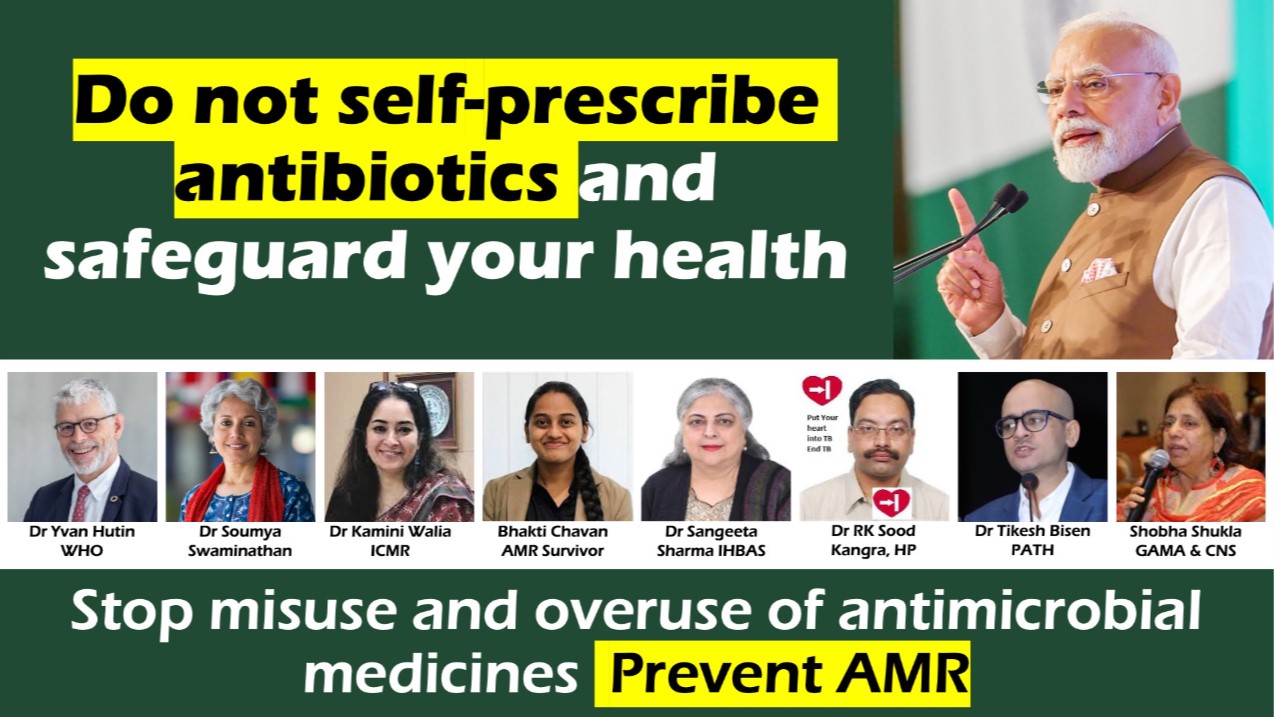
 Antimicrobial resistance (AMR) is among the top 10 global health threats - and is also a threat to food safety and security and environment.




Antimicrobial resistance (AMR) is among the top 10 global health threats - and is also a threat to food safety and security and environment. AMR warrants more robust action to stop misuse and overuse of antimicrobial medicines in all sectors with One Health approach. World leaders have come together twice earlier in 2016 and 2024 at United Nations General Assembly High Level Meetings, and adopted Political Declarations with important time-bound commitments that have spurred stronger global response. But we need more country-level leadership at highest levels of echelons of power and sub-national levels to spark lasting change for health security.
AMR concerns all of us, says Indian PM
"Medicines require guidance, and antibiotics require doctors." Indian Prime Minister Narendra Modi on 28th December 2025 gave a clear message to the people to not take antibiotics at their own discretion - rather take them only when prescribed by medical experts.
The government of India's apex and prestigious medical research body - Indian Council of Medical Research (ICMR) released an important report recently which states that antibiotics are proving ineffective against many diseases like pneumonia and urinary tract infections. According to ICMR report, a major reason for this is people's indiscriminate use of antibiotics. Antibiotics are not medicines that should be taken mindlessly. They should be used only upon medical advice.
"In the final #MannKiBaat of 2025, our PM has cautioned the country on increasing trends of antibiotic resistance. For this, he referred to ICMR's recently published AMR Research and Surveillance Network Report. As per that report, we are seeing increasing levels of resistance to commonly used antibiotics in patients from 25 hospitals across the country. This paints a very grim scenario because patients having drug-resistant infections have to spend more money on treatment, stay longer in the hospitals, and sometimes are not able to recover from these infections leading to their untimely death. AMR is driven by misuse and overuse of antimicrobial medicines. Patients should not consume antibiotics without prescription from the treating doctors," said Dr Kamini Walia who heads ICMR AMR Surveillance Network and is among the senior-most ICMR scientists (Scientist-G).
When simple infections become difficult to treat...
When simple infections become difficult (or impossible) to treat, then it is a completely preventable catastrophe for the people and communities. This is also undoing the historic gains made in modern science as no one wants to slide back to pre-antibiotic era, says Global AMR Media Alliance (GAMA).
Former WHO Chief Scientist and former ICMR Director General Dr Soumya Swaminathan shared: "This is an important message and warning from the Indian PM. Over the counter use of medicines, unnecessary use of antibiotics, rampant use (of antimicrobial medicines) in agricultural and livestock sectors, improper disposal from pharmaceutical factories and hospitals, and ability of bacteria to develop resistant mutations all contribute to AMR."
We have to stop misuse and overuse of medicines - be it antibiotics (which work against bacterial infections like TB), anti-fungal medicines (which work against fungal diseases), anti-viral medicines (which work against viral infections like HIV) or anti-parasitic medicines (which work against diseases like malaria). We also have to stop misuse and overuse of antimicrobial medicines in all sectors, because the problem of misuse and overuse of medicines is rampant in them - such as human health, animal health or livestock, food and agriculture and our environment, says GAMA.
WHO AMR Director commends India's political commitment
"We have been very happy to note that the Prime Minister of India Narendra Modi has made explicit reference to the importance of mitigating the emerging threat of antimicrobial resistance at the national level - and by doing so he made a specific reference to the importance of addressing over-the-counter use of antibiotics," said Dr Yvan JF Hutin, Director, WHO Antimicrobial Resistance Department in Geneva.
Dr Hutin stressed on importance of ensuring that we use antimicrobial medicines responsibly (and stop their misuse and overuse) while we accelerate the development of new medicines - and improve access to healthcare services where no one is left behind.
Hope from India
Dr Hutin commended India which "..has a lot to offer... Whether it is on the capacity for research and development, production capacity, or antimicrobial stewardship, we know that the country has a lot of potential to improve the situation nationally - and - to assist other countries in the world."
Dr Hutin commended ICMR's ongoing nationwide efforts on AMR surveillance in India and offered WHO's continued support to strengthen it. "There could even be some national representative survey that could help us quantify the problems and make sure we have an adopted response," said Dr Hutin.
"AMR is invisible. But I am not"
AMR survivor Bhakti Chavan, who is also a member of the WHO Task Force of AMR Survivors, thanked the Indian PM for bringing AMR to national attention. "I am an AMR survivor. Despite having no previous history of TB, I was diagnosed with extensively drug-resistant TB or XDR-TB (one of the severest forms of drug-resistant TB). This means that these drug-resistant strains are already circulating in the environment. Timely diagnosis, access to the novel medicines and completion of two years treatment as prescribed by my doctor, were critical for my recovery. Along with a responsible use of antibiotics, strengthening early diagnosis, access to the novel treatments, having a robust AMR surveillance system, R&D for new medicines, and creating awareness remain essential to fight against AMR. It is time to act now."
Pledge to prevent AMR
"Let us make a simple pledge today that we will use antibiotics only on medical advice, complete the full treatment course when and as prescribed, and help stop antimicrobial resistance before it stops us," said Dr Sangeeta Sharma, Professor and Head of the Department of NeuroPsycho-Pharmacology at the government-run Institute of Human Behaviour and Allied Sciences (IHBAS) and President of Delhi Society for Promotion of Rational Use of Drugs (DSPRUD). Dr Sangeeta Sharma is also part of the Steering Committee of WHO Civil Society Task Force on AMR.
Drug-resistant infections like TB are entirely preventable
Dr Rajesh Kumar Sood, District Health Officer and District TB Officer, Kangra, Himachal Pradesh, India, who has played a pivotal role in shaping sub-national health responses especially TB, said: "We welcome the AMR statement by Indian PM. Even TB response is challenged by drug-resistant TB. We call upon everyone to join the clarion call to prevent AMR."
Although tremendous efforts have happened, drug-resistant TB rates have almost remained plateaued around 400,000 every year worldwide since last two decades. There is no excuse for inaction, says GlobaL AMR Media Alliance (GAMA). We have to ensure that:
* No one gets infected with TB bacteria or drug-resistant TB bacteria in the first place. So, optimal infection prevention and control in all settings like healthcare, communities and homes is vital, and
* Everyone with TB or drug-resistant TB, gets right and timely diagnosis, right treatment, care and support without any delay. Currently, we barely diagnose and treat one-third of the (under)-estimated people with drug-resistant TB globally - this is so unacceptable.
Urgency must drive AMR response
"The words of Prime Minister of India underscore an urgent reality: antibiotics, once life-saving, are losing their effectiveness against common infections like pneumonia and urinary tract infections, as highlighted in the recent ICMR report. PM's call to action is timely and vital. AMR is a pandemic which is threatening global health security," said Dr Tikesh Bisen of PATH. "Visionary leadership that advocates for such critical issues will undoubtedly help generate awareness at scale and inspire responsible action across communities. This is how we can build a healthier, safer future together."
Let us hope that in 2026 and beyond, no one gets infected from a preventable disease, and all those with infections are able to access right and timely diagnosis, correct treatment, care and support in person-centred and rights-based manner. Right to health is a fundamental human right and it is high time for governments to walk the talk and deliver on #HealthForAll.






.jpeg)








.jpg)
.jpg)
.jpg)
.jpg)
.jpg)
.jpg)


.jpg)
.jpg)
.jpg)