 Thursday, October 08, 2026
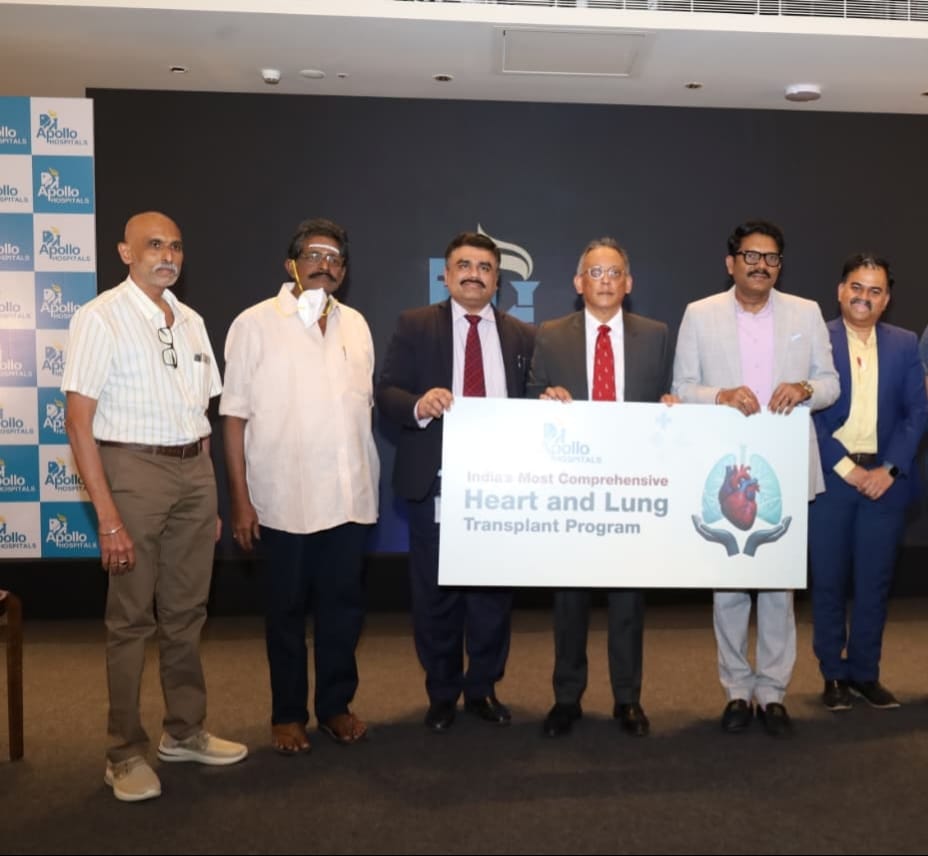
 Consistent, high-survival outcomes position Apollo Hospitals, Chennai as India’s leader in advanced heart and lung failure management.




Chennai, 22 January 2026: Apollo Hospitals, Chennai continues to set national benchmarks in the treatment of advanced heart and lung disease, driven by one of India’s most comprehensive heart, lung, and ECMO-supported transplant programs. The transplant team, with significant national and international experience, have performed 600+ heart and lung transplants, managed over 2,000 transplant patients, 1,000+ Extracorporeal Membrane Oxygenation (ECMO) cases, along with 250+ Left Ventricular Assist Devices (LVAD) procedures and 250+ Chronic Thromboembolic Pulmonary Hypertension (CTEPH) interventions.
The multidisciplinary heart-lung transplant and MCS program at Apollo expertly manages patients with end-stage heart and or lung failure, offering personalised solutions for those who no longer respond to maximal medical therapy. Be it a stabilising, bridging or definitive treatment with transplanting hearts and lungs, or implanting durable mechanical cardiac pumps for failing hearts, our patients are supported through a continuum of focused and evidence-based care.
The team also offers comprehensive solutions for even the most complex cardiopulmonary conditions, such as the gold standard treatment of Pulmonary Endarterectomy (PEA) for appropriate patients with CTEPH, where the chronic blood clots in the lung arteries are removed surgically.
The press conference held to mark this milestone featured patients from different age groups and levels of illness severity, who shared how their lives were transformed by the program. Among them were Mr. Raja Sivagurunathan (59), who survived a critical phase on ECMO support for 48 days before undergoing an emergency double-lung transplant; Mr. B. Saravanan (45), who developed sudden and severe lung failure and was supported on life-saving machines for two weeks until a successful lung transplant; and Mr. Radhae Shyam Raghuvanshi (72), whose condition worsened abruptly and who was airlifted to Chennai before receiving a double-lung transplant after advanced support.
Commenting about ECMO and Transplantation, Dr. Srinivas Rajagopala, Senior Consultant & Clinical Lead - Pulmonology, Sleep Medicine and Lung Transplant, Apollo Hospitals Chennai said, “These outcomes demonstrate how early and appropriate use of ECMO can fundamentally alter the course of severe lung failure. It provides a vital bridge allowing time for stabilisation, informed decision-making, and preparation for lung transplantation. Success lies in constant vigilance, multidisciplinary teamwork, and highly personalized care. Our goal is always meaningful recovery, not merely short-term survival.”
Dr. Kumud Kumar Dhital, Head of Heart and Lung Transplantation at Apollo Hospitals, Chennai, emphasized “Patients suffering from advancing heart and lung failure, with escalating medical therapy and declining quality of life, deserve to be informed of the transplant options at a far earlier stage. Outcomes improve significantly when patients are referred early and managed with strong, protocol-driven hospital care. Age itself is not a limitation - what matters is careful evaluation, optimization, meticulous surgery, expert after-care in the ICU, and life-long post-discharge continuity of care so as to maximize chances of long-term survivorship.”
Dr. IIankumaran Kaliamoorthy, CEO – Chennai Region, Apollo Hospitals also participated in the press conference.
As India’s burden of advanced heart and lung disease continues to rise, Apollo Hospitals remains at the forefront of comprehensive cardiothoracic transplantation, combining innovation, expertise, and compassionate care- proving that even the most critical organ failure can be transformed into a second chance at life.
Apollo Hospitals delivers 360-degree care through an integrated, multidisciplinary model involving cardiology, pulmonology, cardiothoracic surgery, anaesthesia, critical care, transplant coordination, rehabilitation, and seamlessly coordinates this with post-discharge and long-term follow-up. The program’s focus extends beyond survival to restoring functional independence and quality of life for patients while fully informing and supporting their families.
ECMO serves as a vital life-support technology within this ecosystem. This mechanical support temporarily takes over the function of the heart and/or lungs when conventional therapies fail. By oxygenating blood outside the body, ECMO allows failing organs to rest and recover or acts as a crucial bridge to recovery or transplantation. The program integrates VV-ECMO for lung support, VA-ECMO for cardiac and combined heart-lung failure. LVADs in the form of implantable and mechanical heart pumps are offered to suitable candidates as durable alternatives or bridge to heart transplantation.






.jpeg)








.jpg)
.jpg)
.jpg)
.jpg)
.jpg)
.jpg)


.jpg)
.jpg)
.jpg)