 Sunday, October 11, 2026
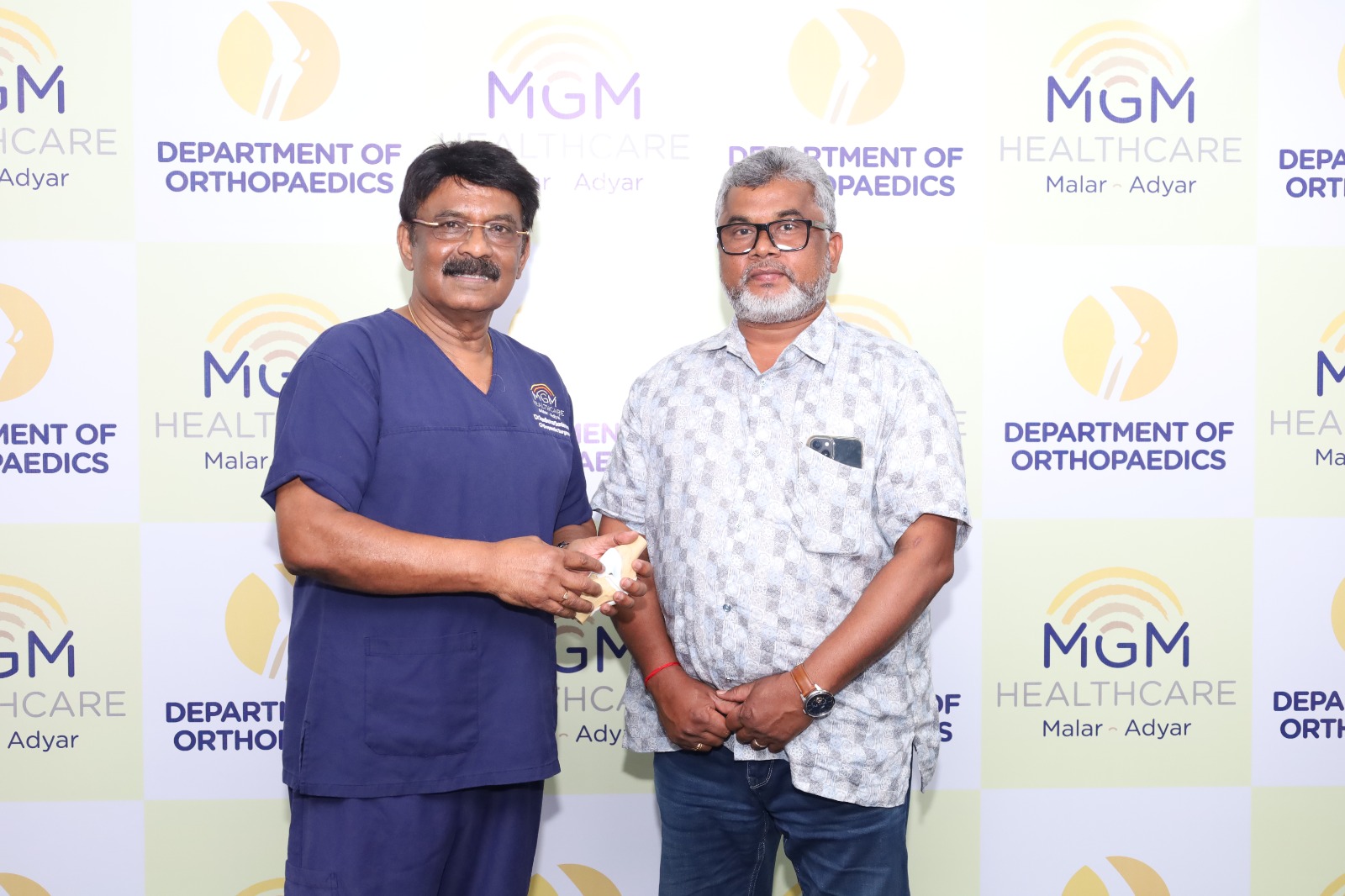
 A 53-year-old patient with long-standing osteoarthritis remains completely symptom-free six years after undergoing this advanced cartilage transplant.




Chennai, December 27, 2025: MGM Healthcare Malar, Adyar has successfully performed a fifth-generation Autograft Cartilage Tissue Transplant, an advanced daycare arthroscopic technique that enables patients to walk immediately after surgery and helps avert the need for total knee replacement. In this single-stage procedure, healthy cartilage is harvested from the patient’s own joint and transplanted to the damaged area, overcoming major limitations of earlier methods such as multiple surgeries or external cartilage culturing.
This advanced cartilage tissue transplant is particularly beneficial for patients with focal chondral defects, osteochondral lesions, early osteoarthritis, and chondromalacia patella, conditions where untreated cartilage damage can lead to severe joint degeneration and the eventual need for total knee replacement. By preserving the natural joint and restoring damaged cartilage early, this advanced technique offers a safer, joint-preserving solution, especially for younger and active patients.
MGM Malar has been pioneering this technique since 2018. Over the years, it has steadily evolved through continuous research, and patients treated with this approach consistently experience long-term healing, high satisfaction, and preservation of their natural joint, without the need for implants, crutches, or intensive physiotherapy.
In his comments, Dr Nandkumar Sundaram, Senior Consultant, Department of Orthopaedics, said, “In cases where the smooth, cushion-like cartilage in a joint is damaged due to injury, wear-and-tear, or arthritis, specialised techniques are required to restore it and maintain smooth joint movement. Among the available options, autograft cartilage tissue transplant is highly effective. The procedure involves graft preparation, PRP application, using platelet-rich plasma from the patient’s own blood to promote healing, and fibrin glue fixation, a natural biological adhesive that secures the graft. All these steps are completed within a single, minimally invasive arthroscopic procedure. Patients can walk immediately after surgery without the need for braces or assistive supports. This surgery reduces pain, improves mobility, repairs sports or traumatic injuries, and helps prevent or delay the progression of arthritis.”
One of the long-term outcome patients is a 53-year-old man from Tamil Nadu, currently working in Madhya Pradesh, who had suffered from severe knee pain and restricted mobility for over 15 years due to osteoarthritis. Progressive cartilage damage and joint deformity had placed him
at risk of requiring a total knee replacement. However, after undergoing a single-stage autograft cartilage transplant in 2018, he has remained completely symptom-free for six years, demonstrating the remarkable recovery this technique can achieve.
Dr Sundaram emphasized that the success of this procedure depends on strict patient-selection criteria. “When appropriately selected, patients experience significant pain relief, improved mobility, and a prolonged joint lifespan, effectively delaying the need for total knee replacement,” he added.
Mr. Venugopal Bhat, Chief Operating Officer, MGM Healthcare Malar, Adyar, quoted, “This long-term success highlights our commitment to minimally invasive innovation that improves patients’ quality of life.”






.jpeg)










.jpg)
.jpg)
.jpg)
.jpg)
.jpg)
.jpg)


.jpg)