Friday, October 23, 2026
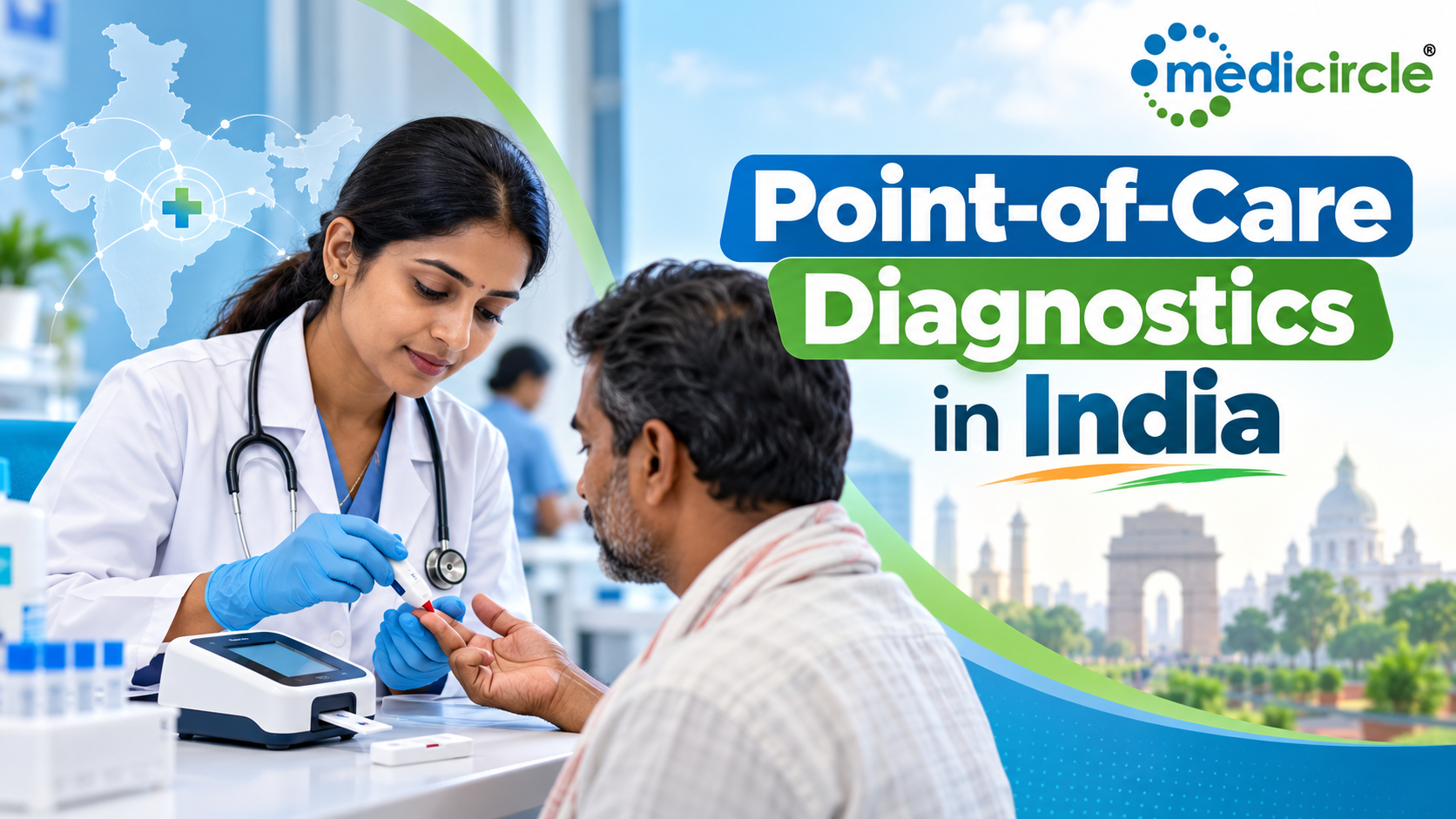
 This article examines point-of-care diagnostics in India from a practical Medicircle perspective, covering the key considerations, implementation or decision points, and ways the topic can support clearer outcomes.





A diagnostic result is useful when it reaches a clinical decision at the right moment. Central laboratories remain essential for many investigations, but some tests can be performed closer to the patient, which may reduce the distance between testing and the next care decision.
Point-of-care diagnostics are therefore about more than speed. Quality assurance, operator competence, connectivity, interpretation and the suitability of a test for the clinical question all determine whether decentralised testing adds real value.
What point-of-care diagnostics change
The defining feature is location. Selected tests are performed close to where the patient is assessed rather than being sent through a longer laboratory pathway. When the result is appropriate for the decision being made, this can shorten a step in the care journey.
It does not mean point-of-care testing replaces laboratories. Many investigations require centralised facilities, specialised equipment or deeper quality processes. The question is where a particular test fits best.
Why the model matters in India
Healthcare access in India varies by geography, infrastructure and health-system capacity. Point-of-care models can be useful in settings where travel to a central laboratory creates delay or where an early result helps determine the next step.
At the same time, decentralisation moves responsibility closer to the point of care. Devices need maintenance, consumables need controlled storage, operators need training and results need dependable recording. Scaling therefore requires systems, not just devices.
Quality management remains essential
A fast result is not automatically a good result. Point-of-care services need defined operating procedures, quality controls, maintenance and pathways for repeat or confirmatory testing where appropriate. Users must also understand the limits of a test.
Digital connectivity can strengthen traceability by recording results and operators, but it should reinforce a quality system rather than create the impression that software removes the need for clinical oversight.
Map testing to the patient journey
A test should answer a defined question. Before deployment, a provider can map who orders it, who performs it, how the result reaches the clinician and what action follows. This helps avoid buying technology first and inventing a workflow later.
The approach is especially useful when point-of-care testing is introduced into a new setting. Clear roles and escalation rules are easier to design before the devices become part of routine practice.
The next step is connected diagnostics
The longer-term opportunity is to connect appropriate near-patient results with the wider health record. This can reduce duplicate entry and give authorised clinicians a more complete picture of the patient's diagnostic pathway.
For India, the potential is meaningful when technology is introduced with measurable quality, good training and a clear patient-access purpose. Speed should be a benefit of the workflow, not its only selling point.
Relevant Internal Reading
Medicircle diagnostics and healthcare coverage
Things to Keep in Mind
- Choose tests around clinical decisions, not novelty.
- Pair decentralised devices with quality controls and training.
- Define who acts on each result before deployment.
- Use digital connectivity for traceability, not as a replacement for governance.
- Evaluate point-of-care programmes by quality and patient access as well as speed.
Frequently Asked Questions (FAQs)
What is point-of-care diagnostics?
It refers to diagnostic testing performed close to the patient rather than only in a central laboratory.
Can point-of-care testing replace laboratories?
No. It is an additional model for selected tests and settings; central laboratories remain essential for many investigations.
Why is quality control important?
Because a rapid result still needs to be reliable, interpretable and produced under an appropriate quality process.
What should providers map before implementation?
They should define the clinical question, operator, workflow, result pathway and action that follows the test.
Wrapping It Up
Medicircle connects healthcare innovation with practical questions about access, quality and patient impact.
For healthcare audiences, the most useful approach is one that makes evidence, process and professional judgement easier to understand. Responsible communication should add context without overstating what the available information can prove.
Resources
WHO - Diagnostics: https://www.who.int/teams/health-product-policy-and-standards/access-to-medicines-and-health-products/diagnostics
WHO - Primary health care: https://www.who.int/health-topics/primary-health-care
Interlinking Keywords
Medicircle diagnostics and healthcare coverage: https://www.medicircle.in/medicircle-blog
Editorial / Medical Disclaimer
This article is intended for informational and educational purposes only. It does not constitute medical advice, diagnosis, treatment or a substitute for professional clinical judgement. Medical decisions should be made with a qualified healthcare professional. Where factual or regulatory information is discussed, readers should consult the latest authoritative guidance because requirements and evidence can change.





-23-300x250.png)

.jpeg)
.jpg)
.jpg)
.jpg)
.jpg)
.jpg)
.jpg)
.jpg)
.jpg)
.jpg)