 Thursday, October 08, 2026
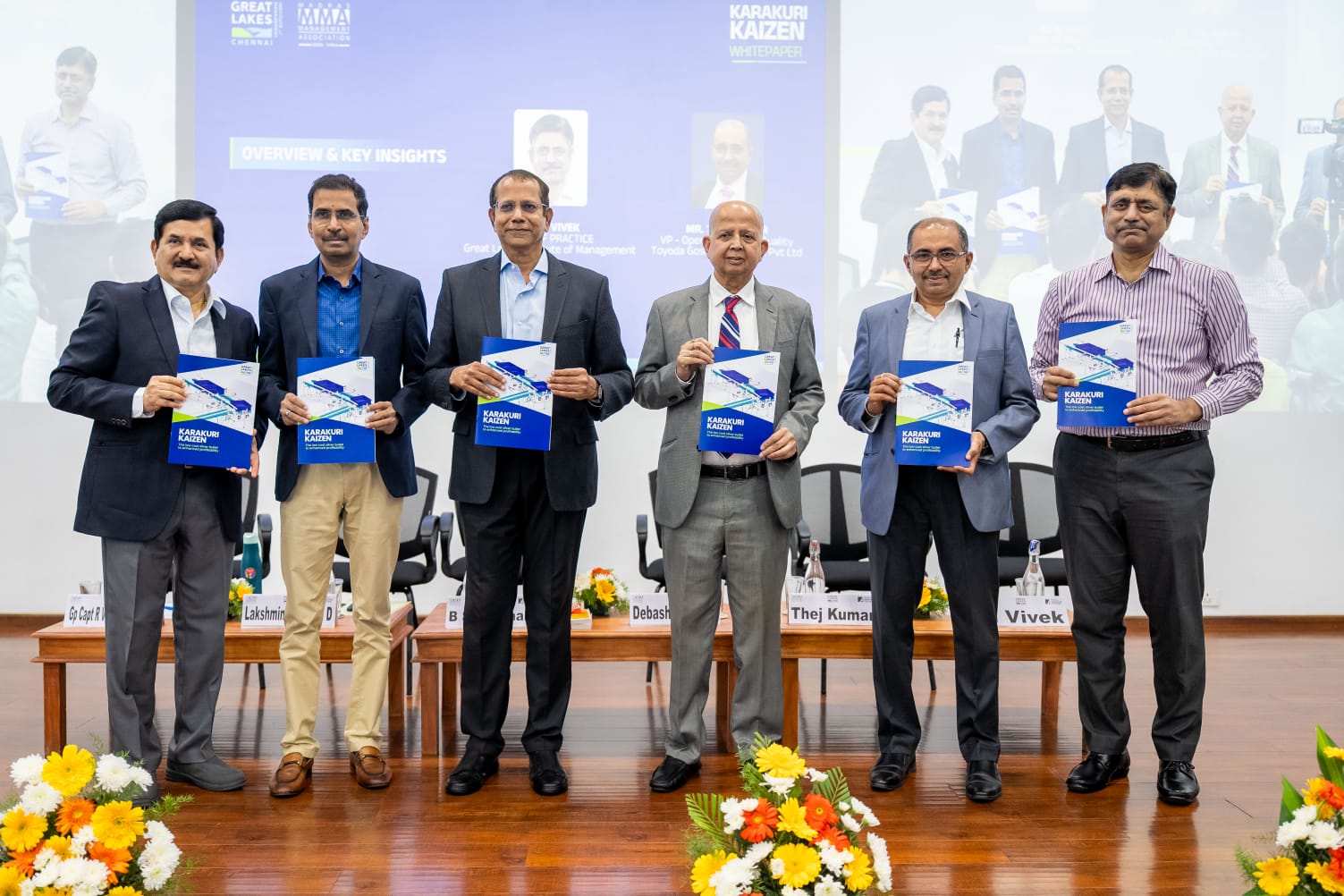
 A new white paper released by Great Lakes Institute of Management, Chennai, in collaboration with the Madras Management Association, finds that power-free mechanical automation can reduce factory cycle times by over 50 percent while improving ergonomics, throughput, and sustainability without heavy capital investment.




Chennai, January 10, 2026: A new white paper released by Great Lakes Institute of Management, Chennai, in collaboration with the Madras Management Association, finds that power-free mechanical automation can reduce factory cycle times by over 50 percent while improving ergonomics, throughput, and sustainability without heavy capital investment.
The white paper titled, Foundations of Organisational Efficiency: Karakuri Kaizen and the Logic of Low-Cost Innovation, is based on primary research conducted in collaboration with Toyoda Gosei South India Pvt. Ltd. It presents India-based, shop-floor findings on how Karakuri Kaizen, a gravity-driven, power-free mechanical automation philosophy from the Toyota Production System, is delivering measurable gains in productivity, ergonomics, cost efficiency, and sustainability without heavy capital investment.
Evidence-backed insights from Indian manufacturing based on direct observation and analysis of live operations at Toyoda Gosei South India, the white paper documents how simple mechanical systems using gravity, rollers, pulleys, levers, and counterweights can replace manual effort and, in some cases, expensive powered automation.
Key findings highlighted during the session include:
- Cycle time reductions of over 50 percent in specific lifting and handling operations, with some processes reduced from approximately eight minutes to three to four minutes
- Zero electricity consumption in processes where Karakuri replaced powered systems
- Improved throughput and smoother material flow in bumper handling and tray movement systems
- Reduced physical strain on workers by eliminating repetitive lifting, bending, and excessive motion
- Scrap reuse levels reaching up to 90 percent, contributing to waste reduction and space optimisation
The research was led by Great Lakes faculty and grounded in on-ground engagement with Toyoda’s operations and workforce. Rather than relying on secondary data or theoretical models, the study captures before-and-after metrics and translates tacit shop-floor practices into structured, transferable insights for Indian industry.
Speaking at the event, Dr. N. Vivek, Professor of Practice - Operations at Great Lakes, Chennai and lead author of the white paper, said, “What makes Karakuri powerful is not its simplicity alone, but its discipline. By studying Toyoda’s shop-floor implementations closely, we were able to demonstrate how thoughtful mechanical design can unlock efficiency, safety, and sustainability simultaneously, without defaulting to expensive automation.”
Co-author Dr. M. S. Narassima, Associate Professor at Great Lakes, Chennai added, “Our contribution was to convert lived operational practice into evidence-backed learning. The findings show that many efficiency problems are design problems, not technology problems, and that distinction is especially important in the Indian manufacturing context.”
The event featured a keynote address by Mr. B. Santhanam, Former CEO – Asia Pacific & India and Chairman, Saint-Gobain India, who served as the Chief Guest. In his keynote, Mr. Santhanam remarked, “Karakuri Kaizen reminds us that innovation does not have to be capital-intensive to be impactful. The ability to achieve higher throughput, better safety, and lower costs through intelligent mechanical design is deeply relevant for the Indian industry, particularly in an era of cost pressure and sustainability expectations.”
The white paper launch was followed by a panel discussion titled Karakuri Kaizen and the Future of Frugal Automation: Lessons for Indian Industry, which explored where low-cost mechanical ingenuity fits alongside digital and robotic automation, and how organisations can build problem-solving capability before investing in high-end technology.
The discussion underscored the paper’s central argument: optimising flow and ergonomics first enables smarter, more context-driven automation decisions later.






.jpeg)








.jpg)
.jpg)
.jpg)
.jpg)
.jpg)
.jpg)


.jpg)
.jpg)
.jpg)