 Thursday, October 08, 2026
 Achieving the next frontier of population health outcomes will require doubling current health investment (CHE) from ~3–4% of GDP today to ~6–7%.




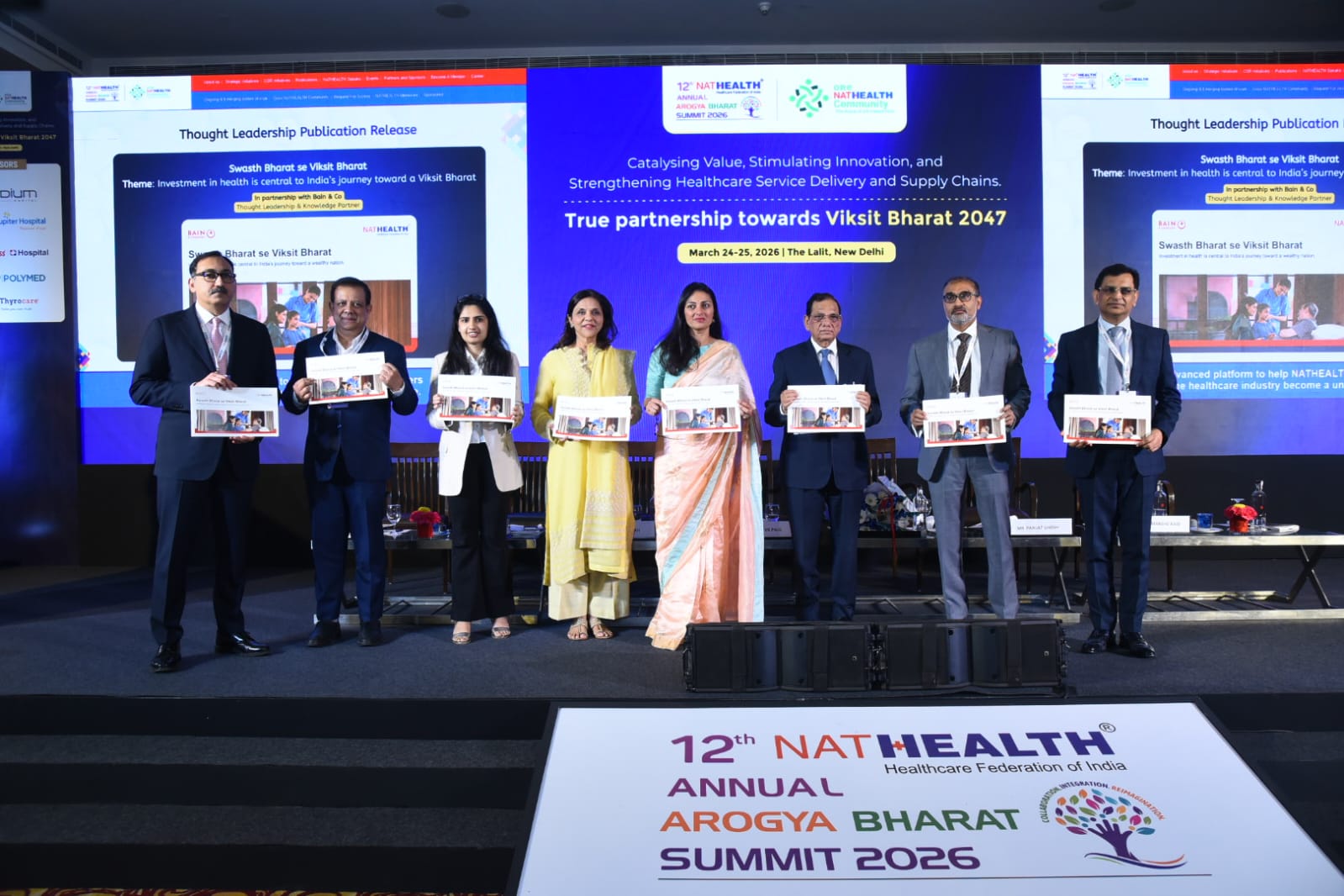
NEW DELHI—March 25, 2026—India’s high disease burden imposes ~$0.8–$1 trillion in annual opportunity cost due to reduced workforce participation, according to a new report released by Bain & Company and NATHEALTH, titled Swasth Bharat se Viksit Bharat: Investment in health is central to India’s journey toward a wealthy nation.
The report highlights that improving population health will be critical to sustaining India’s long-term economic growth and fully harnessing the country’s demographic dividend. India is in a multidecade demographic dividend window – from 2019 to 2053 – when a larger share of the population is of working age. Realizing the full value of that opportunity will depend not only on labor force size, but also on the health, productivity and resilience of the population. Estimates show that India currently loses approximately 37,000 healthy life years per 100,000 population, reflecting years of life lost due to premature mortality and years lived with disability or illness.
Analysis across roughly 190 countries shows a clear inflection point once HALE exceeds approximately 57 years, after which GDP per capita growth accelerates materially. Each additional year of HALE is associated with approximately 7.5% higher GDP per capita.
Population health is a foundational enabler of India’s long-term growth ambition. India’s HALE has already increased from approximately 50 years in 1990 to approximately 61 years today. “We’ve made important progress in improving access and outcomes over the past decade, but the next phase requires sharper focus. The fact that raising HALE from 61 to 70 could deliver a 5x increase in GDP per capita shows how critical it is to double down on prevention, strengthen delivery capacity, and scale digital health across the system,” said Parijat Ghosh, Head of Bain & Company’s Asia-Pacific Healthcare & Life Sciences practice. “This improvement alone could contribute about 70% of India’s aspiration to reach $18,000–$20,000 GDP per capita under the Viksit Bharat vision.” he adds.
Comparisons with peer countries further illustrate the relationship between population health and economic prosperity. Countries with higher healthy life expectancy, such as China, South Korea, and Poland also exhibit significantly higher GDP per capita compared with India. Analysis in the report shows that countries that achieved 10-year HALE gains or more over the past three decades, including China and South Korea experienced roughly two times higher GDP per capita growth.
Sustained and increased investment in health will be essential to accelerating improvements in population health outcomes. To reach the next frontier of health outcomes, the report estimates that India will need to nearly double current health investment (CHE), from approximately 3%-4% of GDP today to 6%-7% over time, in line with benchmark countries. Increased investment will be essential to expand healthcare infrastructure, strengthen workforce capacity, scale prevention and early intervention, and improve access to quality care across the country.
“Health must be viewed not as a cost, but as a long-term investment in India’s economic future,” said Ameera Shah, President, NATHEALTH and Promoter & Executive Chairperson, Metropolis Healthcare. “While India has made meaningful progress in expanding access and improving outcomes over the past decade, the next phase will require a step-change in both investment and execution. Bridging the current investment gap, strengthening healthcare infrastructure and workforce capacity, and enabling more coordinated, outcome-driven policy implementation will be essential. With the right policy support and industry collaboration, India can accelerate progress toward equitable, high-quality healthcare for its population. NATHEALTH can play a vital role in bridging this gap.”
However, higher investment alone will not be sufficient. India will need more integrated execution across the healthcare ecosystem, with financing, service delivery, workforce development, digital infrastructure, procurement, and performance management aligned under a more coordinated governance framework.
The report identifies prevention-embedded universal health coverage, healthcare capacity expansion, digital health adoption, and behavior-shaping policy levers as critical priorities for the next phase of progress.
Dr. Sangita Reddy, President Elect, NATHEALTH and Joint Managing Director, Apollo Hospitals, added “India today has many building blocks in place—strong policy momentum, a vibrant private sector, and rapidly advancing digital capabilities. The opportunity now lies in bringing these elements together with a sharper focus on prevention, early diagnosis, and continuity of care.”
She further added, “Moving forward, the system must shift from being predominantly treatment-led to one that prioritizes wellness, early intervention, and long-term health outcomes. This will require deeper integration across primary, secondary, and tertiary care, alongside stronger alignment between public and private stakeholders.”
As India advances toward its Viksit Bharat 2047 ambition, improving population health will be central to achieving both economic and social progress. A healthier population will be not only to improving quality of life, but also to enabling faster, more inclusive, and more durable economic growth.
Editor's Note: For more information or interview requests please contact:
Sitara Achreja / Shelza Khan – Sitara.Achreja@Bain.com / Shelza.Khan@Bain.com from Bain & Company
Jyotsana Saluja – Jyotsana.saluja@nathealth.co.in from NATHEALTH – Healthcare Federation of India






.jpeg)








.jpg)
.jpg)
.jpg)
.jpg)
.jpg)
.jpg)


.jpg)
.jpg)
.jpg)