 Saturday, November 21, 2026
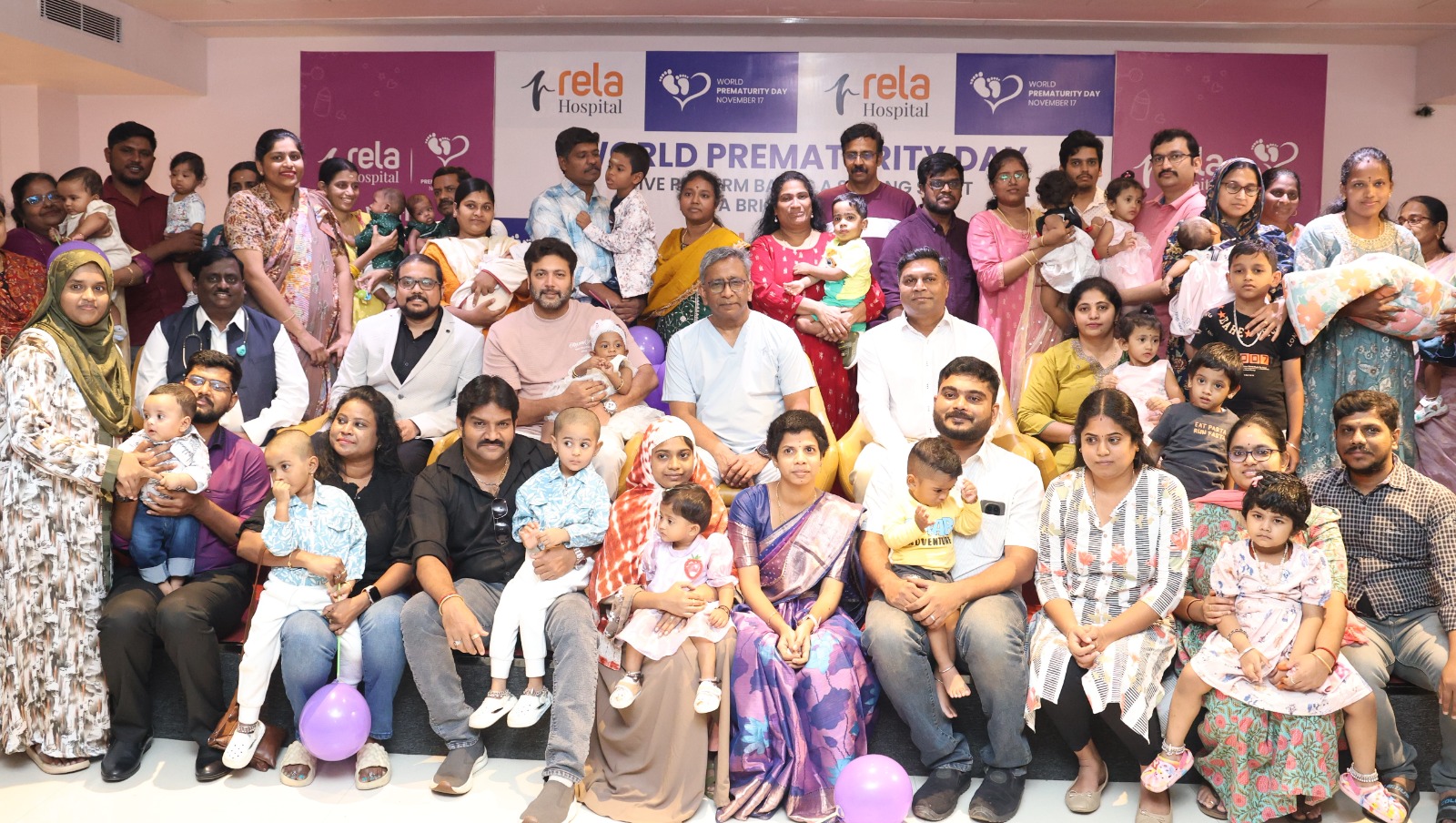
 The survival and well being of pre-term infants have improved significantly due to advancement in Neonatal Intensive Care for even as early as 25 week preemie.





Chennai, November 19, 2025: Rela Hospital marked World Prematurity Day 2025 by organising a special gathering of more than 50 preterm babies and their families, who have undergone treatment and have caught up to their peers developmentally, including children who were born as early as 25 weeks and weighed as little as 600 grams at birth. The event aimed to raise awareness that with the right neonatal intensive care expertise, even the tiniest and most vulnerable newborns can survive and grow into healthy normal children.
Actor Mr. Ravi Mohan took part in the event as the chief guest, which also featured experience-sharing sessions by parents of preterm babies. The function was presided over by Prof. Mohamed Rela, Chairman, Rela Hospital, and attended by Dr. Naresh Shanmugam, Director – Women and Child Health, Dr. Velmurugan Kannappan, Senior Consultant – Neonatologist and Paediatrician, Dr. M. P. Venkatesh, Clinical Lead – General Paediatrics along with the expert team from the hospital’s Neonatal Intensive Care Unit.
As per the World Health Organization, prematurity, or preterm birth, refers to babies born before 37 completed weeks of gestation. World Prematurity Day, observed on 17 November each year, is a global initiative to raise awareness about the challenges faced by premature infants and their families. Around the world 13-15 million babies are born prematurely, About 1 in 10 births.
In his comments, Prof. Mohamed Rela, Chairman, Rela Hospital, said, “Prematurity has become a critical public health concern. Complications from preterm birth remain the leading cause of death in children under five, and many survivors continue to face long-term disabilities that place a significant burden on families and the healthcare system. However, with the right science, technology, and expertise, we can now treat even babies born as early as 25 weeks. These children can grow into healthy adults. In the past, we could save only six or seven out of every ten preterm babies. Today, with advancements in neonatal care, we are able to save almost all of them. Hence, parents should come forward for the treatment of preterm babies with confidence.”
Talking about the incidence rate and the causes of preterm births, Dr. Velmurugan Kannappan, Senior Consultant - Neonatologist and Paediatrician, said, “In India, NFHS-5 data shows that 13% of children are born prematurely and 17% have low birth weight, translating to nearly 3.5 million premature births every year. In recent years, we have seen a steady rise in the incidence of preterm births. Work-related stress among expectant mothers, poor nutrition, and inadequate management of diabetes, hypertension, and other maternal health conditions are major contributing factors. Antenatal mothers can avoid pre-trem birth by following regular checkup.”
On the challenges in treating preterm babies, he explained that preterm babies face three major challenges. One is the risk of intraventricular haemorrhage because of fragile brain vessels, blood pressure fluctuations, and low oxygen levels. They also struggle with digestion due to an immature gut - sometimes even digesting mother’s milk becomes difficult. In addition, their immune system is severely underdeveloped, and many organs, including the lungs and heart, are still immature. “However, despite these challenges, with the right expertise, medicines, and advanced equipment, we can successfully manage each of these complications. We can dramatically improve outcomes and help these children lead healthy, normal lives.”
Rela Hospital has a 15-bed Neonatal Intensive Care Unit equipped to comprehensively manage prematurity-related complications - from primary neonatal care to advanced cardiac and ventilatory support. In addition to treatment, the hospital also offers neonatology counselling to mothers who are at risk to deliver extremely premature babies. The hospital has delivered over 500+ preterm babies in the last seven years.





-23-300x250.png)




















