 Sunday, October 11, 2026
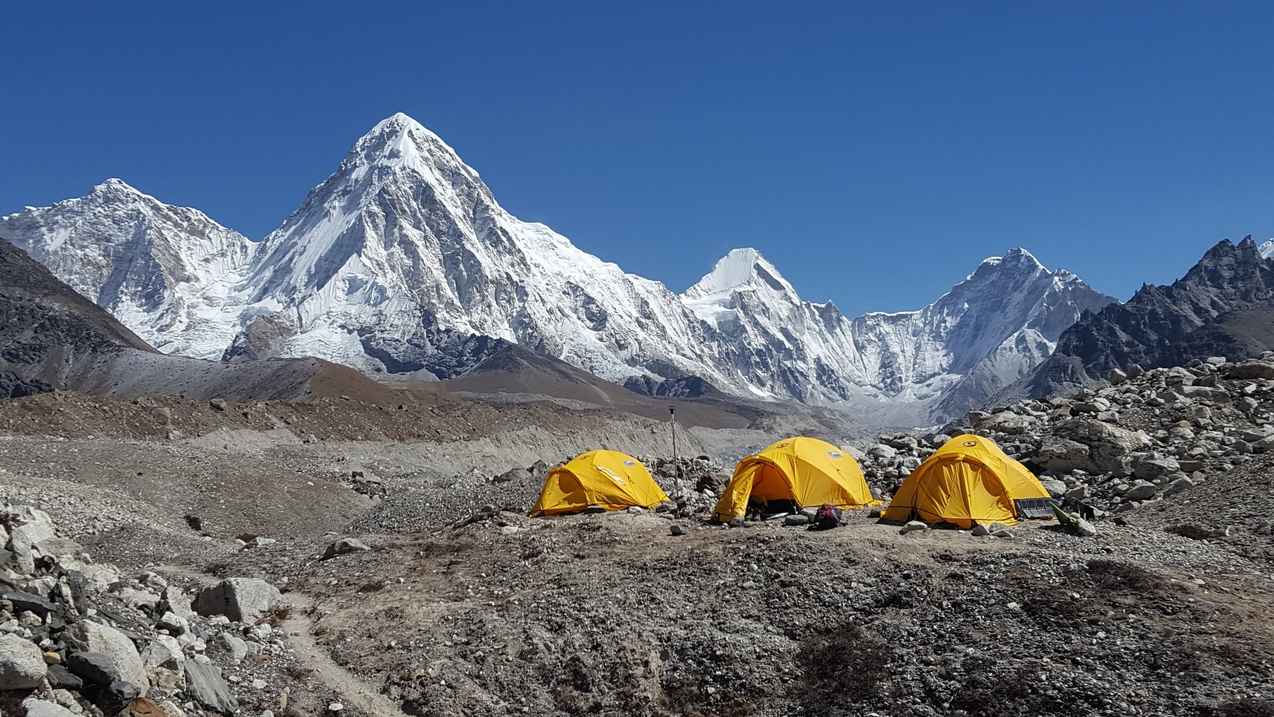
 A team of researchers is making final preparations for a trip to Mount Everest in Nepal next month to explore why the ice of one of the mountain’s most iconic glaciers is so close to the melting point.




March 24th, 2025: A team of researchers is making final preparations for a trip to Mount Everest in Nepal next month to explore why the ice of one of the mountain’s most iconic glaciers is so close to the melting point.
The expedition will take them into the Western Cwm, where they believe that intense radiation from the sun is melting the snow even when air temperatures are below freezing. As the meltwater refreezes it can warm the snow by several degrees, creating glacier ice that is much closer to the melting point than has previously been realised.
If they are right, this is a process that may also be happening on other glaciers across the Himalaya, the meltwater from which sustains many millions of people below.
The researchers from the University of Leeds and Aberystwyth University will be operating at over six kilometres above sea level and half a kilometre above Everest Base Camp, where they will drill into the glacier and use the boreholes to record ice temperatures.
They will have to negotiate the infamous Khumbu Icefall - regarded as one of the most demanding sections of the South Col route to Everest's summit - while their equipment is transported by helicopter.
Once settled on the glacier, the team will be camping on ice with nighttime temperatures dipping below -10 °C. With the Team operating in a low oxygen environment, the effects of altitude on the body can be profound, and the researchers will check on each other every couple of hours to prevent the development of altitude sickness.
Professor Duncan Quincey from the School of Geography in Leeds is leading the team. He said: “This trip will be the most physically and logistically demanding expedition I've ever been part of, and the unknowns are plentiful - we're worried about whether our equipment will work at such high elevations, and if it does work whether we will be able to collect and export our data effectively.
“Although we have worked at and around base camp on half a dozen occasions previously, this is the first time we have continued up-glacier and above the icefall. This means we're exploring new ground, and only a handful of scientists have walked this path before us. If we manage to capture any data, then they will be genuinely the first of their kind.”
The new project follows previous findings by the researchers which showed that the temperature of the ice in the lower parts of Khumbu Glacier is warmer than would be expected given the local air temperature.
Glaciers in the highest mountains of the planet are an extremely important source of water, with millions of people - including many in Nepal, Bhutan, India, Pakistan and Afghanistan - depending on Himalayan runoff.
Changes in the rate of glacier thawing would threaten this water supply, which is routinely used for irrigation, sanitation and hydropower purposes, particularly in the mountain foothills.
The United Nations General Assembly has already proclaimed 2025 as the International Year of Glaciers’ Preservation to raise awareness about the vital role glaciers, snow and ice play in the climate system and water cycle, as well as the far-reaching impacts of rapid glacial melt. And today UNESCO (The United Nations Educational, Scientific and Cultural Organization) will begin celebrations of the very first World Day for Glaciers. The day will be marked annually on 21 March.
The Everest researchers hope their work will give them a new understanding of processes and changes that are relevant for all glaciers in similar settings world-wide and indicate the extent to which other glaciers within the Himalayas may also contain unexpectedly warm ice.
Professor Bryn Hubbard from Aberystwyth University’s Department of Geography and Earth Sciences said: “It may surprise many that snow could be melting at sub-freezing air temperatures high up within Everest’s Western Cwm, but the possibility needs to be investigated and measured. These temperature measurements will improve computer models that are used to predict future changes in glacier extent and water supply – particularly important in this heavily-populated and water-stressed region.
“For this project, we will build on Aberystwyth University’s expertise in borehole drilling and sensor development to record ice temperatures deeper into the ice and at higher elevations than ever before attempted. Since, at these elevations, we can no longer rely on power from combustion motors, we plan to use energy from solar, battery and propane to drill boreholes some tens of metres into the ice. We also plan to use satellites to send real-time data back from the Western Cwm directly to our computers in the UK, reducing the number of future trips required to download and service the equipment.”
One of the world’s leading high-altitude climbers and alumnus of the University of Leeds, Kenton Cool, will be on Everest at the same time as the research team as he embarks on his nineteenth ascent of the mountain
“This expedition to Everest is arguably the most important scientific expedition to the mountain for nearly 20 years. Not only will the team be battling the rigours of high altitude and the dangers of the mountain, but they will be conducting groundbreaking glacial science at over 6400m, findings from which will potentially impact millions of people,” he said.
“Being a Leeds Alum myself I’m proud to be associated with this expedition to a mountain that holds a very special place in my heart. I look forward to not only spending time with the team in Nepal but also to learn about the importance of their research.
“I wish Professor Quincey and his whole team the very best in the last few weeks before their departure.”
The project is funded by the Natural Environment Research Council and is a collaboration between academics from the University of Leeds, Aberystwyth University, University of Bergen (Norway) and Uppsala University (Sweden).






.jpeg)










.jpg)
.jpg)
.jpg)
.jpg)
.jpg)
.jpg)


.jpg)