 Wednesday, November 18, 2026
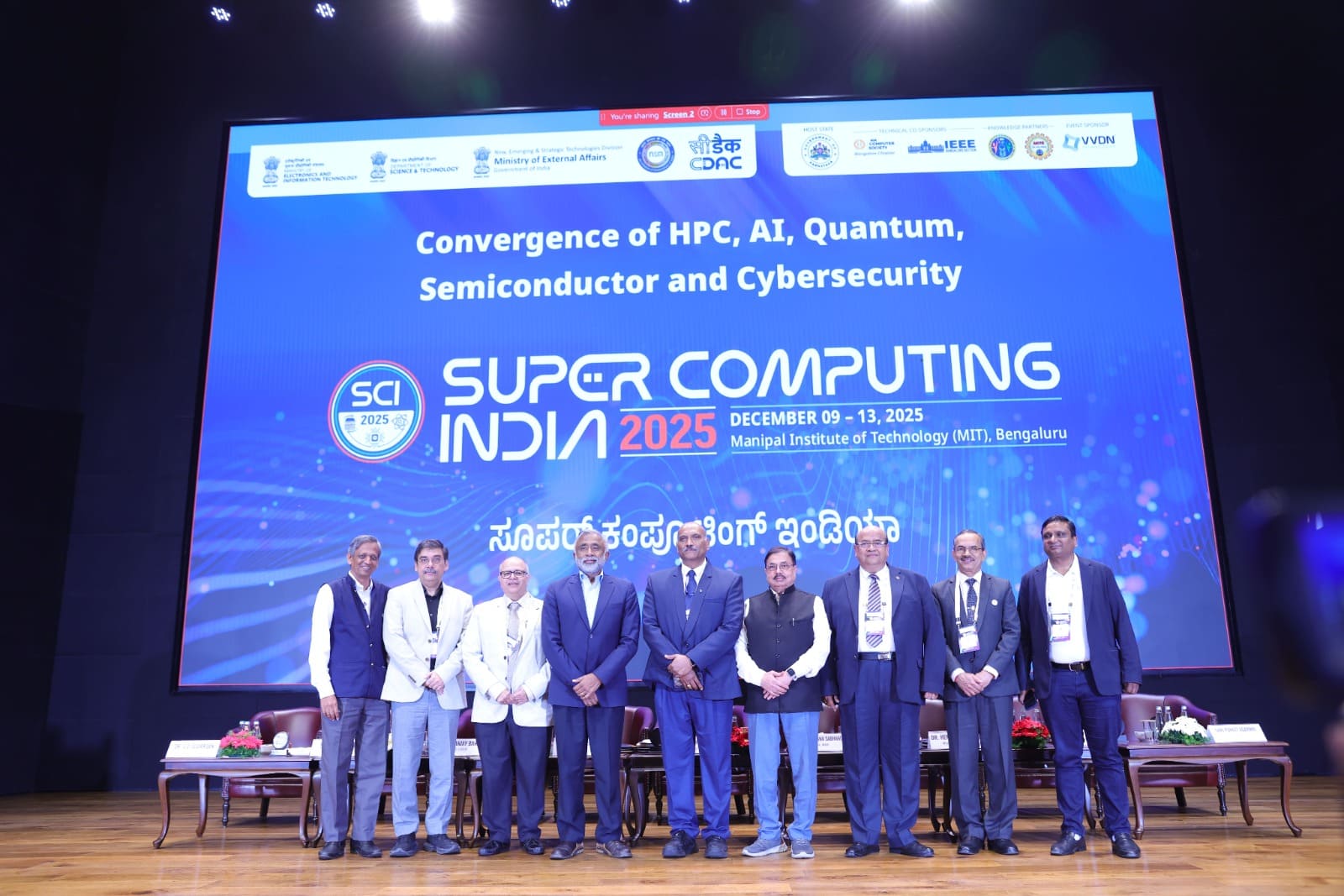
 Participation from VVDN, Kaynes, DELL, HPE, Applied Materials, Intel, AMD, Dell, HPE, Velankani, ASRock Rack, AWS, Prolim, Acceleron, MoSChip, etc.





Hyderabad, 10th December 2025: The inaugural ceremony of the first edition of Supercomputing India 2025 (SCI 2025) was held today at the Manipal Institute of Technology (MIT), Yelahanka, Bengaluru, in the presence of dignitaries from government, industry and academia. Dr S D Sudarsan, Executive Director, C-DAC Bangalore started the proceedings by welcoming the dignitaries. Shri E. Magesh, Director General, C-DAC gave an overview of the conference. Shri Ashwini Vaishnaw, Hon’ble Union Minister for Railways, Information and Broadcasting, and Electronics & Information Technology, Government of India, delivered the inaugural address for the event. He outlined the need to move from a service nation to a product nation with the advancement of new technologies including Quantum and AI. Shri Jitin Prasada, Hon’ble Minister of State for Electronics & Information Technology, Government of India in his address emphasised the various mission mode programs which have been initiated by the government as part of moving towards a product nation. Mr. Sanjay Bahal, DG CERT-In, Mr. Brajendra Navnit IAS, Principal Secretary to Government of Tamilnadu, Dr K D Nayak, Ex-Chairman DRDO, Mr. Puneet Agarwal, CEO, VVDN, Mr. Thomas Zacharia, SVP, AMD, and Dr. Narayana Sabhahit, Pro VC MAHE shared the dais. Dr. Hemant Darbari, Mission Director NSM proposed the vote of thanks. The Inaugural Ceremony opened the Summit with strong momentum and conviction, shaping the path for what is poised to become a defining milestone for India’s high-performance computing landscape.
SCI 2025, with the theme “HPC, AI & Quantum Computing”, brings together the country’s foremost minds to chart a roadmap for India’s emergence as a deep-tech powerhouse. Organized by the Centre for Development of Advanced Computing (C-DAC) under the aegis of the National Supercomputing Mission (NSM) and joined by global collaborators, the conference aims to foster a sustained HPC ecosystem across academia, industry, defence, space, healthcare and other strategic sectors.
Over the five days, SCI 2025 will convene one of India’s largest gatherings dedicated to High-Performance Computing, AI and Quantum technologies, featuring a technical conference in collaboration with IEEE, alongside a TechExpo hosting 175+ exhibitors, including leading multinationals, emerging startups, innovative SMEs, and premier academic and R&D institutions. The event is set to welcome over 5,000 delegates from India and across the world, representing key decision-makers, scientific pioneers, and technology leaders.
The inaugural edition has attracted strong participation from leading global technology partners, including Intel, AMD, Arm, Dell, HPE, Applied Materials, AWS, and ASRock Rack, alongside India’s rapidly growing advanced computing ecosystem represented by VVDN, Kaynes, Velankani, MosChip, HCLTech, L&T Vyoma, MiPhi, Aheesa, Prolim, and Bharat Electronics Limited (BEL). Their collaboration underscores the emergence of India as a trusted hub for high-performance computing and deep-tech innovation.
The conference features a distinguished lineup of global and national leaders whose insights are set to shape the future dialogue around HPC, AI, and quantum technologies. Prominent speakers include Prof. Anil Sahasrabudhe, Chairman, NAAC; Ms. Ratnaprabha, Managing Director, Head of innovation for India and Asia-Pacific, Morgan Stanley; Dr. Thomas Zacharia, Senior Vice President, AMD; Subramani Kengeri, Corporate Vice President & GM, Applied Materials,USA; Mike Piech, Vice President, Business Development, Rigetti Computing; Ken Toyoda, Director, Fujitsu Research of India Pvt. Ltd.; Cullen Bash, Vice President and Deputy Director, Hewlett Packard Enterprise; Dr. Hiroshi Horii, Senior Manager of Quantum-Centric Supercomputing (QCSC), Head of IBM Quantum Japan; Rossen Apostolov, Director, Swedish AI Innovation Factory, Project Director, GANANA (EU–India HPC Partnership); Dr. Peter Hofstee, Distinguished Research Staff Member,IBM, Austin, TX, USA, Emeritus Professor in Big Data Systems at Delft University of Technology; among many other eminent thought leaders and technologists from across academia, national R&D institutions, and industry.
The TechExpo is showcasing cutting-edge compute architectures, AI accelerators, quantum-hybrid platforms, chip-design innovations, high-speed interconnects, and advanced data-security frameworks. The Conference agenda includes several focused initiatives, including Women in Technology (HPC, AI, Quantum), celebrating leadership and inclusion in frontier sciences; Birds of a Feather (BoF) sessions that foster open, interactive peer-to-peer dialogue; and a Doctoral Symposium designed to equip young researchers with advanced tools, domain expertise, and future-driven competencies. As India builds design-led capabilities, the Chip Design Conclave will bring semiconductor innovators together to explore breakthroughs in indigenous compute systems. The PARAM Shavak User Meet will convene practitioners from academia and research institutions to exchange experiences and accelerate adoption of India’s home-grown supercomputing platforms.
SCI 2025 also offers unique global collaboration opportunities. With participation from international research labs, technology vendors, academic institutions and global HPC communities, the event provides a platform for cross-border cooperation, technology transfer, joint R&D, and investment, enhancing India’s role in the global technology ecosystem.





-23-300x250.png)





















