 Thursday, October 08, 2026
 Ending gender-based violence is human rights imperative.




Few weeks ago, the World Health Organization (WHO) Director General Dr Tedros Adhanom Ghebreyesus had said: "Violence against women is one of humanity’s oldest and most pervasive injustices, yet still one of the least acted upon. No society can call itself fair, safe or healthy while half its population lives in fear. Ending this violence is not only a matter of policy; it is a matter of dignity, equality and human rights."
A woman's right to live free from violence is upheld by international agreements such as the legally binding UN treaty, formally called as the Convention on the Elimination of All Forms of Discrimination against Women (CEDAW) 1979, as well as by the 1993 UN Declaration on the Elimination of Violence against Women, among others.
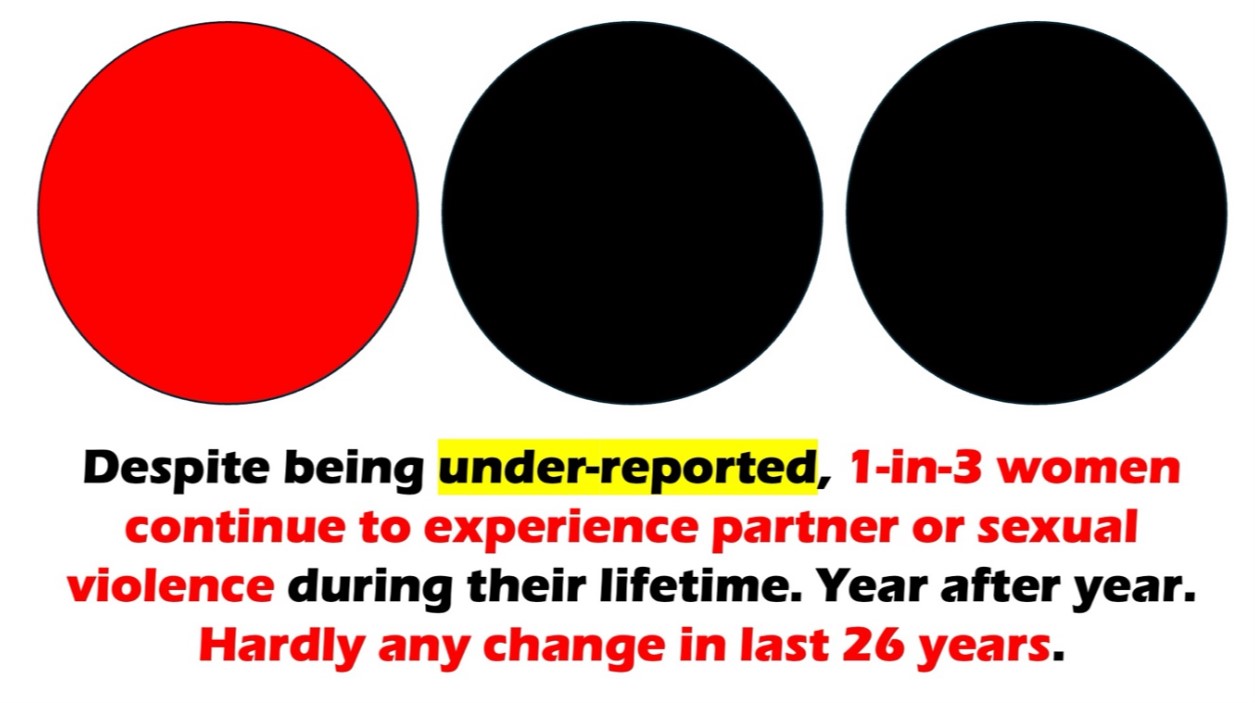
But recent data shows that despite violence against women and girls being the most persistent and under-addressed human rights violations and crises, the number of women who experience it in their lifetime, has NOT changed much in last 26 years (since 2000).
1 in 3 women continue to experience partner or sexual violence during their lifetime – year after year – with barely any change in this figure since 2000. The annual decline has been abysmally and painfully too slow: 0.2% over the past two decades. These figures are under-reported ones because of high degree of stigma, fear and other barriers girls, women and other people in all their diversities face in reporting gender-based violence. Emotional violence is among the least reported.
Not all countries have comprehensive legislation addressing domestic violence
Of the 165 countries with domestic violence laws, only 104 countries have comprehensive legislation addressing domestic violence. However, the countries with domestic violence legislation have lower rates of intimate partner violence than those without such legislation (9.5% compared to 16.1%).
Not just we are lagging in comprehensive legislations in every country to eliminate all forms of sexual and gender-based violence, but even funding is on a rapid decline for initiatives addressing gender equality.
Despite mounting evidence on effective strategies to prevent violence against women, the new WHO report warns that funding for such initiatives is collapsing - just as when humanitarian emergencies, technological shifts, and rising socio-economic inequality are further increasing risks for millions of women and girls. For instance, in 2022, only 0.2% of the global development aid was allocated to programmes focused on prevention of violence against women, and funding has further fallen in 2025.
Right to health and gender equality are fundamental human rights
Dr Tlaleng Mofokeng, United Nations Special Rapporteur on the Right to Health said in SHE & Rights (Sexual Health with Equity & Rights) session: "We must invest in equity. Resourcing the movement is key, and that investment must be comprehensive and unrestricted and it should not be conditional - it should not be that I will get this funding if I do not support the rights of sex workers or if I do not support the rights of migrant people. It means that maternal health, sexual and reproductive health and rights, and universal health coverage must not be competing agendas. They are all-encompassing and they are part of the same promise of human dignity."
"We do not speak about the right to health as an ‘abstract right’, but as a fundamental human right. Human rights are a living testimony to justice, to bodily autonomy, and to equity. We have explored what it means to operationalise these rights, what it means to build health systems that are comfortable, inclusive and gender responsive, and rooted in human rights. We must acknowledge that challenges remain; some are emerging as part of a new global reality as it unfolds across many regions around the world and anti-rights narratives and aggressive policies are gaining ground. Access to sexual and reproductive health and rights are being restricted in ways that we have not seen before. Healthcare workers and human rights defenders around the world are being silenced, and evidence-based policies are being replaced by ideology,” added Dr Tlaleng Mofokeng.
1 in 4 countries faced backlash against women’s rights in 2024
“In 2024 alone, nearly 1 in 4 countries experienced a backlash against women’s rights. The urgency to act, and to act together has never been greater. Around the world sexual and reproductive health and rights (SRHR) are under threat. Regressive policies and shrinking solidarity are rolling back hard-won gains, especially for women, girls, and marginalised communities. The Right to Health is a legal obligation grounded in international human rights law, and it must be protected, implemented, and enforced for the wellbeing of women and all gender diverse peoples,” said Alison Drayton, Assistant Secretary General, CARICOM, Guyana. CARICOM is an intergovernmental organisation in the Caribbean focused on economic integration and cooperation among its member countries.
Agrees Dr Haileyesus Getahun, Founder and Chief Executive Officer, Global Center for Health Diplomacy and Inclusion (CeHDI): “Right to health is not merely an obligation, it is a commitment, and it was enshrined in several international laws, and the main one being the International Covenant on the economic, social, and cultural and rights, which was signed by 174 countries. It entails deep commitment and obligation by the governments to (i) respect that governments will not interfere in any way in the enjoyment of the life course of their citizens; (ii) be committed and obligated to make sure to not bring any harm into this enjoyment, and (iii) governments should place everything needed from administrative systems to ensure that this right to health is enjoyed by every person in their country.”
Ahead of UHC Day on 12th December, Dr Getahun said: “Right to Health is a gateway to universal health coverage which contains every service and every need of everyone, without any gender discrimination - and sexual and reproductive health are integral part of that right.”
When SRHR is not rooted in UHC then it takes a toll on the bodies of women and girls
“Right to health for girls and women in marginalised communities still feels a very distant dream. Despite SRHR being so critical, lifesaving and crucial for everyone, especially for young girls and women, it is not a priority yet in those communities. I think it is because it is not just a health issue, but a very patriarchal and gender justice issue," said Aysha Amin, Founder Baithak, Pakistan "When SRHR is not integrated as a right in universal health coverage or as a priority, it takes a toll- and most of the toll is on the bodies of young girls and women. And those are the voices that are missing in decision making spaces."
“Also, SRHR is not there, especially for communities that are affected by climate disasters- like rural communities that are mostly impacted by the brunt of these disasters. When medical health facilities are washed away with floods, women are forced to give birth in very unsafe conditions, in make shift emergency rooms, (which is a very serious encroachment upon their dignity, safety and health); adolescent girls are forced to manage their menstruation without any access to facilities for water, sanitation and hygiene - putting them at risk of infections, as well as gender-based violence. And that is the cost we pay by not having SRHR integrated into policy,” added Aysha Amin.
“Access to quality healthcare should not be a privilege - it is a human right. And I think by working in partnerships we can achieve that. Brazil has made great strides towards achieving universal health coverage through primary healthcare, and community-based approaches. The most important thing that we have done in the past several years is to strengthen the government’s connection with the population we serve and their needs. We need to listen to the people we are working for and offering healthcare services, including SRHR for the women and girls. We need to go to the communities, listen to their needs and take those lessons into account. By listening, we can find our methods to achieve every choice that our population needs to have, including methods to protect from sexually transmitted infections (STIs). This is an important reminder for all of us who work in this and other fields that we need to listen to the people we are working with and to take those lessons into account,” said Dr Ana Luiza Caldas, Vice Minister of Health, Brazil.
Ending violence against women and girls is not merely an obligation but human rights imperative
To accelerate global progress and deliver meaningful change for the lives of affected women and girls, we call for decisive government action and funding to: scale up evidence-based programmes (especially those which are community-led) to prevent violence against women and girls; strengthen survivor-centred health, legal and social services; invest in data systems to track progress and reach the most at-risk groups to protect them from sexual and other forms of gender-based violence; and enforce laws and policies empowering women and girls.






.jpeg)










.jpg)
.jpg)
.jpg)
.jpg)
.jpg)
.jpg)


.jpg)