 Friday, October 09, 2026
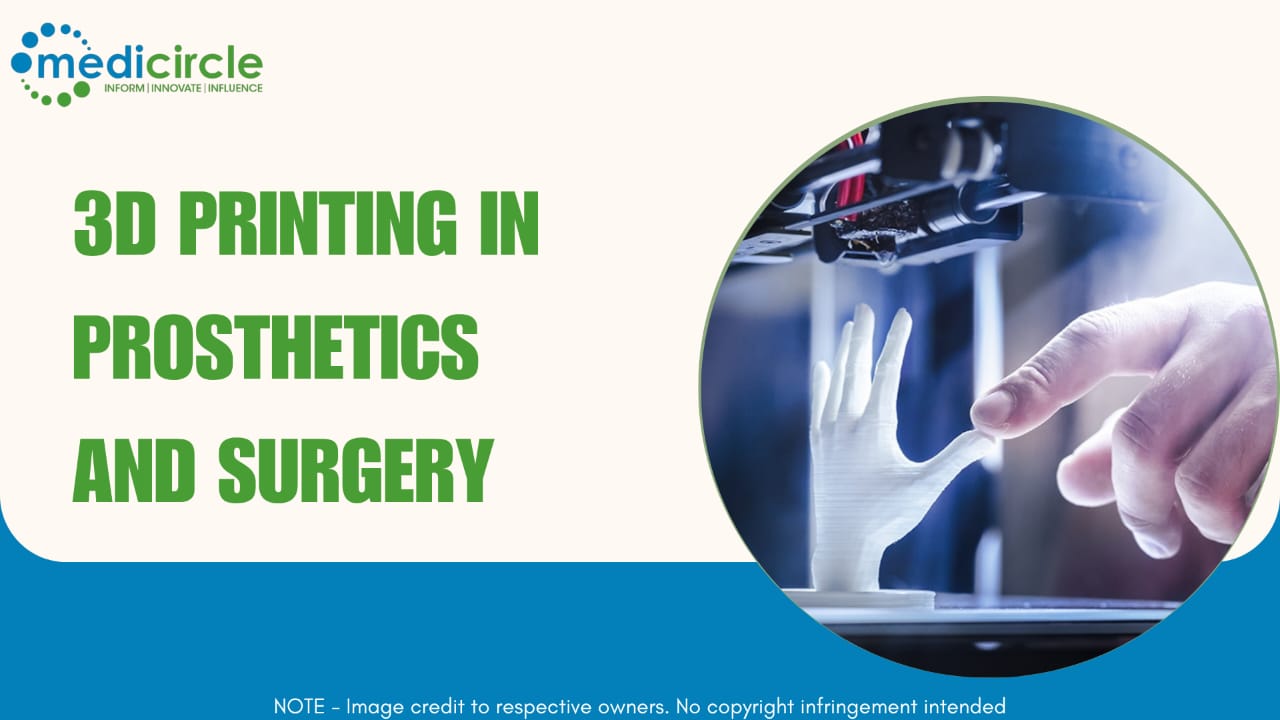
 3D printing is quietly transforming Indian healthcare, making prosthetics and surgeries more personal, affordable and precise, while empowering local innovation and improving patient outcomes nationwide.




Walk through the corridors of a modern Indian hospital today and you might find a surprising piece of technology humming quietly in a corner. It is not a complex robot, but a 3D printer, diligently building medical solutions one fine layer at a time. This technology is steadily changing lives, offering a new kind of hope that is both deeply personal and remarkably practical.
For countless individuals who have faced limb loss or require intricate reconstructive surgery, this is not just a news headline. It represents a tangible shift towards a future where their medical care is designed uniquely for them. It is about restoring function and with it dignity.
3D printing in prosthetics:
A personal approach:
Think of the journey to get a traditional prosthetic limb. It can be a long, expensive and often impersonal process. Now, consider an alternative: a prosthetic device that mirrors the unique shape of your body, arrives in a matter of days and does not demand a small fortune. This is the powerful reality 3D printing is building across India.
So, how does it work? The process begins with compassion and a 3D scanner. A technician carefully scans the patient's residual limb, creating a precise digital map of its contours. This digital blueprint is then fine-tuned using design software, ensuring every curve is accounted for. Finally, the 3D printer brings this design to life using durable, medical grade materials to construct a limb that is truly one of a kind.
The advantages of this method are profound, especially in the Indian context:
Financial accessibility: The high cost of conventional prosthetics can be a barrier for many. 3D printing dramatically lowers this wall, making functional limbs accessible to a wider population.
Speed from need to solution: The wait time shrinks from several months to just a few days. This rapid turnaround can accelerate a person's rehabilitation and return to daily life.
Unmatched customization: A 3D printed limb is not adjusted to fit; it is created to fit. This personalized approach translates directly to superior comfort and usability.
Simplified maintenance: If a component wears out or breaks, a new identical part can be printed quickly and easily without starting from scratch.
In a nation where many grapple with mobility challenges, this technology is a beacon of hope. It empowers local innovators, from engineering colleges to social enterprises to craft affordable solutions for their communities.
Surgeon’s new toolkit:
Planning with precision:
The influence of 3D printing extends far beyond the prosthetic workshop and right into the heart of the operating room. Surgeons are now using this technology to navigate the complex geography of the human body with a confidence that was previously hard to achieve.
Let us look at how this is unfolding in India:
Rehearsing for success: At leading institutions, surgeons no longer rely solely on flat MRI or CT scans. They can now hold an accurate, physical 3D model of a patient’s specific anatomy, be it a fractured spine or a delicate skull, to plan and practice the entire procedure in advance. This rehearsal leads to shorter operation times and enhanced patient safety.
Implants that belong: For complex cases requiring implants, the one size fits all approach is being replaced by a “made for you” standard. There have been successful procedures where surgeons have used 3D printed titanium implants, custom designed to match a patient’s unique spinal structure, leading to better stability and fusion.
Clarity for complex cases: Holding a tangible model allows a surgical team to visualize the challenge from every angle, anticipate complications, and execute with greater accuracy. This is invaluable in trauma reconstruction and complex joint surgeries.
This shift is fundamental. It moves healthcare from a standardized process to a deeply personalized surgical experience, built around the individual lying on the operating table.
India’s journey:
The current landscape:
The adoption of 3D printing in Indian medicine is a story of impressive growth, though it is not without its challenges. The journey has moved from initial curiosity to a phase of solid, practical application.
The signs of progress are encouraging. Indian surgeons are increasingly publishing their findings and pioneering new techniques. Homegrown startups are now designing and manufacturing patient specific implants within the country, reducing dependence on international suppliers. Major medical institutions have established dedicated 3D printing facilities to aid both surgery and the training of the next generation of doctors.
However, the path forward requires navigating some critical challenges:
Regulatory pathways: Clear and specific guidelines for approving 3D printed medical devices are still evolving, which can slow down widespread implementation.
The initial investment: While the cost per device is low, setting up a 3D printing facility requires significant upfront investment in equipment and expertise, which can be a hurdle for smaller hospitals.
Urban-rural divide: Ensuring that advanced scanning technology and technical know-how reach beyond metropolitan centers is crucial for equitable access.
Building a skilled workforce: For this technology to truly flourish, India needs more technicians skilled in medical design and 3D printing operations.
The road ahead:
What does the future whisper? It speaks of a landscape where 3D printing becomes seamlessly woven into the fabric of Indian healthcare. Researchers are already exploring the frontiers of bio printing, which dreams of one day creating functional tissues. The combination of this technology with other digital tools promises even greater precision in planning and execution.
For the people of India, this translates to something simple yet profound: healthcare that sees them as individuals. It means a farmer can get a prosthetic hand that lets him return to his fields, a child can receive a spinal implant crafted for her small body and a family can have hope where there was little before.
This story is not about machines taking over. It is about technology becoming a brush in the hands of a skilled artist. It is a tool that amplifies human ingenuity and compassion, helping to build a nation where a life of mobility and dignity is within everyone’s reach. The next layer is being printed now and it looks brighter for us all.






.jpeg)










.jpg)
.jpg)
.jpg)
.jpg)
.jpg)
.jpg)


.jpg)