Sunday, October 25, 2026
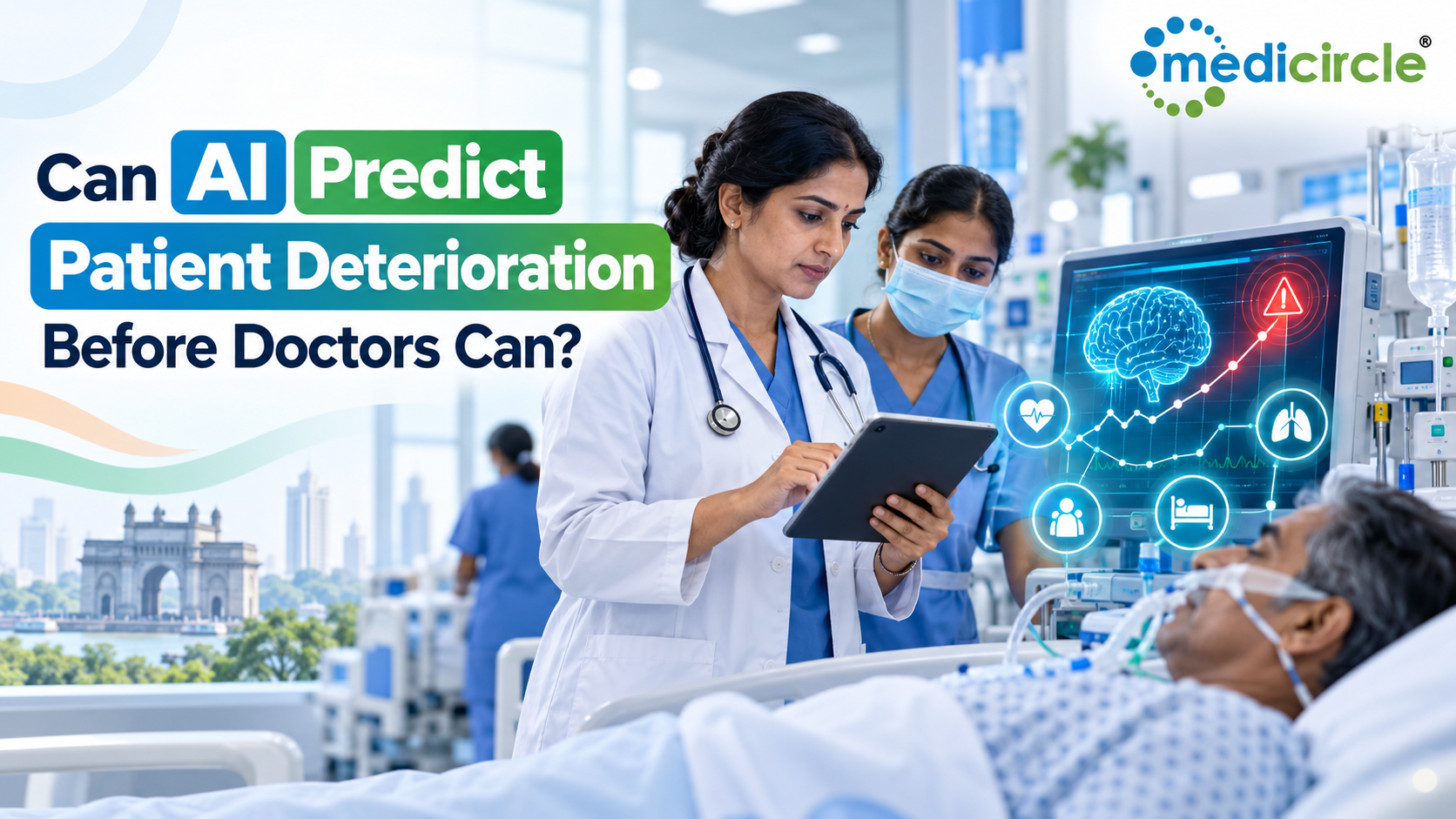
 AI-powered early warning systems can predict patient deterioration hours before clinical signs appear, with transformative implications for Indian hospital safety and preventable death reduction.




Introduction
Every year, thousands of hospitalized patients experience a sudden and often preventable decline in their condition. A patient admitted for a routine procedure develops sepsis. Another, recovering steadily in a general ward, goes into unexpected cardiac arrest. These events do not happen without warning. The human body almost always sends distress signals before a full clinical crisis unfolds. The problem has never been the absence of signals but the inability of conventional systems to detect them early enough, and consistently enough, to matter.
Artificial intelligence is now changing that reality in a significant and measurable way. AI-powered early warning systems are being designed, tested, and deployed to monitor hospitalized patients continuously, identifying subtle physiological patterns that point to deterioration long before a nurse or physician would flag a concern. The results emerging from clinical trials across the world, including from Indian hospitals, are both promising and striking.
For a country like India, where hospitals are stretched across an enormous and diverse patient load and where continuous monitoring is typically confined to intensive care units, the promise of AI-driven predictive care represents a fundamental shift in how patient safety can be delivered.
Why Traditional Early Warning Systems Fall Short
For decades, hospital wards have depended on early warning scores to identify patients at risk. Systems such as the National Early Warning Score, known as NEWS and later updated to NEWS2, standardized the assessment of acute illness by assigning numerical values to vital sign readings and triggering clinical responses when scores crossed defined thresholds. These systems represented meaningful progress in their time. They introduced structure and consistency to clinical observation.
However, their limitations are increasingly apparent. Traditional early warning scores depend entirely on periodic manual checks. A nurse may assess a patient's vital signs every four to six hours. Between those checks, a great deal can change. By the time an abnormal vital sign is recorded, scored, and acted upon, the opportunity for early intervention may have narrowed significantly.
Clinical deterioration is often preceded by subtle physiological changes that, if unheeded, can lead to adverse patient outcomes. The precision of traditional scoring systems in detecting these precursors has limitations, prompting the exploration of AI-based predictive models as a means to enhance predictive accuracy.
This is the core problem that AI is attempting to solve. It is not that doctors and nurses are not vigilant. It is that the human eye, reviewing isolated data points at fixed intervals, cannot match the pattern-recognition capability of an algorithm processing thousands of data points continuously across dozens of patients simultaneously.
How AI Predicts Patient Deterioration
AI-based early warning systems work by analyzing streams of patient data in real time and identifying combinations of trends that collectively indicate rising risk. These systems do not rely on a single abnormal reading. Instead, they recognize deterioration as a developing pattern.
What makes these systems different from conventional alarms is that they do not rely on one abnormal reading alone. Instead, they analyze combinations of subtle trends across multiple parameters over time. A slight rise in respiratory rate combined with falling oxygen saturation and reduced movement may collectively indicate risk, even if each individual metric remains within acceptable limits.
The data sources feeding these algorithms vary across different platforms:
- Continuous vital sign streams from wearable or contactless sensors
- Electronic health record entries including nursing notes, lab results, and medication logs
- Demographic and historical patient data
- Real-time inputs such as movement patterns and sleep-wake cycles
One particularly noteworthy area of research has explored nursing documentation as a source of early signals. A team of researchers from Columbia University, Harvard Medical School, and Brigham and Women's Hospital found signals not in lab results or vital signs but in the patterns of how nurses document their observations. Their landmark clinical trial, published in Nature Medicine in April 2025, demonstrated that an AI system built on nursing surveillance patterns was associated with a reduction in hospital deaths by over one-third.
The specific results were compelling. Patients on intervention units experienced a 35.6 percent reduction in the instantaneous risk of in-hospital mortality. Hospital length of stay decreased by 11.2 percent. The risk of sepsis dropped by 7.5 percent. Unanticipated ICU transfers increased by 24.9 percent, a counterintuitive finding that actually represents success, as it indicates earlier recognition and escalation of care for deteriorating patients.
What the Evidence Tells Us About AI Early Warning Systems
The body of clinical evidence supporting AI-powered deterioration prediction has grown considerably over recent years. Several studies across different countries and hospital settings have produced consistent findings.
Research from the Feinstein Institutes for Medical Research, using wearable sensors on nearly 900 non-ICU inpatients, showed that the AI model continuously analyzed data from clinical wearables and demographics and flagged at-risk patients an average of 17 hours before their condition worsened. AI predicted 50 percent of rapid response team activations.
In the domain of sepsis, a condition that is both common and frequently fatal when identified late, artificial intelligence has been increasingly applied to continuously updated clinical data to facilitate earlier detection, though the quality, interpretability, and clinical readiness of these models remain areas of ongoing investigation. The direction of research is clear: machine learning models analyzing dynamic clinical data significantly outperform static scoring systems in identifying sepsis risk early.
For cardiac arrest prediction, AI models have demonstrated promising performance. Machine learning algorithms showed promising results with AUC values ranging from 0.73 to 0.96 in predicting cardiac arrest in different settings, including critically ill ICU patients, patients in the emergency department, and patients with sepsis.
These results are not theoretical. They are emerging from real patients in real hospitals, measured against hard outcomes such as mortality, ICU transfers, and length of stay.
The India Context: A Problem of Scale and a Window of Opportunity
India's hospital system operates under conditions that make predictive AI not merely a technological advancement but a practical necessity. The country has approximately 2 million hospital beds. The vast majority of hospitalized patients across the country reside in general wards, not ICUs, and approximately 1.9 million patients in general wards rely on manual spot checks for monitoring. Continuous monitoring is resource-intensive and has historically been reserved for the sickest patients in critical care settings.
This creates a gap where clinical deterioration in general wards often goes undetected until it becomes a medical emergency, at which point the cost, complexity, and risk to the patient all rise sharply.
An Indian healthtech company called Dozee has developed and studied an AI-powered Early Warning System specifically designed to address this gap. The system uses contactless ballistocardiography, a technology embedded in a sensor sheet placed under a patient's mattress, to continuously track heart rate, respiratory rate, and blood pressure without requiring any wearable device to be attached to the patient.
A prospective observational study conducted at King George's Medical University in Lucknow, one of the largest of its kind in Indian tertiary care, monitored 706 patients across 84,448 hours. Out of these patients, 33 experienced clinical deterioration. The deterioration group consistently had a higher number of alerts compared to those who were discharged normally across all time points. On average, the time between the initial alert and clinical deterioration was 16 hours within the last 24 hours preceding the event. The sensitivity of the system varied between 67 percent and 94 percent.
This early detection holds the potential to save 21 lakh lives annually and reduce healthcare costs by Rs 6,400 crore. The system also demonstrated an operational benefit: continuous automated monitoring saved healthcare practitioners approximately 10 percent of their working time, equivalent to 2.4 hours per day, time that can be redirected toward direct patient care.
This is particularly significant for tier-2 cities and district hospitals across India where nursing ratios are often stretched and where any technology that reduces the burden of routine monitoring while increasing clinical vigilance would have an immediate and tangible impact.
Challenges in Implementing AI Early Warning Systems
The clinical evidence is encouraging, but the path from research to widespread hospital adoption involves navigating several real and important challenges.
Data quality and integration remain significant barriers. AI models are only as reliable as the data they are trained on. In many Indian hospitals, electronic health record systems are still being established or are inconsistently used. Gaps in data documentation, irregular vital sign recording, and incompatible software platforms all create friction for AI deployment.
Alert fatigue is another well-documented concern. If an AI system generates too many alerts, clinical staff may begin to ignore them, undermining the very purpose of the technology. Calibrating the sensitivity and specificity of these systems to generate alerts that are both early and actionable requires careful validation in local hospital environments.
Equitable access must also be considered. India's public hospital system, which carries the largest patient burden, operates with significant resource constraints. Affordability, infrastructure readiness, and staff training are all prerequisites for meaningful adoption. The Dozee study at KGMU is significant precisely because it demonstrated clinical utility within a large public tertiary care hospital in India, making the case that this technology can work within real-world Indian conditions rather than only in well-resourced private settings.
Finally, questions around clinical trust and accountability need to be addressed thoughtfully. AI systems function as decision-support tools, not replacement clinicians. The physician and nursing team must understand what the system is flagging and why, and the final clinical judgment must always rest with trained healthcare professionals.
What This Means for the Future of Indian Healthcare
India's National Health Policy and the Ayushman Bharat Digital Mission both emphasize the importance of technology-enabled, equitable, and quality healthcare. AI-powered patient monitoring systems align closely with these goals. They have the potential to extend ICU-level vigilance to general ward patients, to reduce preventable deaths from late-detected sepsis and cardiac events, and to allow a stretched healthcare workforce to operate more efficiently.
The integration of AI into clinical decision-making is not a distant concept in India. It is already being piloted and validated. As these systems mature, become more affordable, and are validated across a wider range of clinical environments, including smaller hospitals in tier-2 and tier-3 cities, they have the potential to change the standard of care for millions of patients who currently depend on intermittent manual checks for their safety.
The question is no longer whether AI can detect deterioration before it becomes a crisis. The evidence now suggests it can, and in some cases by many hours. The more pressing question is how quickly and equitably this capability can be made available across Indian healthcare settings.
Frequently Asked Questions
Q1: How does AI detect patient deterioration before doctors or nurses do?
AI systems continuously monitor streams of patient data, including vital signs, nursing notes, and movement patterns, and identify subtle combinations of trends that together signal rising risk. Unlike periodic manual checks, these systems analyze data in real time and can recognize patterns hours before an obvious clinical change would prompt human concern.
Q2: Has AI patient deterioration prediction been tested in Indian hospitals?
Yes. One of the largest observational studies of this kind in Indian tertiary care was conducted at King George's Medical University in Lucknow. The study, published in Frontiers in Medical Technology, found that an AI-powered Early Warning System predicted clinical deterioration with a sensitivity of 67 percent to 94 percent, on average 16 hours before the event occurred.
Q3: Can AI early warning systems replace clinical judgment?
No. AI systems in this context are clinical decision-support tools. They flag patients who may be deteriorating and alert clinical staff to investigate further. The final judgment, diagnosis, and treatment decisions always remain with trained doctors and nurses. AI enhances human vigilance; it does not replace it.
Q4: What types of conditions can AI predict in hospitalized patients?
Current AI models have demonstrated meaningful predictive capability for sepsis, cardiac arrest, unplanned ICU transfers, respiratory deterioration, and in-hospital mortality. Research is ongoing across a wide range of clinical deterioration scenarios.
Q5: Is AI-powered patient monitoring affordable for Indian hospitals?
Affordability is a central concern and is actively being addressed. Systems like the Dozee contactless monitoring platform are designed to provide continuous monitoring at a significantly lower cost than full ICU infrastructure. The potential economic benefit of preventing deterioration, in terms of reduced ICU admissions and shorter hospital stays, also supports the cost-effectiveness argument. Public hospital deployments in India, such as the KGMU study, demonstrate that these systems can function within resource-constrained settings.
Resources
- Frontiers in Medical Technology, Dozee-KGMU Study on Continuous Contactless Vital Signs Monitoring in Indian General Wards
- Nature Medicine, April 2025: Landmark clinical trial on AI built on nursing surveillance patterns and in-hospital mortality reduction
- BMC Medical Informatics and Decision Making: Meta-analysis on AI-powered early warning systems and clinical deterioration outcomes
- PubMed / National Center for Biotechnology Information (ncbi.nlm.nih.gov): Repository of peer-reviewed clinical research on AI sepsis prediction and cardiac arrest risk models
- Ministry of Health and Family Welfare, Government of India (mohfw.gov.in): National health policy frameworks relevant to digital health and hospital patient safety
Interlinking Keywords:
AI in Indian hospitals, early warning system healthcare, patient deterioration prediction, AI clinical decision support, sepsis detection India, Ayushman Bharat Digital Mission, predictive healthcare technology, hospital patient safety
Last medically reviewed by:
Dr. Manthan Tripathi, Editorial and Medical Advisory Team, Medicircle.in on 7, September 2026
Medical Disclaimer:
This article is intended for informational and awareness purposes only. It does not constitute medical advice, diagnosis, or treatment. Readers should consult qualified healthcare professionals for any clinical concerns or decisions. All clinical data referenced in this article is sourced from published peer-reviewed research and institutional studies.





-23-300x250.png)

.jpeg)


.jpg)
.jpg)
.jpg)
.jpg)
.jpg)
.jpg)
.jpg)
.jpg)
.jpg)