 Friday, October 09, 2026
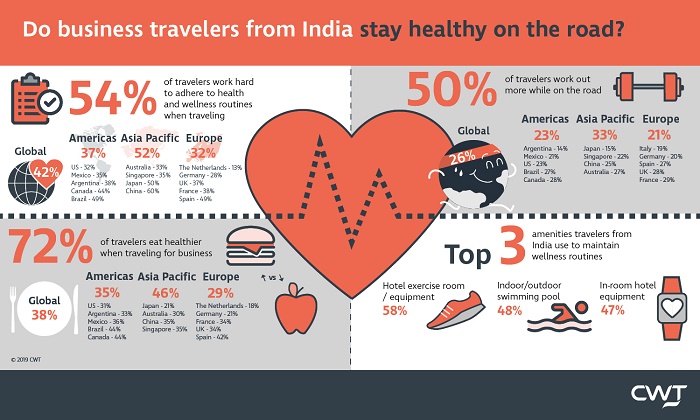
 Research by CWT, the B2B4E travel management platform, shows that business travelers across the global, including those from India, are increasingly paying attention to their health while on business trips. According to the survey, 54% of business travelers from India work hard to adhere to their he




Research by CWT, the B2B4E travel management platform, shows that business travelers across the global, including those from India, are increasingly paying attention to their health while on business trips.
According to the survey, 54% of business travelers from India work hard to adhere to their health and wellness routines, while 40% try but find it challenging. The health and wellness amenities most commonly used by Indian business travelers include hotel gyms (58%), hotel swimming pools (48%) and in-room equipment such as yoga mats and stationary bikes (47%).
Half (50%) of the Indian respondents surveyed also indicated that they work out more while on the road, while only 6% do not typically work out during business trips. And nearly three-quarters (72%) said they eat healthier when traveling for business – the highest number globally.
“Sticking to your regular routine on business trips can be challenging for various reasons, such as limited options or tight schedules,” said Vishal Sinha, CEO, India, CWT. “You’re focused on your work and trying to make the most of your trip, so you don’t have time to search for a gym or affordable healthy eating options if they’re not easily accessible. By creating travel policies that factor these things in, such as allowing travelers to stay at hotels with fitness facilities and ensuring their meal allowance is enough to cover healthy food choices, companies can create a much better travel experience for their employees.”
Among regions, travelers in Asia Pacific are likely to work out more (33%) while abroad, compared to travelers in Americas (23%) and Europe (21%). On the flipside, Europe business travelers are less likely to work out while on the road (48%) vs. travelers in Americas (38%) and Asia Pacific (32%).
Meanwhile, only 7% of travelers do not adhere to health and wellness routines when traveling. The percentage is higher among Europeans (10%) and Americans (8%), while travelers in Asia Pacific are the least likely to steer away from their wellness routines (3%).
“Maintaining healthy habits while traveling is nearing the top of the priority list for travelers around the world,” said Niklas Andréen, CWT’s Chief Traveler Experience Officer. “At the end of the day, being in tune with what matters to your employees is indispensable for retaining and attracting the best talent.”
Since 2017, maintaining health and wellness routines while on the road has become an increasing priority for travelers. Across all regions, business travelers are striving to achieve their health and wellness routines regardless of where they are in the world.





.jpeg)










.jpg)
.jpg)
.jpg)
.jpg)
.jpg)
.jpg)


.jpg)