 Sunday, October 11, 2026
 The condition bronchopulmonary sequestration - a congenital malformation of the airway and lung was diagnosed during fetal development.




Chennai, March 17 2026: MGM Healthcare Malar, Adyar has successfully performed a Video-Assisted Thoracoscopic Surgery (VATS), a minimally invasive procedure, on a one-year-old girl to remove a congenitally developed non-functional portion of the lung (the lower lobe of the left lung) which posed a potential risk of severe respiratory complications, recurrent infections, or bleeding in the future, and could also have adversely affected heart function.
The condition, known as bronchopulmonary sequestration - a congenital malformation of the airway and lung - was diagnosed during fetal development and closely monitored until the child turned one year old, allowing doctors to plan the surgery safely for optimal outcomes. The condition is rare, accounting for only about 2% of congenital lung anomalies. The successful use of VATS to treat bronchopulmonary sequestration marks a first-of-its-kind achievement in Chennai.
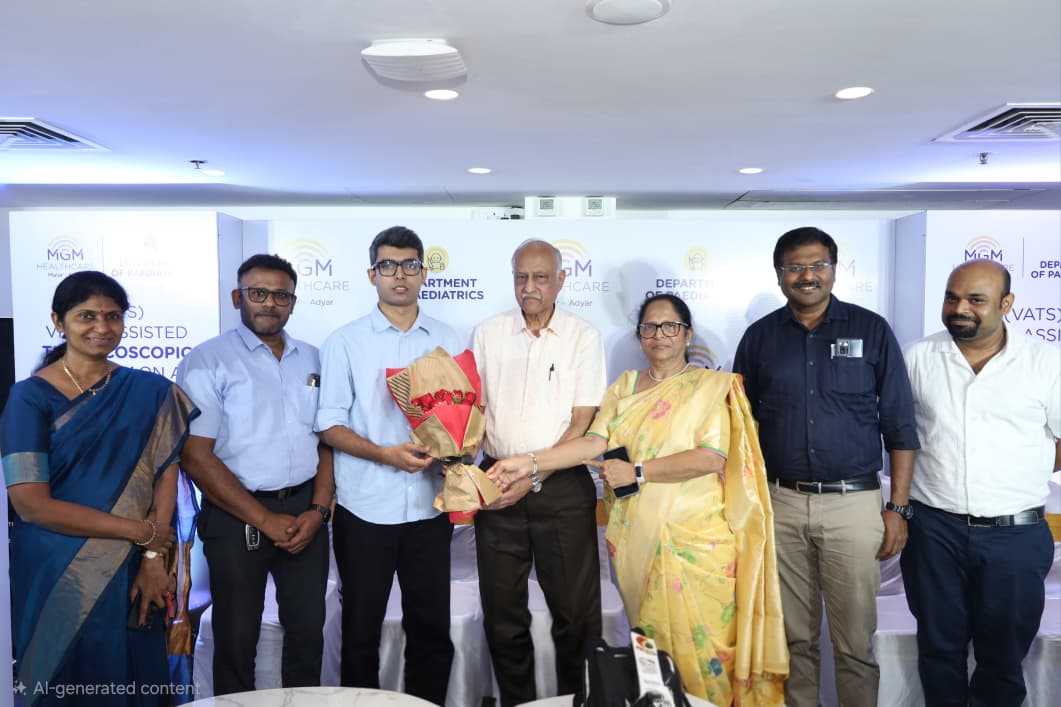
The procedure was performed by Dr. Karpaga Vinayagam, Senior Consultant - Paediatric Surgery, who led a team including Dr. Mohan Raj, Consultant - Paediatric Surgery; Dr. Prabhakaran G, Senior Consultant, Paediatrics; Dr.Arun Kumar S, Lead Consultant - Neonatology, Dr. N.K.V. Vigneshwar, Associate Consultant - Neonatology, Dr. Vidhya Mohanram, Senior Consultant, Anaesthesia; and the multidisciplinary ICU team.
The procedure lasted approximately three and a half hours. During surgery, the team carefully removed the affected lower lobe of the left lung and ligated the abnormal blood supply from the aorta to the diseased segment.
In his comments, Dr. Karpaga Vinayagam said, “This was a particularly challenging surgery because the bronchopulmonary sequestration was located entirely within the left lung lobe and had a major blood supply directly from the aorta. Performing the procedure thoracoscopically in a child is technically demanding due to the limited space in the chest cavity. However, we opted for it, as this minimally invasive approach could mean less post-operative pain, a shorter hospital stay, and faster recovery compared to conventional open surgery.”
The child’s recovery has been remarkable. She was monitored in the ICU, shifted to the ward after two hours, and discharged within three days. Paediatric lungs continue to grow until around nine years of age, allowing the remaining lung to compensate for the removed lower lobe. She is expected to lead a normal, healthy life.
In his comments, Mr. Venugopal Bhat, Chief Operating Officer and Vice President - Group Strategic Initiatives, MGM Healthcare Malar, Adyar, said, “This successful surgery demonstrates our commitment to advanced paediatric surgical care and highlights our focus on minimally invasive techniques that ensure faster recovery and better outcomes for our patients.”






.jpeg)










.jpg)
.jpg)
.jpg)
.jpg)
.jpg)
.jpg)


.jpg)