 Tuesday, October 27, 2026
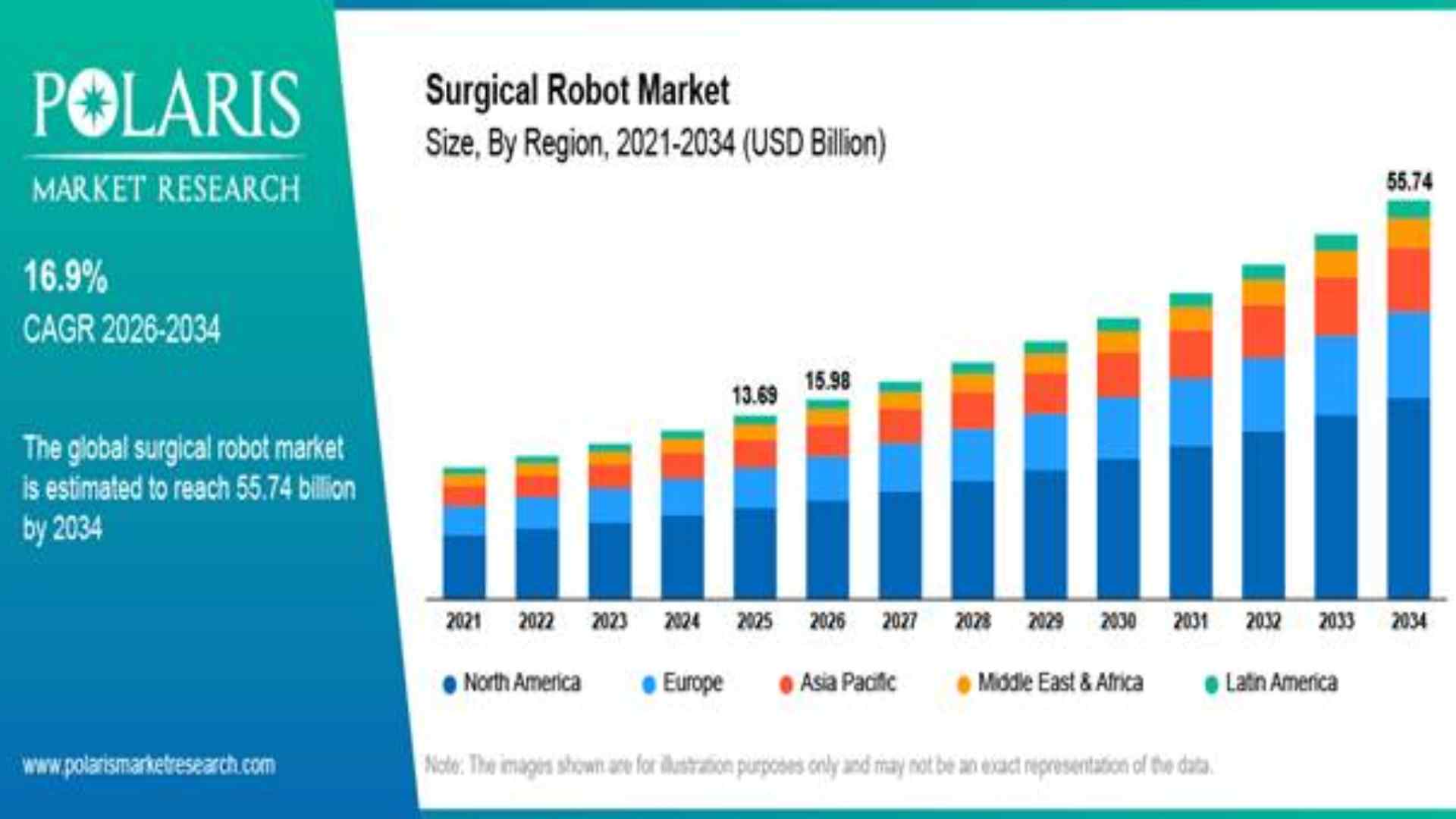
 The global surgical robots market is undergoing a seismic transformation, emerging as one of the most dynamic segments within the medical technology sector. Valued at USD 15.98 billion in 2026, the market is forecasted to surge to USD 55.74 billion by 2034, expanding at a robust compound annual growth rate (CAGR) of 16.9% during the 2026–2034 forecast period.




The global surgical robots market is undergoing a seismic transformation, emerging as one of the most dynamic segments within the medical technology sector. Valued at USD 15.98 billion in 2026, the market is forecasted to surge to USD 55.74 billion by 2034, expanding at a robust compound annual growth rate (CAGR) of 16.9% during the 2026–2034 forecast period. As healthcare systems worldwide grapple with rising surgical volumes, aging populations, and the demand for precision care, surgical robots are rapidly becoming an indispensable cornerstone of modern operating rooms.
What Is Driving the Surgical Robots Market Forward?
The convergence of multiple macro forces is powering what analysts describe as a golden decade for robotic-assisted surgery. At the heart of this growth are two dominant forces: the surging demand for minimally invasive surgical procedures and accelerating investment in the broader MedTech ecosystem.
The Minimally Invasive Surgery Revolution
Patient preference has fundamentally shifted. Minimally invasive procedures—characterized by smaller incisions, reduced trauma, less post-operative pain, and faster recovery—are now the standard of care across a widening range of specialties. According to the American Society of Plastic Surgeons, approximately 23 million minimally invasive cosmetic surgeries were performed in 2022 alone, representing an extraordinary 188% increase compared to pre-2019 levels. This trend is not confined to cosmetic applications; it spans urology, gynecology, general surgery, orthopedics, and neurosurgery.
Surgical robots are the critical enablers of this shift. By delivering sub-millimeter precision, enhanced visualization, and ergonomically superior instrument control, these systems empower surgeons to perform complex procedures through incisions barely visible to the naked eye. As patient awareness of the benefits grows, healthcare providers are under increasing pressure to adopt robotic platforms to remain competitive and deliver optimal outcomes.
MedTech Investment Fueling Innovation
The capital flowing into medical technology is amplifying the pace of innovation at every level of the surgical robotics value chain. Venture-backed startups, multinational corporations, and government-backed initiatives are collectively channeling billions into research and development, manufacturing scale-up, and clinical validation. In May 2024, for example, Kotak Alternate Asset Manager Ltd. committed USD 48.2 million to Biorad Medisys for a new medical device manufacturing plant—a signal of investor conviction in the sector's long-term trajectory.
This investment wave is accelerating the development of AI-integrated robotic platforms, next-generation imaging systems, and cloud-enabled telesurgery capabilities that are redefining what is possible inside the OR.
The Role of Artificial Intelligence in Next-Generation Surgical Robots
Perhaps no force is reshaping the surgical robotics industry more profoundly than artificial intelligence. AI algorithms are now capable of analyzing comprehensive patient data and surgical history to provide predictive insights in real time during procedures. Machine learning and computer vision technologies enhance spatial accuracy, minimize human error, and optimize instrument movement—directly translating to reduced recovery times and improved patient outcomes.
AI also facilitates more intuitive interaction between robotic systems and surgeons, streamlining complex workflows during laparoscopic, orthopedic, and neurological procedures. The integration of AI is not a future ambition—it is already operational. In March 2026, Healinno Tech introduced the metaFlow Waterjet Surgical Robot, an AI-enabled platform designed specifically to improve precision and safety in urological surgery. In April 2024, Intuitive Surgical's landmark da Vinci 5 system received FDA clearance, boasting over 150 enhancements—including force feedback and advanced imaging—from its predecessor.
These innovations mark a decisive inflection point: surgical robots are evolving from precision instruments into intelligent surgical partners.
Market Segmentation: Where Is Growth Concentrated?
By Product Type
The instruments and accessories segment stands out with a projected CAGR of 22.5%—the highest within the product category. This growth stems from the recurring need to repurchase, repair, and upgrade accessories to maintain optimal system performance. The main robotic systems—laparoscopic, orthopedic, and neurological—continue to anchor the hardware landscape, each serving distinct clinical applications from prostatectomy and hysterectomy to knee replacement and deep brain stimulation.
By End-User
Hospitals dominated the surgical robots market with an 80% revenue share in 2025, a position reinforced by their resource depth, skilled workforce, and volume of complex surgical cases tied to chronic disease and trauma management. Ambulatory Surgical Centers (ASCs) represent a growing segment as robotic systems become more compact and cost-efficient.
Regional Landscape: North America Leads, Asia Pacific Accelerates
North America commanded the largest regional share at 40% in 2025, supported by the presence of over 7,000 hospitals across the U.S. and Canada and the headquarters of leading market players. The region benefits from a mature reimbursement environment, robust R&D infrastructure, and high adoption rates of cutting-edge surgical technologies.
Asia Pacific, however, is where the most explosive growth is anticipated, with a projected CAGR of 21.0% through 2034. Rising partnerships between global MedTech companies and regional innovators are accelerating technology transfer and commercialization. India, in particular, is projected to register the highest individual country CAGR of 18.5%, driven by surging foreign direct investment—including a 90% increase in FDI into the hospital sector in Q2 2023—and the entry of technologically advanced new players.
Competitive Landscape: Innovation at Scale
The surgical robot market is intensely competitive, with established global leaders and agile innovators vying for market share. Key players include Intuitive Surgical, Medtronic, Stryker Corporation, Smith & Nephew, Zimmer Biomet, Boston Scientific, Renishaw plc, THINK Surgical, Medrobotics Corporation, and TransEnterix Surgical. These companies pursue aggressive strategies involving mergers, acquisitions, FDA submissions, and next-generation platform launches.
Notable milestones include Smith & Nephew's June 2024 launch of its CORIOGRAPH Pre-Operative Planning and Modeling Services integrated with the CORI Surgical System, and Medtronic's rollout of AI-enhanced live streaming surgical tools for its Touch Surgery ecosystem, now available across the U.S. and Western Europe.
Challenges on the Horizon
Despite the extraordinary growth trajectory, the surgical robot market is not without its headwinds. The shortage of trained surgical robotics specialists remains a significant restraint. Operating robotic systems requires dedicated certification, ongoing technical training, and institutional commitment—factors that create adoption barriers in lower-resource healthcare settings. Addressing this talent gap through simulation-based training programs and intuitive AI-assisted interfaces will be critical to unlocking the full potential of the market.
Conclusion: A Market Built for the Future of Surgery
The global surgical robots market is not merely growing—it is fundamentally redefining the practice of medicine. From AI-powered precision to telesurgery enabling cross-continent operations, the technologies emerging from this sector are expanding access to expert surgical care and delivering outcomes unimaginable a generation ago.
For healthcare investors, hospital administrators, MedTech innovators, and policymakers, the message is clear: the era of robotic surgery has arrived, and its pace of adoption is only accelerating.





-23-300x250.png)

.jpeg)








.jpg)
.jpg)
.jpg)
.jpg)
.jpg)
.jpg)
.jpg)
.jpg)
.jpg)

