Tuesday, October 06, 2026
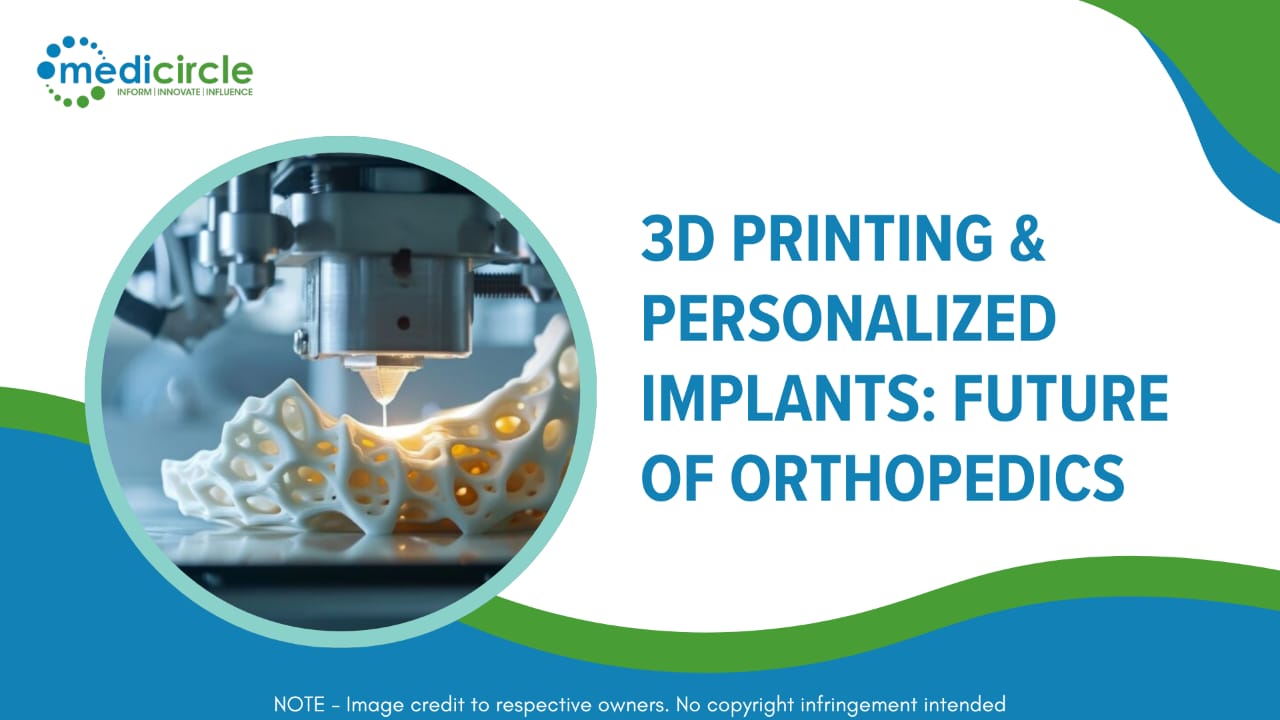
 This article explores how 3D printing enables personalized orthopedic implants, improves surgical planning, shortens recovery time and drives innovation across India’s medical landscape through precise, patient specific solutions.




Something extraordinary is taking root in India's leading hospitals. It is not a new drug or a novel procedure, but a new way of creating medical solutions from scratch. Surgeons and engineers are now collaborating to build custom implants, piece by microscopic piece, using 3D printing technology. This approach is transforming the field of orthopedic surgery, offering hope for patients whose conditions were once considered too complex or risky to treat.
So, what does 3D printing mean for bone care? At its heart, it is a form of additive manufacturing. Imagine building a structure not by carving away material, but by adding it in incredibly thin layers, following a precise digital blueprint. In the medical realm, this translates to creating surgical models, guides and implants that are tailor made for a single individual. For a nation as biologically diverse as India, where no two skeletons are exactly alike, this move away from standardized implants is nothing short of revolutionary.
From scan to reality:
The journey of a custom implant begins with a detailed picture. A patient first undergoes a CT or MRI scan, which captures high resolution, cross sectional images of the affected bone or joint. This collection of images forms a digital map of the patient’s anatomy.
This map is then fed into specialized computer software. Here, the two dimensional slices are combined to form a detailed 3D model. Surgeons can rotate this model, examine the problem from every angle and even simulate the surgery. Once the design is finalized, the digital file is sent to a 3D printer.
The printers use different methods depending on the intended purpose of the final product:
Fused Deposition Modeling (FDM) pushes a filament of medical grade plastic through a heated nozzle, building the object layer by layer.
Selective Laser Sintering (SLS) uses a high powered laser to fuse tiny particles of metal powder, creating strong and durable implants ideal for weight bearing applications.
Stereolithography (SLA) uses an ultraviolet laser to harden liquid resin into solid plastic, suitable for producing highly detailed surgical models.
The outcome is a tangible object such as a patient specific jawbone, spinal segment or hip joint that exists only for that individual.
India’s homegrown stories:
The Indian medical community’s engagement with 3D printing is not entirely new. For more than a decade, forward thinking orthopedic surgeons have explored its potential, with early work in complex joint revisions and trauma cases laying the groundwork. In recent years however, adoption and innovation have grown dramatically.
A widely discussed example demonstrates its profound impact. A few years ago, doctors in Mumbai faced an enormous challenge: a baby born with a severe heart defect. After conventional surgery options were ruled out, the medical team used 3D printing to create an exact model of the infant’s heart. Holding this physical model enabled surgeons to plan and practice a lifesaving procedure, which they performed successfully. This case showcased the technology’s power and inspired widespread experimentation.
Today, Indian companies are creating customized solutions not only for orthopedics but also for spinal, cranial and dental procedures. These enterprises are proving that India can adopt, innovate and excel in advanced medical technologies.
Benefits for patients:
For the average Indian patient, this technology translates into clear, life improving benefits:
An Implant that feels native: Standard implants force the body to adapt while 3D printed implants fit the patient’s unique anatomy precisely. This is crucial in complex cases involving missing or deformed bone.
Shorter time under anesthesia: When surgeons study a physical model beforehand, the procedure becomes more efficient. This reduces surgical time, minimizes anesthesia exposure and lowers the risk of infection.
A smoother recovery: Many custom implants feature a porous surface that encourages natural bone growth. This leads to stronger integration and a more stable, long lasting repair, often resulting in faster recovery.
Long term economic sense: Although custom implants may initially cost more, the overall expense can be lower due to shorter surgeries, fewer complications and reduced hospital stays. As adoption increases, costs will continue to fall.
The road ahead:
The future of 3D printing in Indian medicine is promising, though not without challenges. The market is expanding rapidly and several trends will shape its trajectory:
The dawn of bio-printing: Researchers are experimenting with printing techniques that use living cells. The long term ambition is to create functional tissues and possibly entire organs, addressing donor shortages and reducing rejection risks.
Smarter, stronger materials: New materials that mimic human bone more closely are emerging. Advanced polymers and titanium alloys are being refined to be lighter, stronger and more biocompatible.
Clearer regulations: For this field to mature, India needs a well-defined regulatory framework. Standardized approval processes for 3D printed medical devices will ensure quality and safety nationwide.
Wider access: Currently, most expertise is concentrated in major cities. The next challenge is expanding access to tier 2 and tier 3 cities, ensuring equitable care for patients across the country.
Personalized future ahead:
The significance of 3D printing goes beyond its technical brilliance. Its true strength lies in its patient centered approach. It represents a shift from mass produced medical devices to personalized care. In a country as diverse and populous as India, this transformation could profoundly impact millions.
The journey, as industry experts often note, has seen ups and downs. But every successful surgery and every patient who regains mobility reinforces its potential. The future of orthopedics in India is not only about repairing bones but about restoring quality of life with precision once thought impossible.






.jpeg)
.jpg)
.jpg)
.jpg)
.jpg)
.jpg)
.jpg)


.jpg)
.jpg)
.jpg)
.jpg)
.jpg)
.jpg)