 Tuesday, October 27, 2026
 India already faces a major shortage of donor organs. Despite gradual improvements in awareness, the country’s organ donation rate remains significantly lower than that of many developed nations.




Every day in hospitals across India, a race against time unfolds. Somewhere in a critical care unit, a patient waits for a kidney that may never arrive. In another ward, a child’s survival depends on a liver transplant that could come too late. Behind each case lies a fragile chain of coordination involving doctors, transplant centres, organ registries, and regulatory authorities. The system depends heavily on transparency and timely reporting, because in the world of organ transplantation, accurate data can mean the difference between life and death.
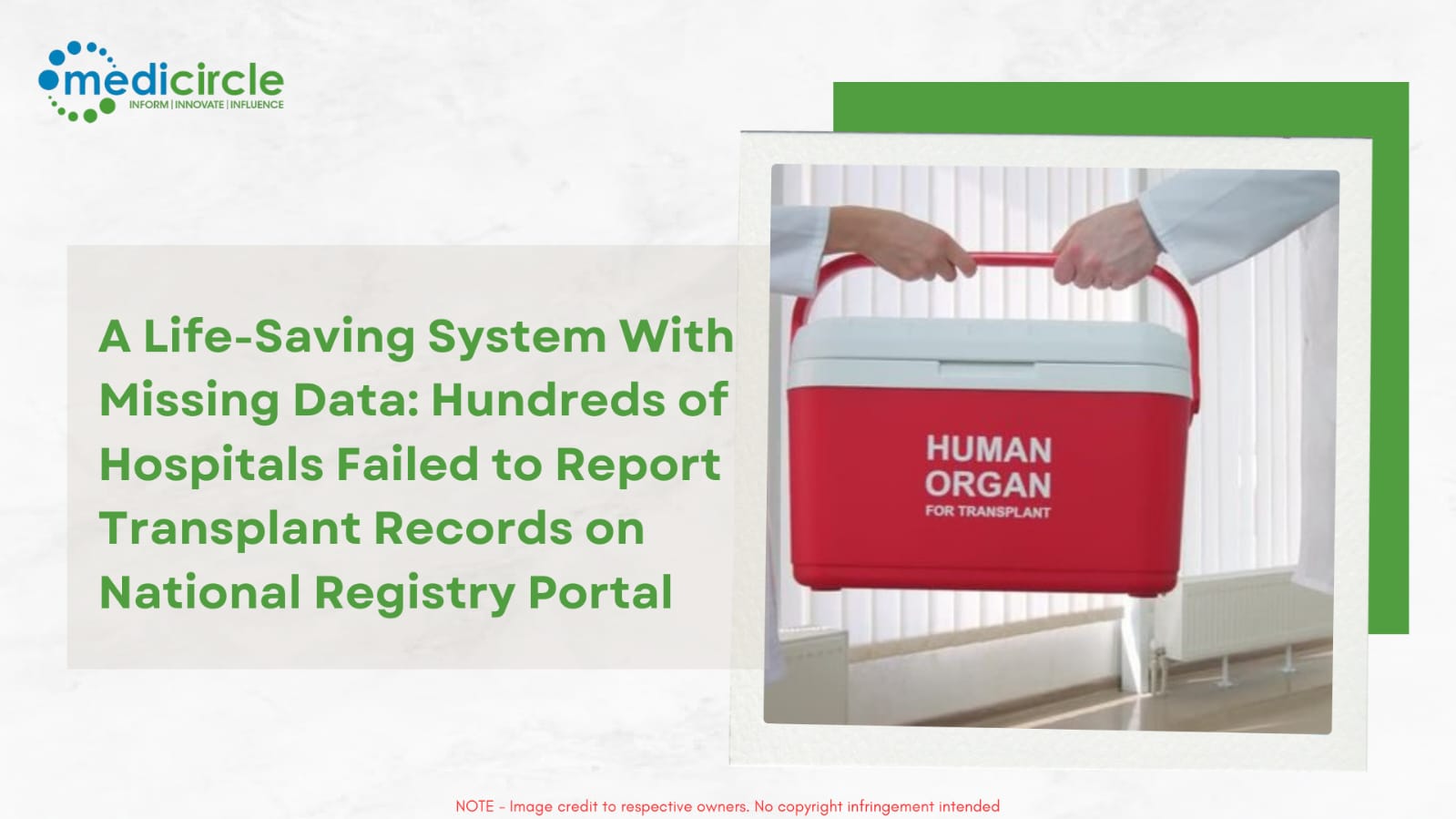
A recent disclosure in Parliament has revealed a troubling gap in this system. Out of 804 hospitals registered to perform organ transplantation in India, 217 hospitals did not report their transplant data to the national registry during 2025. The revelation, made by Minister of State for Health Prataprao Jadhav in a written reply in the Rajya Sabha, has raised uncomfortable questions about compliance, accountability, and the reliability of the country’s transplant data infrastructure.
At first glance, the numbers may appear administrative and just another case of delayed reporting. But the implications are far deeper. Organ transplantation operates within a tightly regulated ecosystem where accurate and up-to-date information is essential. The national transplant registry does not merely record statistics; it acts as a central nervous system that tracks organ donations, transplant surgeries, waiting lists, and hospital performance across the country.
When hundreds of authorised transplant hospitals fail to submit data, that system begins to lose clarity.
India’s organ transplant network has evolved significantly over the past two decades. The framework is governed by the Transplantation of Human Organs and Tissues Act, a landmark legislation originally enacted in 1994 to regulate organ donation and transplantation. The law was designed to prevent illegal organ trade while enabling ethical donation and transplantation practices.
Under this legal framework, hospitals cannot simply begin transplant surgeries on their own initiative. They must first be registered and authorised by state governments or Union Territory administrations. These regulatory bodies act as the “appropriate authorities” responsible for monitoring hospitals, granting licences, and ensuring compliance with transplant protocols.
In theory, this layered system should ensure strict oversight. In practice, however, oversight depends heavily on reporting. Hospitals performing transplants are required to upload data to the national registry so that the government and transplant organisations can track the flow of organs, monitor waiting lists, and identify gaps in the system.
The registry in question is maintained by the National Organ and Tissue Transplant Organisation, commonly known as NOTTO. Established to coordinate organ donation and transplantation across the country, NOTTO manages the National Organ and Tissue Transplant Registry Portal, a digital platform that has been operational since 2015.
The portal allows authorised hospitals and transplant centres to upload information about transplant surgeries, donor details, waiting lists, and other relevant clinical data. Over time, it has become a key tool for understanding how the transplant ecosystem functions in India.
That is precisely why the recent revelation is worrying. According to the government’s data, more than a quarter of the registered transplant hospitals did not report their activity to the national registry in 2025. This means that the national database may not fully reflect the true scale of organ transplant activity in the country.
Such gaps can distort the understanding of demand and supply. Consider the waiting list alone. As of early March 2026, the national registry recorded 89,839 patients waiting for major organ transplants in India. The figure represents people waiting for kidneys, livers, hearts, lungs, and other life-saving organs. For many of them, time is running out.
At the same time, the number of transplant procedures performed across the country during 2025 was 20,019, according to the data submitted to the registry.
Even on paper, the gap between demand and supply appears enormous. But if more than two hundred hospitals have not reported their transplant activity, the true picture may be either slightly better or possibly worse than the numbers suggest.
Data transparency plays a crucial role in managing organ transplant systems worldwide. Countries with highly developed transplant networks rely on real-time data to match donors with recipients, allocate organs fairly, and monitor outcomes.
Without accurate reporting, it becomes difficult to answer basic questions:
How many transplants are actually happening in India each year?
Which states have the highest success rates? Where are the biggest shortages occurring?
How efficiently are donor organs being utilised?
When a transplant centre knows how long the waiting list is for a particular organ, it can counsel patients more realistically. When policymakers see data showing regional disparities, they can invest in transplant infrastructure where it is most needed.
Incomplete reporting undermines all of these efforts.
The Indian government has attempted to strengthen the transplant ecosystem through several initiatives. One of the most significant is the National Organ Transplant Programme, which aims to improve transplant infrastructure, strengthen organ donation systems, and increase public awareness.
Under this programme, regional and state-level organisations have been established to coordinate transplant activities across the country. These include Regional Organ and Tissue Transplant Organizations (ROTTOs) and State Organ and Tissue Transplant Organizations (SOTTOs).
The idea behind these bodies is to create a structured network that connects hospitals, organ donation programmes, and transplant registries.
For instance, ROTTOs operate at a regional level to oversee organ allocation and facilitate coordination between states. SOTTOs, on the other hand, manage transplant activities within individual states, including hospital registration, data collection, and public awareness campaigns.
Together with NOTTO, they form a three-tier system designed to ensure that organs are distributed ethically and efficiently.
But systems are only as strong as their compliance.
If hospitals fail to upload data to the national registry, the network loses visibility. The result is a kind of informational blind spot within the transplant ecosystem.
The government has indicated that regulatory action may be taken against the hospitals that failed to report their data. Under the Transplantation of Human Organs and Tissues Act, state authorities have the power to investigate such violations and impose penalties.
But enforcement in healthcare regulation often faces practical challenges. Hospitals vary widely in size, resources, and administrative capacity. Some large private hospitals have sophisticated data management systems that automatically update registries. Others, particularly in smaller cities, may struggle with reporting processes due to staff shortages or administrative delays.
However, transplant data reporting cannot be treated as a minor bureaucratic formality. It is an integral part of patient safety and ethical practice.
Transparency in transplant systems also helps prevent illegal activities. Organ trafficking and unethical transplantation practices have historically been concerns in several parts of the world, including India. Mandatory reporting to national registries helps create a traceable record of each transplant procedure, making it harder for illicit networks to operate unnoticed.
Accurate transplant data also allows researchers to study outcomes and improve clinical practice.
For example, transplant registries help track long-term survival rates of transplant recipients, identify complications, and evaluate the effectiveness of different surgical techniques or immunosuppressive therapies. Without comprehensive data, such insights become harder to generate.
The issue also touches on another sensitive area of healthcare: public trust. Organ donation relies heavily on the goodwill of families who agree to donate the organs of their loved ones after death. For such decisions to be made, society must believe that the transplant system is transparent, fair, and well regulated.
If gaps in reporting create doubts about how organs are allocated or tracked, it could affect public willingness to participate in organ donation programmes.
India already faces a major shortage of donor organs. Despite gradual improvements in awareness, the country’s organ donation rate remains significantly lower than that of many developed nations.
Several factors contribute to this gap, including cultural beliefs, lack of awareness about brain death, and limited infrastructure for organ retrieval and transplantation.
In recent years, campaigns led by hospitals, government agencies, and civil society groups have attempted to address these barriers. Stories of successful organ donation have helped change perceptions in many communities.
However, sustaining that momentum requires confidence in the system.
When people hear that hundreds of transplant hospitals are not reporting their activity to the national registry, it raises legitimate questions. Are all transplant procedures being documented? Is the national waiting list accurate? Are regulatory authorities monitoring compliance effectively?
The answers to these questions matter deeply to patients waiting for organs. They also matter to doctors who dedicate years of training to transplant medicine. For transplant surgeons, the process of retrieving, preserving, and implanting organs represents one of the most technically demanding fields in modern healthcare.
Every transplant surgery involves careful coordination among surgeons, anaesthesiologists, intensivists, transplant coordinators, and laboratory teams.
Such complexity requires robust systems of accountability.
The disclosure in Parliament therefore serves as a reminder that healthcare governance is an ongoing process rather than a finished structure. Laws, registries, and programmes create frameworks, but their effectiveness ultimately depends on consistent implementation.
India has made significant progress in building its organ transplant ecosystem over the past decade. The creation of national registries, the expansion of transplant centres, and the growing conversation around organ donation all reflect a healthcare system trying to evolve.
But the latest data suggests that the journey is far from complete. Nearly ninety thousand people remain on transplant waiting lists across the country. Behind that number are individuals who measure time differently from dialysis sessions to hospital visits, from one medical update to the next.
For them, the transplant system is not just a regulatory structure. It is a lifeline. Ensuring that every transplant hospital reports its activity to the national registry may sound like a technical requirement. In reality, it is part of building a healthcare system that patients can trust.
Because when the stakes involve human organs, life-saving surgery, and the hopes of thousands waiting for a second chance at life, even a small gap in transparency can cast a long shadow.
And in a system where every organ counts, silence from hundreds of hospitals is a warning that the architecture of accountability still has unfinished work ahead.





-23-300x250.png)

.jpeg)






.jpg)
.jpg)
.jpg)
.jpg)
.jpg)
.jpg)
.jpg)
.jpg)
.jpg)



