 Thursday, October 08, 2026
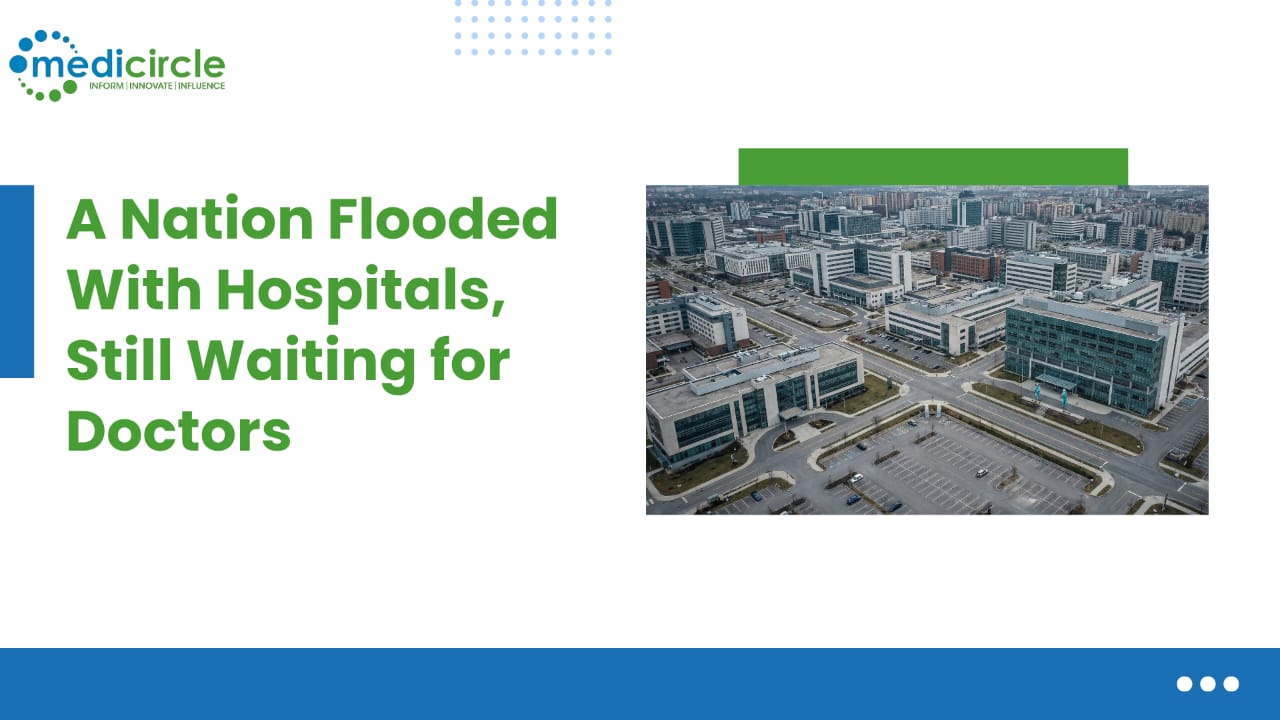
 If India can continue strengthening medical education, bringing healthcare closer to underserved regions, and supporting doctors in meaningful ways, it will become a reflection of a nation that no longer waits for a doctor.




India often celebrates its expanding healthcare system, pointing proudly to the rising number of medical colleges, the thousands of new MBBS and PG seats, and the remarkable growth of the AYUSH ecosystem. Yet behind these encouraging figures lies a quieter truth that rarely finds space in everyday conversation but affects every home in the country. It is the reality that many citizens continue to struggle for timely medical care despite the promise of progress. This paradox becomes clear when the doctor-population ratio stands at 1:811, a number the government recently placed before Parliament. It may sound reassuring at first glance, but the gaps become evident when we peel back the layers and look at what these figures actually mean for people who rely on the public health system every day.
When the Union Health Minister shared that India has over 13.88 lakh registered allopathic doctors and more than 7.51 lakh AYUSH practitioners, it seemed like a milestone worth noting. When adjusted for availability, assuming that 80 per cent of them are in active practice, the doctor-population ratio becomes 1 doctor for every 811 citizens. For a country of India’s scale, this number reflects progress, but it also raises important questions. Averages often hide the lived experiences of people in underserved regions, where the nearest doctor may be several kilometres away and where the healthcare system depends less on statistics and more on human presence. A nation cannot rely on numbers alone when reality paints a far more uneven picture.
This is why the rapid expansion of medical education becomes even more critical. In just a decade, medical colleges have increased from 387 to 818. Undergraduate seats have surged from 51,348 to an unprecedented 1,28,875, and postgraduate seats from 31,185 to 82,059. These numbers show intent, investment, and effort, but they also carry a deeper message that India is preparing for the long haul. A strong medical workforce does not emerge overnight; it is built through years of training, mentorship, and exposure to communities where healthcare is a daily struggle. The rise in UG and PG seats is a step toward bridging shortages, but the true test lies in whether these doctors eventually choose to serve where they are needed most.
The government’s initiatives try to address this imbalance, especially in rural and tribal regions where healthcare gaps remain wide. Under the centrally-sponsored scheme that supports new medical colleges attached to district hospitals, 137 out of the 157 approved institutions are already operational. This approach has a clear purpose which brings medical education closer to areas that lack doctors, so that tomorrow’s physicians learn the realities of rural healthcare early in their journey. When medical students observe firsthand the challenges faced by people living far from urban hospitals, their understanding of public health becomes more grounded and empathetic.
One of the most important steps in this direction is the Family Adoption Programme, which has now become part of the MBBS curriculum. Medical colleges adopt villages, and every MBBS student adopts families within these villages. This connection transforms learning from a classroom exercise into a lived experience. Students interact with families not during emergencies but during routine life i.e. measuring growth in children, guiding young girls on menstrual hygiene, checking iron-folic acid compliance, supporting nutrition needs, tracking vaccination schedules, identifying early disease symptoms, and reinforcing healthy lifestyle practices. They also help families understand the many government health programmes that exist but often remain underutilised simply because people are not fully aware of them.
This regular interaction does something no textbook can achieve. It builds responsibility. It teaches future doctors that healthcare is not only about treating disease but about preventing it. It shows them that public health requires patience, presence, and continuity. The hope is that these experiences shape the medical workforce of tomorrow, creating doctors who understand India’s diverse health needs not from reports but from real people.
The District Residency Programme by the National Medical Commission adds another layer to this transformation. Second and third-year postgraduate students are required to spend time in district hospitals, where the medical realities of India are far more visible. These hospitals handle high patient loads, limited resources, and varied clinical conditions. For PG students, this experience becomes a defining part of their training, grounding them in the challenges they are likely to face when they become independent specialists. Exposure to rural and semi-urban healthcare systems ensures that future experts do not grow detached from the environments where millions of Indians seek care.
Recognising that specialists are scarce in rural and remote areas, the government has introduced a hard-area allowance to encourage doctors to work in such regions. These incentives reflect a simple truth that healthcare gaps cannot be solved with infrastructure alone. Buildings and equipment matter, but people matter more. Attracting doctors to remote areas requires thoughtful policies, financial support, and a work environment where professionals feel valued. Under the National Health Mission, states are free to offer negotiable salaries and explore flexible recruitment strategies such as the “You Quote We Pay” model. This gives local health systems the freedom to respond quickly to shortages without getting stuck in bureaucratic delays.
Another interesting development lies in the temporary registration pathway for foreign medical practitioners. Under new regulations, foreign-qualified and foreign-registered doctors can work in India for defined purposes such as fellowships, expert visits, training roles, research, or voluntary service. This brings global knowledge into the Indian health system and helps hospitals benefit from specialised skills during short periods. For students and young doctors, working with international experts can broaden perspectives and strengthen clinical training. For patients, it opens doors to expertise that might otherwise take years to establish locally.
Yet, despite all these efforts, the heart of the issue remains the doctor-population gap that continues to shape India’s healthcare journey. A ratio of 1:811 can feel reassuring on paper, but its comfort fades when seen through the eyes of families waiting long hours in overcrowded public hospitals. It becomes less comforting when looked at through the struggles of tribal communities where the nearest hospital is miles away. It loses meaning when emergency cases are delayed simply because a doctor is unavailable or a specialist visits only once a week. Numbers matter, but lived experiences matter more.
India’s healthcare system stands at a unique moment. Investment in medical education is expanding like never before. Policy innovations are trying to reshape how and where doctors train. Surveillance systems, digital tools, and public health programmes are reaching deeper into communities. But the country still needs more hands, more specialists, more general physicians, and more trained professionals willing to serve where the need is greatest. The challenge is not only to produce more doctors but to create a healthcare ecosystem where professionals choose to stay, choose to serve, and choose to remain connected to the communities that depend on them.
A healthy doctor-population ratio is not a number to be celebrated once and forgotten. It is a moving target that keeps changing with population growth, disease patterns, technological advances, and social needs. What India requires is constant reflection and sustained commitment. The rise in medical colleges and seats shows that the foundation is being strengthened. The adoption programmes and residency reforms show that the intention is to produce doctors with strong community understanding. The financial incentives show that the system is aware of geographic inequalities. And the temporary registration pathway shows an openness to global collaboration.
But the journey remains long, and every step must be taken with clarity. The future of India’s healthcare depends not only on expanding capacity but on understanding why that capacity matters. A village that finally sees a doctor after years of waiting feels the impact more deeply than any statistic ever could. A family that receives timely guidance from a medical student under the Family Adoption Programme experiences healthcare in a way that policy papers cannot describe. A district hospital benefitting from a PG resident’s skills becomes a lifeline for hundreds of patients.
India’s health story is evolving, shaped by ambition, challenges, and the persistent hope that each effort will bring care closer to the people who need it most. The doctor-population ratio of 1:811 is a reminder that progress is visible, but so is the distance that remains. As the healthcare system continues to expand, reform, and re-imagine itself, the country stands at a crossroads where the next decade will decide whether India becomes a nation with enough doctors or a nation still waiting for one.
The path forward requires compassion backed by policy, numbers backed by action, and education backed by community connection. If India can continue strengthening medical education, bringing healthcare closer to underserved regions, and supporting doctors in meaningful ways, the ratio will not just improve, it will become a reflection of a nation that no longer waits for a doctor but walks confidently towards a healthier future for all.





.jpeg)








.jpg)
.jpg)
.jpg)
.jpg)
.jpg)
.jpg)


.jpg)
.jpg)
.jpg)